
MITHLUX · Official IPL Device Store
Skin & Hair Guide for At-Home IPL
Learn how skin tone and hair color affect IPL suitability, comfort, and expected results. Use this guide to decide when home IPL may be a good fit, when to be cautious, and when to avoid IPL.
Want a quick fit check? Try our IPL Suitability Checker or explore Aftercare & Results for realistic timelines.
This guide explains how skin tone and hair color can affect at-home IPL suitability, comfort, and what results you can realistically expect. Use it to decide whether home IPL is a good fit, when to start cautiously, and when it’s better to avoid treatment.
This page is for general education and is not medical advice.
Lighter skin with dark hair
Often the most suitable combination for IPL. Dark hair contains more pigment to absorb light, while lighter skin usually creates clearer contrast between hair and skin.
- Usually suitable for at-home IPL when there are no other contraindications.
- Shave first, start at a lower level, then increase gradually based on comfort. Shave before IPL ›
- Stop and reassess if you feel strong pain, burning, or notice unexpected skin changes. If skin reacts badly ›
New to IPL? Do a patch test before regular use.
Medium or olive skin with dark hair
Often still suitable, but the contrast between hair and skin is smaller. This means you should use more caution, start lower, and move more slowly.
- Be extra careful on naturally darker areas (knees, underarms) and any recently tanned skin. Sensitive areas guide ›
- Follow patch test instructions before moving to regular sessions. Patch test steps ›
- If your skin tans easily, wait until the tan fades before using IPL again. When IPL is not recommended ›
For a full chart and examples, see Skin Tone & Hair Color Guide for IPL.
Deeper skin tones
With deeper skin tones, skin can absorb more IPL energy. This increases the chance of discomfort and pigment changes, especially at higher settings.
- At-home IPL is generally not recommended for very deep skin tones.
- If your skin tone is close to the “not suitable” area of a chart, do not use IPL. Does IPL work for all skin tones? ›
- When in doubt, it is safer to avoid IPL rather than “try and see”. Who should avoid IPL ›
If you are unsure, start with the Skin Tone & Hair Color Guide for IPL.
Very light, red, or grey hair
IPL targets pigment in hair. Very light blond, red, or grey hair usually contains less pigment, so the light may not be absorbed effectively.
- These hair colours often respond poorly to IPL. How hair color affects results ›
- Even with repeated sessions, results may be limited or not visible. Light/fine hair & IPL ›
- If most of your hair is in these colours, IPL is unlikely to be a good choice. Does IPL work for everyone? ›
For suitability boundaries, see Does skin tone affect IPL safety? and the Skin Tone & Hair Color Guide for IPL.
How IPL interacts with skin tone
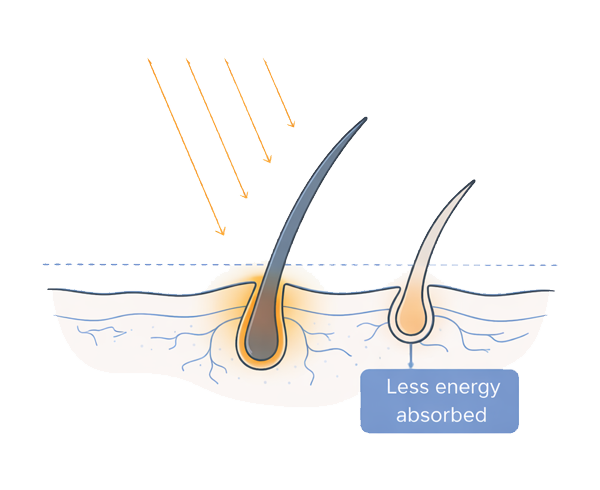
IPL energy is absorbed by pigment. The goal is to direct more energy to hair while keeping skin comfortable.
IPL energy is absorbed by pigment. Both your skin and your hair contain pigment, so the goal is to send most of the energy into the hair while keeping the skin comfortable. How IPL works ›
The skin tone chart on this page shows a range from lighter to deeper tones. The lighter sections are generally more suitable for home IPL. The deeper sections move into a “caution” zone and then a “not suitable” zone where the risk of side effects becomes higher. Does skin tone affect IPL safety? ›
If your natural (untanned) skin tone is close to the “not suitable” area, it is safer not to use IPL at home. Who should avoid at-home IPL? › Wait until any tan has faded and check again. When IPL is not recommended › Do not base your decision on how your skin looks under strong lighting or filters. Safety & suitability basics ›
How hair colour affects results
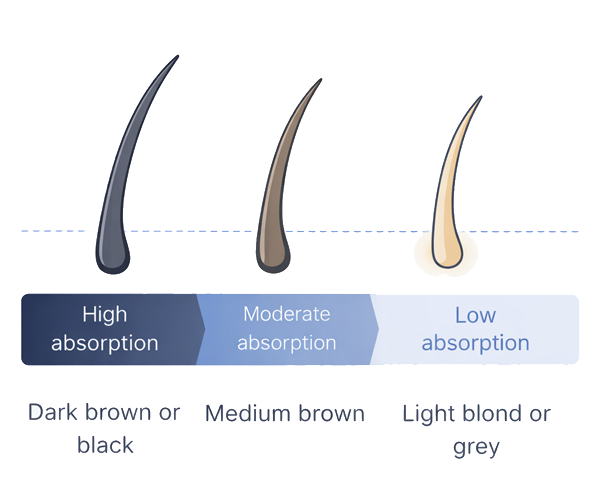
IPL works best when there is a clear contrast: darker hair on lighter skin. Dark brown and black hair usually respond the most, while mid-brown hair can also respond well with consistent use. Hair color & IPL results ›
- Dark brown to black hair – often the best response with regular sessions. When results typically start ›
- Medium brown hair – usually responds, but may need more time and consistency. How often to use IPL safely ›
- Light blond, red, or grey hair – limited or no response in many cases. Does IPL work on light or fine hair? ›
If most of your hair is very light, red, or grey, IPL might not be the most effective choice and you may prefer other hair removal methods. Hair color & safety considerations ›
When to avoid IPL
IPL is not suitable for every skin or every situation. In the following cases, it is safer to avoid using an at-home IPL device: When IPL is not recommended ›
- Very deep skin tones that fall in the “not suitable” area of the skin tone chart. Skin tone & IPL safety ›
- Skin that is sunburned, recently tanned, or still recovering from strong sun exposure. Avoid IPL when sun-exposed ›
- Areas with open wounds, active infections, severe irritation, or recent cosmetic procedures. What to do if skin reacts ›
- Areas with large, dark moles or tattoos – these should be avoided during treatment. Placement tips to reduce risk ›
If you are unsure whether IPL is suitable for you because of a skin condition or medication, it is best to speak to a healthcare professional before using any light-based device. Read the full safety guide ›
Choosing a starting level
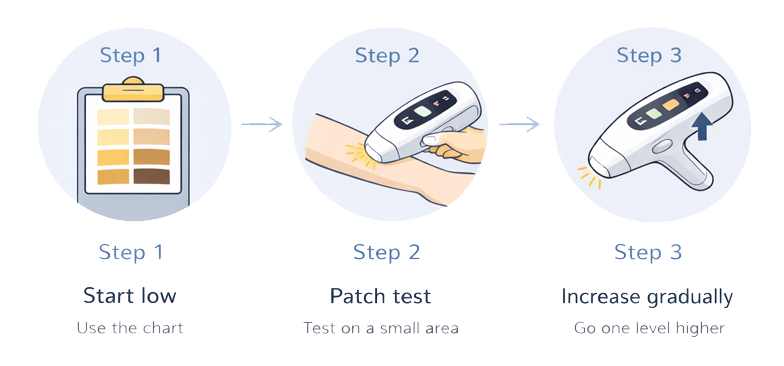
Start with a lower level, perform a patch test, and increase gradually only if the skin remains comfortable.
Once you have checked that your skin tone and hair colour are suitable, you can choose a starting level. The safest approach is to start lower, test, and only increase if the skin remains comfortable. How to choose a starting IPL level ›
- Use the skin tone chart to find the recommended range of levels for your skin. Skin tone & IPL safety ›
- Perform a patch test on a small area first, using the lowest level in the recommended range. How to perform a patch test ›
- Wait 24 hours. If there is no unexpected reaction, you can move one level higher next time. What reactions are normal? ›
Comfortable warmth during a flash is expected. Strong stinging, burning, or lasting redness are not and mean you should lower the level or stop using the device on that area. What to do if your skin reacts badly ›
Related guides
Helpful next reads — for comparing options, setting expectations, and building a safe routine.
- IPL vs. Laser Hair Removal: What’s the Difference? A clear comparison of light type, comfort, cost, and who each option fits best.
- What to Expect in Your First Weeks of IPL Use A realistic timeline — what changes first, and what usually takes longer.
- Why isn’t my at-home IPL working? The most common reasons results stall — and simple fixes that matter.
- IPL Hair Removal (Hub) Your central overview: how IPL works, safety basics, and key guides.
- At-Home IPL Hair Removal A complete at-home view: suitability, routine planning, and best practices.
- Shop MITHLUX IPL devices If you’re ready, explore the device and start with suitability & safe usage first.
Recommended knowledge
Quick navigation to the most useful hubs and safety pages — ideal if you’re deciding where to start.
- Skin Tone & Hair Color Guide for IPL Match your skin tone & hair colour before choosing levels.
- IPL Hair Removal Safety The safest way to start: patch test, limits, and when to stop.
- Safety & Suitability Who should use at-home IPL — and who should avoid it.
- Safety & Usage Prep steps, correct technique, and common mistakes to avoid.
- Aftercare & Results What’s normal after a session and how results build over time.
- IPL Basics Definitions, how IPL works, and realistic expectations.