
MITHLUX · Official IPL Device Store
This guide shares general, non-medical information for at-home IPL use. Individual results and comfort can vary. Always follow the instructions in the MITHLUX S2 Pulse User Manual. If you're new, start with the basics on IPL Basics and use the IPL Suitability Checker to confirm whether at-home IPL is a good fit before you begin.
Why medium or olive skin needs more caution
Medium or olive skin with dark hair is still often a workable combination for IPL at home. However, compared with lighter skin tones, the contrast between hair and skin can be smaller. That means you should be more conservative with starting levels and more consistent with patch testing before regular use. For a clearer overview, review the Skin & Hair Guide and the Safety & Suitability hub pages.
A simple way to reduce risk is to begin lower than you think you need and increase slowly only if your skin stays comfortable. Use How to Choose a Starting Level for Home IPL and Choose Your Energy Level on MITHLUX S2 PULSE as a step-by-step reference.
Before treating a larger area, do a careful patch test and wait to see how your skin responds. Follow How do you perform a patch test before IPL? and if you notice stronger-than-expected redness, stinging, or discomfort, see What should you do if your skin reacts badly to IPL?.
Also avoid treating higher-risk spots such as tattoos, permanent makeup, and darker pigmented marks. If you're unsure whether a condition or area should be treated, read When IPL Is Not Recommended and keep your routine aligned with the safety guidance in IPL Hair Removal Safety.
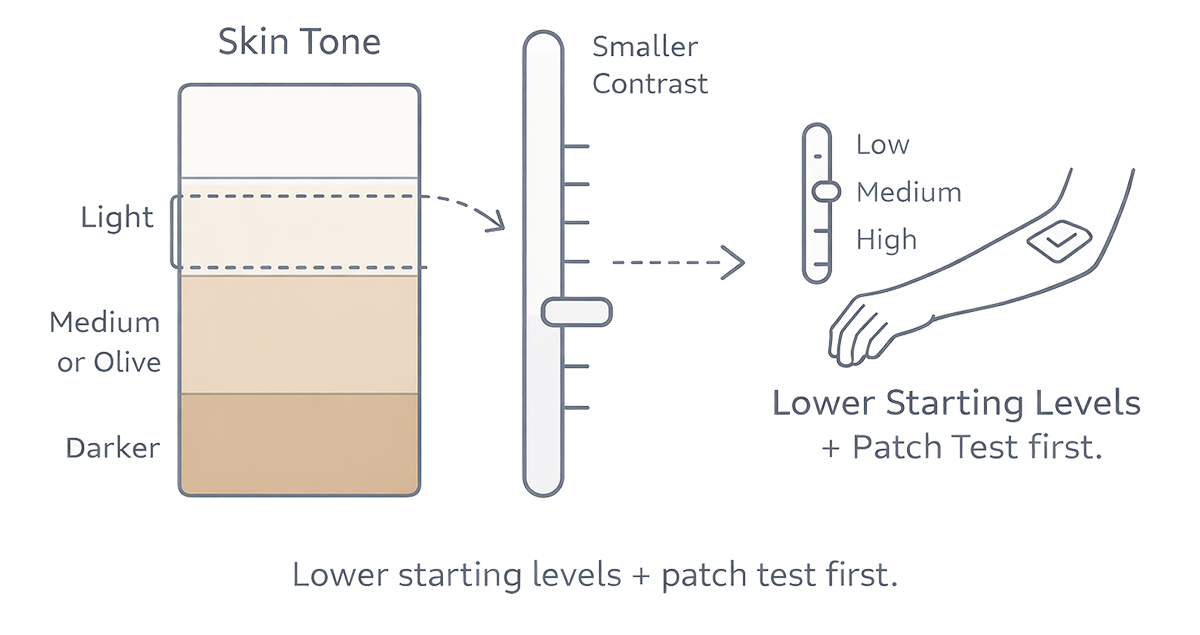
Lower starting levels and patch testing are recommended for medium or olive skin with dark hair.
Start lower, increase slower
A safer approach is to begin at a lower energy level and increase only after you confirm your skin responds comfortably. Avoid chasing “maximum intensity” early. Consistency and gradual adjustment matter more than starting high. If you're unsure how to pace your first few weeks, read What to Expect in Your First Weeks of IPL Use.
A simple starting rule
- Start at a lower level than you think you need.
- Use the same area and settings for the patch test first.
- Increase only if your skin remains comfortable and looks normal after the observation window.
For a structured walkthrough, see: How to Choose a Starting IPL Level and How to Choose a Starting Level for Home IPL. (If you prefer a device-specific guide, use Choose Your Energy Level on MITHLUX S2 PULSE.)
Patch test: the step that matters most
For medium or olive skin tones, a patch test is essential. It helps confirm comfort and reduces the chance of unnecessary irritation. Choose a small area where you plan to treat and test with a conservative level before continuing. Step-by-step guidance is here: How do you perform a patch test before IPL?.
Patch test checklist
- Shave first (do not wax or pluck before IPL). If you’re unsure why, read Shave the Area Before Using MITHLUX S2 PULSE.
- Clean and dry the skin; remove lotions, oils, and deodorant. A quick prep routine is outlined in How to Prepare Your Skin for Safe At-Home IPL Sessions.
- Pick a small test area and start on a lower level.
- Observe your skin before continuing regular sessions. If your skin reacts more strongly than expected, see What should you do if your skin reacts badly to IPL?.
Areas that need extra care
Even on the same person, some body areas can naturally appear darker. These areas often require lower settings and careful observation. Also avoid treating tattoos and very dark spots; guidance is covered in When IPL Is Not Recommended.
- Knees and elbows
- Underarms
- Bikini line
- Any area that looks noticeably darker than surrounding skin
Two technique details that help reduce “hot spots”: keep the window flat (Place the Window Flat During IPL Use) and move slowly, one area at a time (Move Slowly, One Area at a Time).
If you tan easily, pause and reassess
If your skin tans easily or you recently had strong sun exposure, it’s safer to wait until the tan fades before using IPL. Tanned skin can respond differently, and higher settings may increase discomfort. If you’re planning sessions around sun exposure, use the timing guidance in IPL Hair Removal Schedule.
Changes in sun exposure or skincare routines can affect how your skin feels during IPL. When in doubt, pause, patch test again, and restart at a lower level.
What “normal” vs. “not normal” can look like
During IPL, brief warmth or a quick snapping sensation is common. Mild, temporary redness may also occur. Avoid pushing through strong discomfort or continuing if your skin shows unexpected changes. If you want a quick reference for typical after-feel and timing, see What skin reactions are normal after using IPL?.
- If it feels too intense, reduce the level.
- If your skin looks unusual, stop and reassess before continuing. A safety deep-dive is available in IPL Hair Removal Safety.
- Always follow the guidance in the MITHLUX S2 Pulse User Manual.
See the skin tone chart
If you’re unsure where you fall on the spectrum, a skin tone reference can help. This is especially useful for medium or olive tones that may darken with sun exposure. For a clearer explanation of skin tone and hair color fit, also check Skin Tone & Hair Color Guide for IPL.
See the skin tone chart › or use the quick tool: IPL Suitability Checker ›
Recommended reading
Quick guides to help you choose a safe level, follow a realistic schedule, and know when to pause.
How to Choose a Starting IPL Level
A simple rule for beginners and how to increase safely.
How do you perform a patch test before IPL?
The safest “go / no-go” step for medium to olive tones.
IPL Hair Removal Schedule
A realistic plan: starter phase → maintenance.
When IPL Is Not Recommended
When to pause, avoid, or get professional advice.
What mistakes should you avoid with at-home IPL?
Common mistakes that cause discomfort or slower results.
IPL Suitability Checker
A quick tool to confirm whether at-home IPL is a good fit.