
MITHLUX · Official IPL Device Store
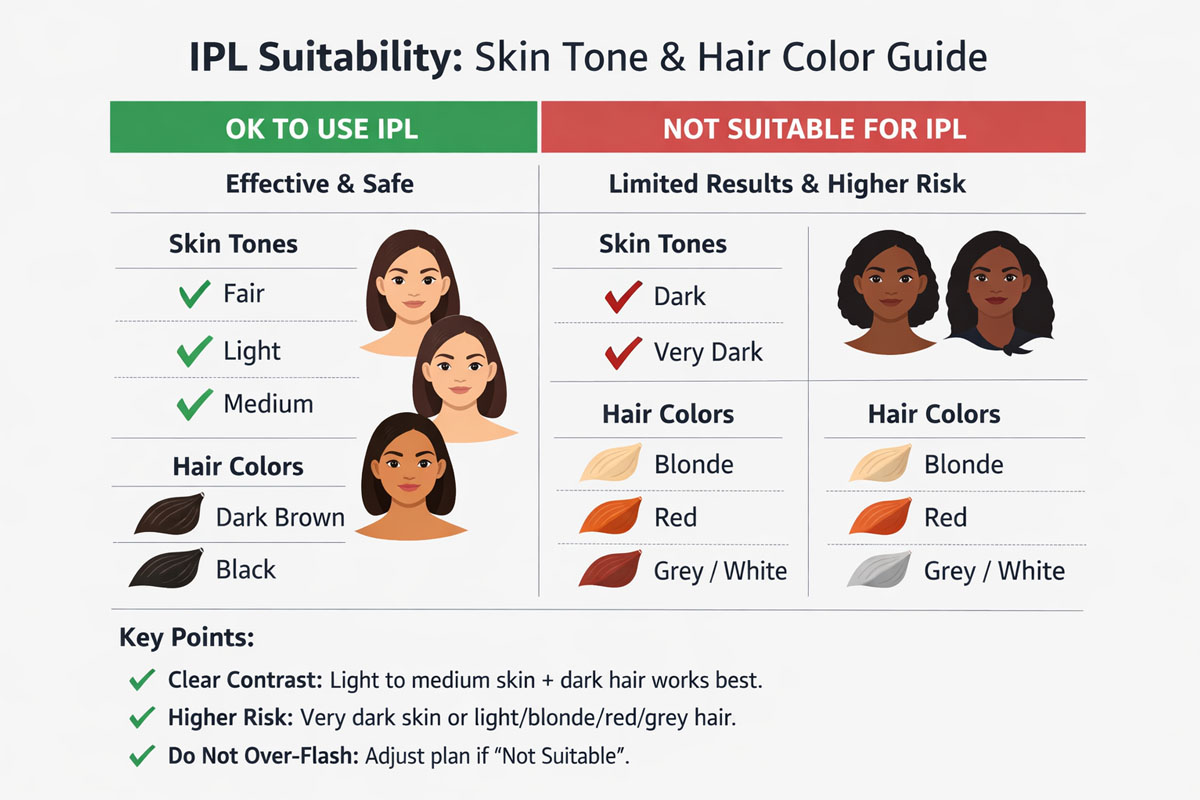
Short answer: At-home IPL works best when there’s clear contrast—typically lighter-to-medium skin with dark hair. If your skin is in the “very deep” range or your hair is very light (blonde/red/grey/white), results may be minimal and safety risk can increase. In that case, it’s usually smarter to stop “pushing power” and switch strategy.
This is the most common root cause behind “IPL isn’t working”: the device may be fine, your routine may be consistent, but your skin tone + hair color combo doesn’t give IPL enough “target contrast” to work efficiently. And when contrast is low, trying to fix it by cranking up the level can backfire.
If you want a faster, visual check first, use our tool: Device Feature Fit Quiz (it helps you map your needs to safer device features and realistic expectations).
Why suitability matters (in plain words)
IPL hair reduction relies on light energy being absorbed more by hair pigment than by skin pigment. When skin pigment is high (deeper skin tones) or hair pigment is low (very light hair), the “selective targeting” becomes harder. That can mean slower results, patchy results, or more heat felt on skin.
Quick suitability checklist (60 seconds)
- Hair color: Is the hair you want to treat naturally dark brown or black (best), or is it blonde/red/grey/white (often minimal response)?
- Skin tone (treated area): Is the area light-to-medium, or is it very deep in tone (higher risk of absorbing more energy)?
- Contrast: When you look at the area in normal indoor light, do you see a clear contrast between hair and skin?
- Recent tan / sun exposure: Has the area been tanned recently (including self-tanner)? This can shift your “real” tone and raise risk.
- Past sessions: After 4–8 weeks of consistent use, do you see slower regrowth or easier shaving (early signs), even if you don’t see dramatic shedding?
For a more detailed, reference-style explanation, see: Skin Tone & Hair Color Guide for IPL.
What “not suitable” really means (and what to do next)
“Not suitable” doesn’t mean you did something wrong. It means the physics is working against you: the device can’t reliably distinguish hair pigment from skin pigment (or there isn’t enough pigment in the hair to “grab”).
If your hair is very light (blonde/red/grey/white)
- Expect limited reduction with IPL, even if your skin is light.
- Do not try to “force results” by repeatedly over-flashing the same spot.
- Safer alternatives are often shaving, professional evaluation, or in some cases electrolysis for truly light hair.
Related reading: Does hair color affect IPL results?
If your skin is in the very deep range (or the treated area is naturally darker)
- Risk can increase because more energy may be absorbed by the skin.
- If you are close to the “not suitable” boundary on skin tone charts, the safest decision is often to avoid IPL on that area.
- If you still proceed, you must be extra conservative: lower levels, strict spacing, and stop rules (and consider professional guidance).
Related reading: Does skin tone affect IPL safety?
A safe decision rule (don’t “chase results” with power)
If IPL “isn’t working,” the unsafe instinct is: increase level + flash more times. A safer rule is:
- First confirm suitability (skin tone + hair color + recent tan).
- Then confirm technique (coverage spacing, no excessive overlap, consistent weekly routine).
- Only then, if skin reaction is calm, consider a modest increase—never “stack” increases with extra passes on the same spot.
If you’re unsure, do a patch test reset: How do you perform a patch test before IPL?
When to pause (simple stop rules)
- Heat that feels “sharp” or escalating during a session (not just mild warmth).
- Blistering, scabbing, or a burn-like pattern.
- Rapid darkening that looks unusual or keeps worsening.
- Any reaction that makes you think: “This is not my normal skin.”
More safety context: IPL Hair Removal Safety and Safety & Usage.
Image suggestion (optional, but very “Google-citable”)
If you want this page to look and feel like a true reference source, add one simple visual: a “Suitability = contrast” diagram (skin tone bar + hair color bar + “best / mixed / not suitable” zones), plus a tiny note: “Reference only. Device charts vary. Always follow your manual.”
Sources & references (third-party, verifiable)
- DermNet NZ — Skin phototype (Fitzpatrick skin type): dermnetnz.org
- DermNet NZ — Intense pulsed light therapy (IPL) overview & precautions: dermnetnz.org
- NCBI Bookshelf (StatPearls) — Intense Pulsed Light (IPL) Therapy (clinical overview): ncbi.nlm.nih.gov
- American Academy of Dermatology — Hair removal overview (dermatologist perspective): aad.org
Note: Suitability charts can vary by device. This page provides general education, not medical advice. Always follow your device instructions and do a patch test before full treatment.
Part of this hub: IPL Troubleshooting: Why It’s Not Working (and How to Fix It Safely)