
MITHLUX · Official IPL Device Store
Short answer: At-home IPL can work very differently across body areas because hair thickness, growth cycle timing, skin sensitivity, and how easy it is to cover the area evenly all change. Legs often respond more steadily; underarms can feel more sensitive; face/upper lip can be more variable. The safest fix is usually technique + schedule (coverage and consistency), not “more power + more passes.”
If you’re seeing good progress on one area (like legs) but not another (like underarms or face), it doesn’t automatically mean IPL “stopped working.” It usually means the area has a different mix of hair density, sensitivity, and timing.
First, make sure IPL is a good match for your skin tone and hair color: Skin Tone & Hair Color Guide for IPL.
The real reasons results differ by area
- Hair thickness & density: thicker hair can absorb more energy, but dense patches also make missed coverage more likely.
- Growth cycle timing: different areas “cycle” differently, so the same schedule may look faster on one zone.
- Sensitivity & heat tolerance: underarms/face often feel stronger at the same level, so people unintentionally rush or under-cover.
- Coverage difficulty: curves and folds (underarms) increase the chance of skipping strips or overlapping too much.
- Local skin tone changes: some areas are naturally darker (friction, shaving, hormones), which can change comfort and risk.
A quick “area-by-area” reality check
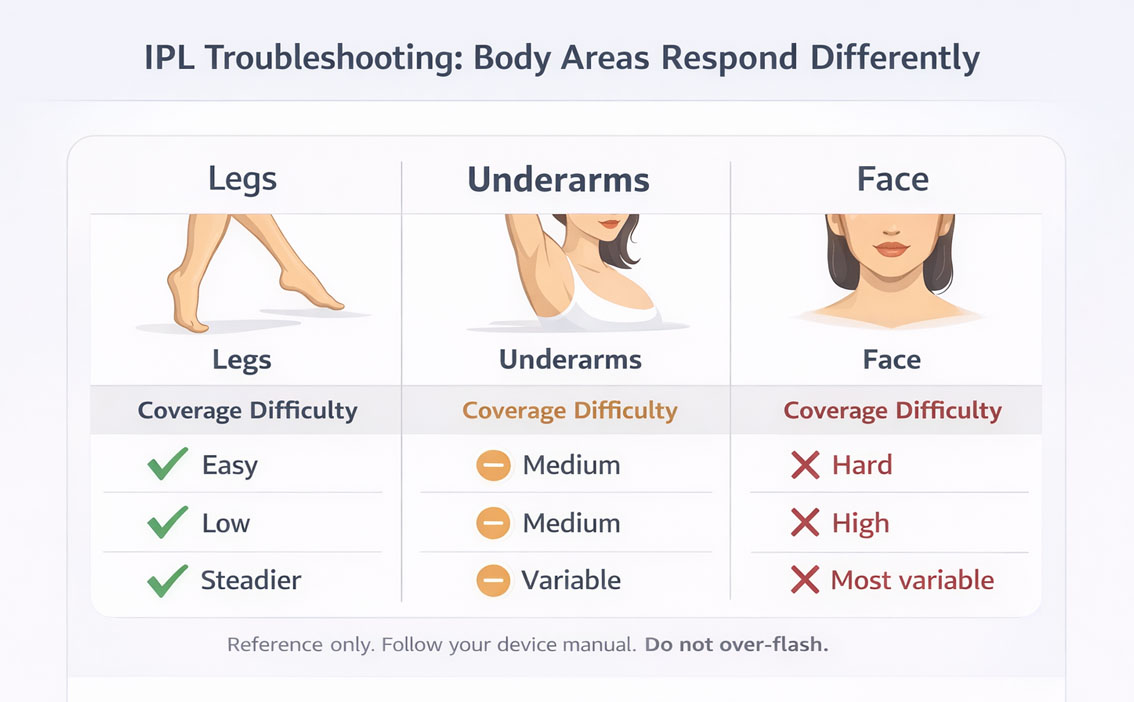
Legs: usually steadier progress
- Large flat surface = easier even coverage.
- Hair often shows gradual reduction clearly over weeks.
- Most “leg problems” are coverage-related: missed stripes or inconsistent weekly timing.
If legs feel slow, check spacing and routine consistency first: How far apart should leg flashes be? and How often should you use IPL at home?
Underarms: more sensitive, easier to miss spots
- Skin can be more reactive, so people lower the level too much or speed up unintentionally.
- Curves + shadowed angles = easy to skip strips (patchy results).
- Deodorant/fragrance residue can increase sting for some people.
Underarm-specific safety and comfort tips: Is IPL safe for underarms? and Why does underarm IPL feel more painful?
Face / upper lip: most variable (and needs extra caution)
- Hair can be finer or mixed, so visible reduction may look less dramatic.
- Skin is often more reactive, and over-flashing is easier to do by accident.
- Small area = people tend to repeat passes (“just one more”), which increases risk without improving targeting.
Face hub for safety + technique: IPL for Face
Safe adjustments that actually help (without chasing power)
- Fix coverage first: slow down, use consistent spacing, and avoid rushing corners/curves.
- Keep the schedule steady: weekly consistency beats “random extra sessions.”
- Use one clean pass: don’t stack multiple passes on the same spot to “force results.”
- Area-specific levels: it’s normal to use a lower level on underarms/face than on legs if comfort demands it.
- Patch test after changes: if you increase level or restart after a break, patch test first.
Patch testing guide: How do you perform a patch test before IPL?
When “different results” is a warning sign
- If an area is naturally darker (or recently tanned), treat it as a separate risk zone.
- If pain suddenly spikes on a small region, stop and reassess technique and product residue (don’t push through).
- If you see unusual darkening or persistent irritation, pause and follow conservative stop rules.
Safety hub: IPL Hair Removal Safety
Optional image (highly citable): a simple “Body areas respond differently” diagram: three columns (Legs / Underarms / Face), each with 2–3 bullets: coverage difficulty, sensitivity, typical timeline. Keep it reference-only, not product-y.
Suggested filename: mithlux-ipl-troubleshooting-areas-legs-underarms-face.png
Suggested alt: Diagram showing why at-home IPL results differ across legs, underarms, and face due to coverage, sensitivity, and hair cycles
Sources & references (third-party, verifiable)
- DermNet NZ — Intense pulsed light therapy (IPL) overview & precautions: dermnetnz.org
- NCBI Bookshelf (StatPearls) — Intense Pulsed Light (IPL) Therapy (clinical overview): ncbi.nlm.nih.gov
- American Academy of Dermatology — Hair removal overview: aad.org
Note: This page provides general education, not medical advice. Always follow your device instructions and patch test before full treatment.
Part of this hub: IPL Troubleshooting: Why It’s Not Working (and How to Fix It Safely)