
MITHLUX · Official IPL Device Store
Short answer: If you’re taking an antibiotic that can make your skin more sensitive to light (photosensitivity), it’s safer to pause IPL and restart only after your skin has stayed calm for a while. When in doubt, wait, then patch test and start conservative—because “pushing through” is how irritation turns into weeks of setbacks.
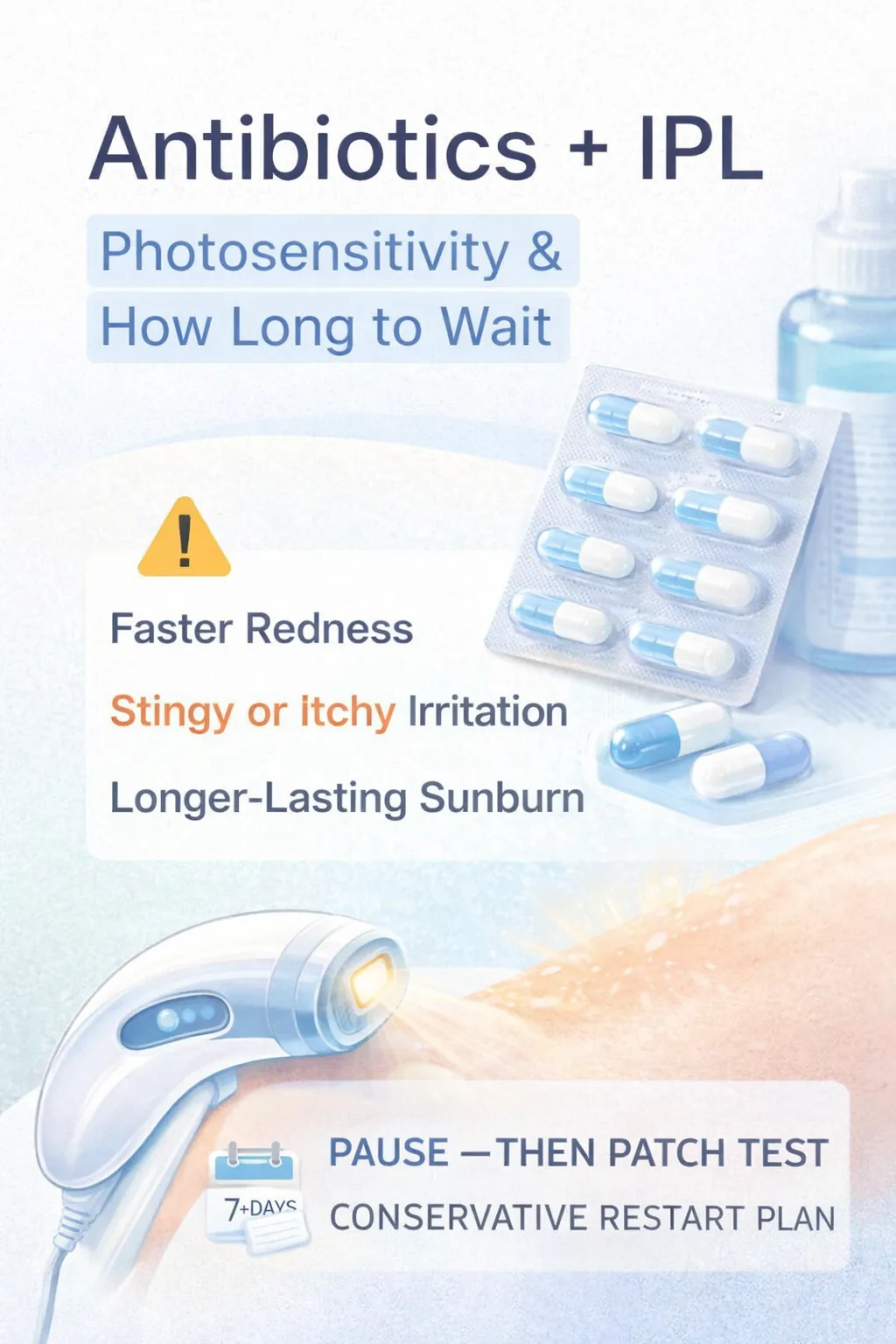
Why antibiotics can change the IPL safety picture
At-home IPL is “light-based.” Some antibiotics (and some other medications) can make your skin react more strongly to light—think faster redness, stingy/itchy irritation, or longer-lasting inflammation. If you treat while your skin is temporarily more reactive, you may not get faster results—you may just buy yourself a forced break.
Two important notes:
- Not every antibiotic causes photosensitivity. But enough of them can that it’s worth checking.
- Different bodies react differently. Your friend may be fine; your skin may not be. Your skin is the “boss,” not your schedule.
First check: is your antibiotic known for photosensitivity?
Photosensitivity is a known issue for certain antibiotics—especially some in the tetracycline family and some fluoroquinolones. This doesn’t mean “danger every time,” but it does mean your safe play is to treat IPL like a “pause zone” until you’re sure your skin is calm again.
If you’re unsure, use this rule:
- If the medication label or pharmacist warning mentions sunlight / UV sensitivity, treat it as a pause for IPL.
- If you recently burned, tanned faster than usual, or feel unusually stingy, also treat it as a pause.
Practical tip (the calm way): call your pharmacy and ask one sentence—“Does this antibiotic increase photosensitivity?” If they say yes (or “it can”), don’t gamble.
A simple “Stop / Pause / Continue” rule you can trust
Use this as your decision tree. It’s conservative on purpose.
- Continue only if: you are not on a photosensitizing antibiotic, your skin is calm, and your last IPL sessions produced only mild warmth or light redness that settled quickly.
- Pause & adjust if: you’re currently taking a photosensitizing antibiotic, you’ve had increased redness/itching, or your skin feels “more reactive than usual.”
- Stop & get advice if: you develop blistering, broken skin, intense swelling, or pain that doesn’t improve.
If you’re dealing with redness or irritation patterns, use the troubleshooting hub and start with the “pause early” approach: IPL Troubleshooting.
How long should you wait after antibiotics before starting IPL?
This is the part people want as a single number. Realistically, it depends on:
- Whether your antibiotic is photosensitizing (some are, some aren’t).
- How your skin behaved while taking it (any unusual redness or sun sensitivity?).
- Whether you had recent sun exposure (sun + photosensitivity is the worst combo).
Here’s a conservative, easy-to-follow approach that avoids “false confidence”:
- If your antibiotic is known to cause photosensitivity: wait until you’ve finished the course and your skin has been calm. Then restart with a patch test and conservative level.
- If you’re not sure whether it causes photosensitivity: assume “maybe,” pause IPL, and confirm with your pharmacist or prescriber.
- If you had any sunburn/tan lines during or right after antibiotics: treat that as a restart situation and use the sun-exposure restart plan below.
If you want a safer step-by-step restart, follow the restart plan here: Sun Exposure and IPL Results: How Long to Wait (and How to Restart Safely).
Restart plan: the “patch-test reset” (fastest safe path)
If you paused because of antibiotics (or you’re unsure), restart like this:
- Pick one small test zone (not your most sensitive area).
- Start conservative (lower than you think you “can handle”).
- Patch test, then wait and watch your skin response over the next day(s).
- Only expand the treated area if your skin stays calm—no rising redness trend, no stingy “worse each session” feeling.
Helpful step-by-step: How do you perform a patch test before IPL? and Restarting after a break: how to patch test and reset levels.
Common mistakes that cause “avoidable” irritation
- Trying to “catch up” by doing sessions more often after a pause.
- Raising the level to compensate for missed time (more intensity doesn’t fix a biological timing problem).
- Chasing missed hairs with overlap flashes on the same spot.
- Mixing harsh skincare during a period when your skin is already reactive.
If your skin feels stingy or progressively worse, you’ll want this decision page: If skin feels stingy after IPL, when can you restart?.
When antibiotics are NOT the real issue (but it looks like it)
Sometimes people blame antibiotics, but the actual trigger is:
- Sun exposure (even “just driving” with one arm in the sun)
- Self-tanner / spray tan (creates uneven light absorption)
- Skincare actives (retinoids, acids, benzoyl peroxide)
Use these to troubleshoot the real cause:
- Retinol, Acids, Benzoyl Peroxide: When Skincare Makes IPL Feel Worse
- Can you use self-tanner while doing an IPL routine?
- How long should you wait after sun exposure before IPL?
One calm checklist before your next session
- Do I have any “sun sensitivity” warning with this medication? If yes, pause.
- Is my skin calm today? No active irritation, no rising redness trend.
- Can I commit to weekly sessions? Consistency beats intensity.
- Did I patch test after the pause? If not, do it first.
Part of this hub: Back to IPL Eligibility
📍Related guides 📍Helpful technique & safety- How do you perform a patch test before IPL?
- Restarting after a break: how to patch test and reset levels
- IPL Troubleshooting
Sources & references (third-party, verifiable)
These references cover medication-related photosensitivity and general safety expectations around light-based hair removal.
Practical takeaway: when medications may increase photosensitivity, the safest plan is to pause, reset, patch test, and restart conservatively.