
MITHLUX · Official IPL Device Store
If you have sensitive skin, choosing an IPL hair removal device is less about finding the highest energy output and more about finding a device you can use comfortably and consistently. Cooling, adjustable intensity, skin and hair compatibility, and clear safety guidance can matter more than headline power numbers.
If your main question is whether IPL is appropriate for reactive skin at all, start with our guide to at-home IPL and sensitive skin . If you are unsure whether your skin tone and hair color are a good match, you can also use the IPL Suitability Checker before comparing devices.
What Should You Look for in an IPL Device for Sensitive Skin?
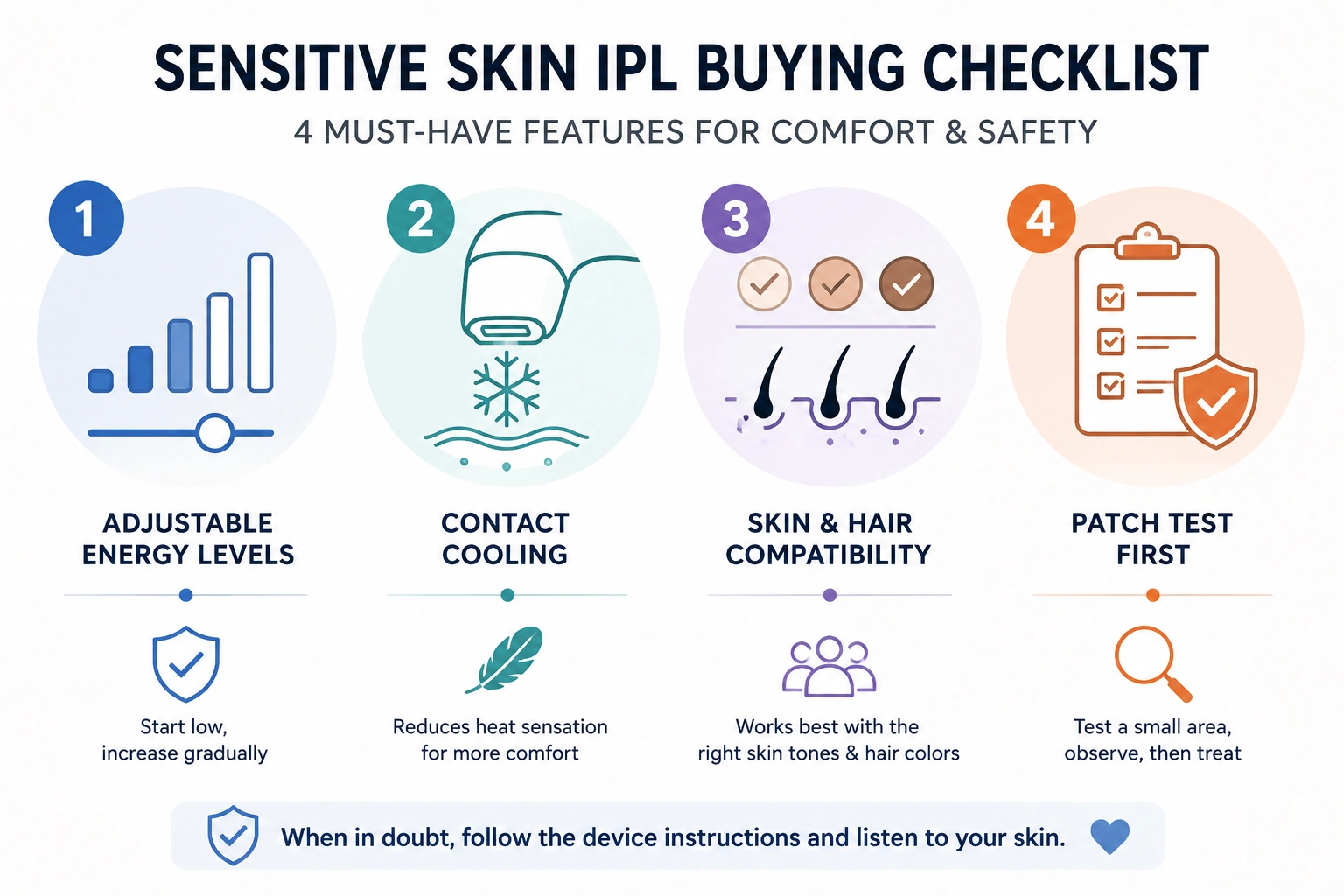
For sensitive skin, prioritize adjustable energy levels, clear skin-tone guidance, reliable skin contact, and comfort features such as contact cooling. A good IPL device should let you start gently and increase intensity only when your skin tolerates treatment well.
Cooling can make flashes feel more comfortable, but it does not make IPL suitable for every skin tone or every skin condition. A patch test and correct energy setting are still important.
For the broader safety framework, see our IPL Hair Removal Safety guide .
7 Features That Matter Most
| Feature | Why It Matters for Sensitive Skin |
|---|---|
| Adjustable energy levels | Lets you begin conservatively and increase only if your skin remains comfortable. |
| Contact cooling | Can reduce heat sensation at the treatment window and make repeated flashes easier to tolerate. |
| Skin-tone compatibility | Helps determine whether IPL is appropriate before treatment begins. |
| Hair-color compatibility | IPL generally works best when the hair contains enough pigment and contrasts with the surrounding skin. |
| Stable skin contact | Helps maintain consistent flashes and avoid unnecessary overlap. |
| Manual and automatic modes | Can make it easier to treat small sensitive areas differently from larger body zones. |
| Clear safety instructions | Patch testing, starting level guidance, and stop rules matter just as much as specifications. |
1. Adjustable Energy Levels Matter More Than Maximum Power
It is easy to compare IPL devices by looking only at maximum energy output. For sensitive skin, however, the ability to control intensity is often more useful than simply choosing the strongest device.
Skin tolerance varies by body area. An intensity that feels comfortable on the legs may feel noticeably stronger on the underarms, bikini line, upper lip, or chin.
A device with several adjustable levels lets you begin conservatively and increase intensity gradually rather than forcing every area into the same treatment level.
If you are unsure where to begin, see our 6 energy levels and body-area guide .
2. Contact Cooling Can Make IPL More Comfortable
Many newer IPL devices include some form of cooling. The important question is where and how the cooling reaches the skin.
A cooling surface that directly contacts the treatment area can help reduce the warm or stinging sensation associated with repeated flashes. This may be particularly useful on areas that tend to feel more sensitive, including the face, underarms, and bikini line.
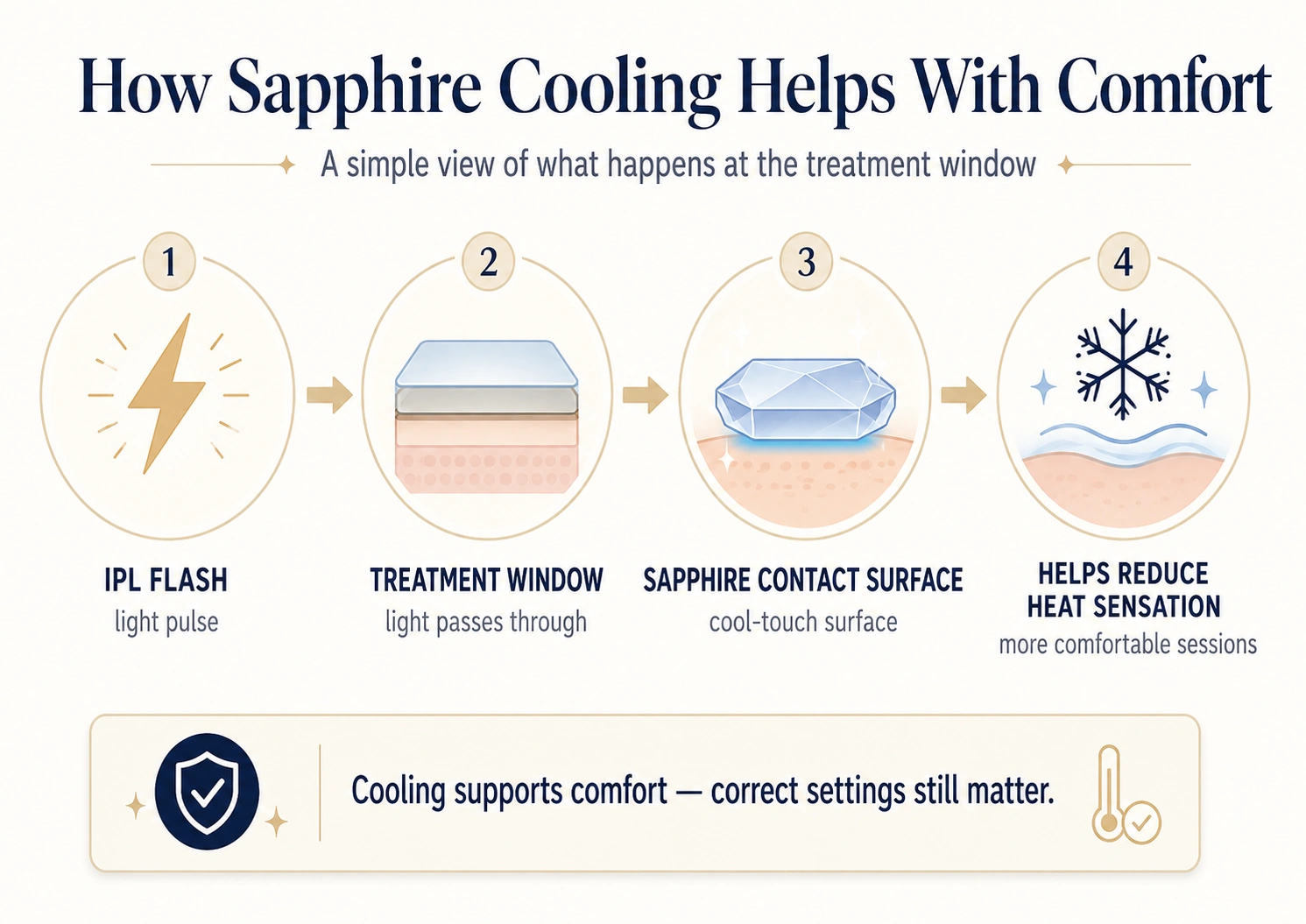
Cooling should still be treated as a comfort feature rather than permission to use excessive energy. If the skin becomes unusually painful or irritated, treatment should be stopped rather than continued simply because the device has cooling.
If you are deciding whether cooling is worth paying for, compare the trade-offs in Ice Cool IPL vs. Regular IPL .
An IPL Device Worth Considering for Comfort
One example is the Mithlux S2 Pulse IPL Hair Removal Device. It combines a sapphire cooling contact window with six adjustable intensity levels, allowing users to begin at a lower setting and gradually adjust treatment based on comfort.
Its cooling system is designed to provide direct cool-touch contact around the flash window, which may be useful for people who find heat sensation to be one of the less comfortable parts of at-home IPL.
As with any IPL device, suitability still depends on skin tone, hair color, treatment area, and following the manufacturer’s instructions.
3. Check Skin-Tone Compatibility Before Buying
IPL works by targeting pigment in the hair. Because light energy can also interact with pigment in the skin, not every IPL device is appropriate for every skin tone.
A sensitive-skin-friendly buying decision therefore starts with a clear compatibility chart. Avoid assuming that lower intensity or stronger cooling makes an otherwise unsuitable skin tone appropriate for IPL.
For a detailed explanation of contrast, suitability, and realistic expectations, see our Skin Tone & Hair Color Guide for IPL .
If you prefer a quick interactive check instead, use the IPL Suitability Checker .
4. Hair Color Is Just as Important as Skin Sensitivity
Even a very comfortable IPL device may provide limited benefit if the hair contains too little pigment.
At-home IPL generally performs best on darker hair with lighter to medium skin tones. Very light blonde, red, white, or gray hair may respond poorly because there is less melanin for the light energy to target.
Checking both skin tone and hair color before purchasing can prevent unnecessary treatments and disappointment later.
You can explore the practical differences in our at-home IPL skin and hair compatibility guide .
5. Look for Good Skin Contact and Easy Control
Sensitive skin often benefits from a predictable routine. A device that is awkward to position may lead to inconsistent contact, repeated flashes over the same area, or unnecessary treatment time.
A clearly defined treatment window, comfortable grip, responsive controls, and reliable skin contact can make treatment easier to manage.
For smaller areas such as the upper lip or chin, manual control can also be useful because it gives you more control over exactly where each flash is delivered.
If facial hair is your main concern, see our dedicated IPL guide for the upper lip and chin .
6. A Patch Test Is Especially Important for Sensitive Skin
Even when a device is suitable for your skin tone, individual sensitivity can vary.
Before treating a large area, follow the device instructions for a patch test. Start with a lower energy level and observe the skin before progressing to larger areas or higher settings.
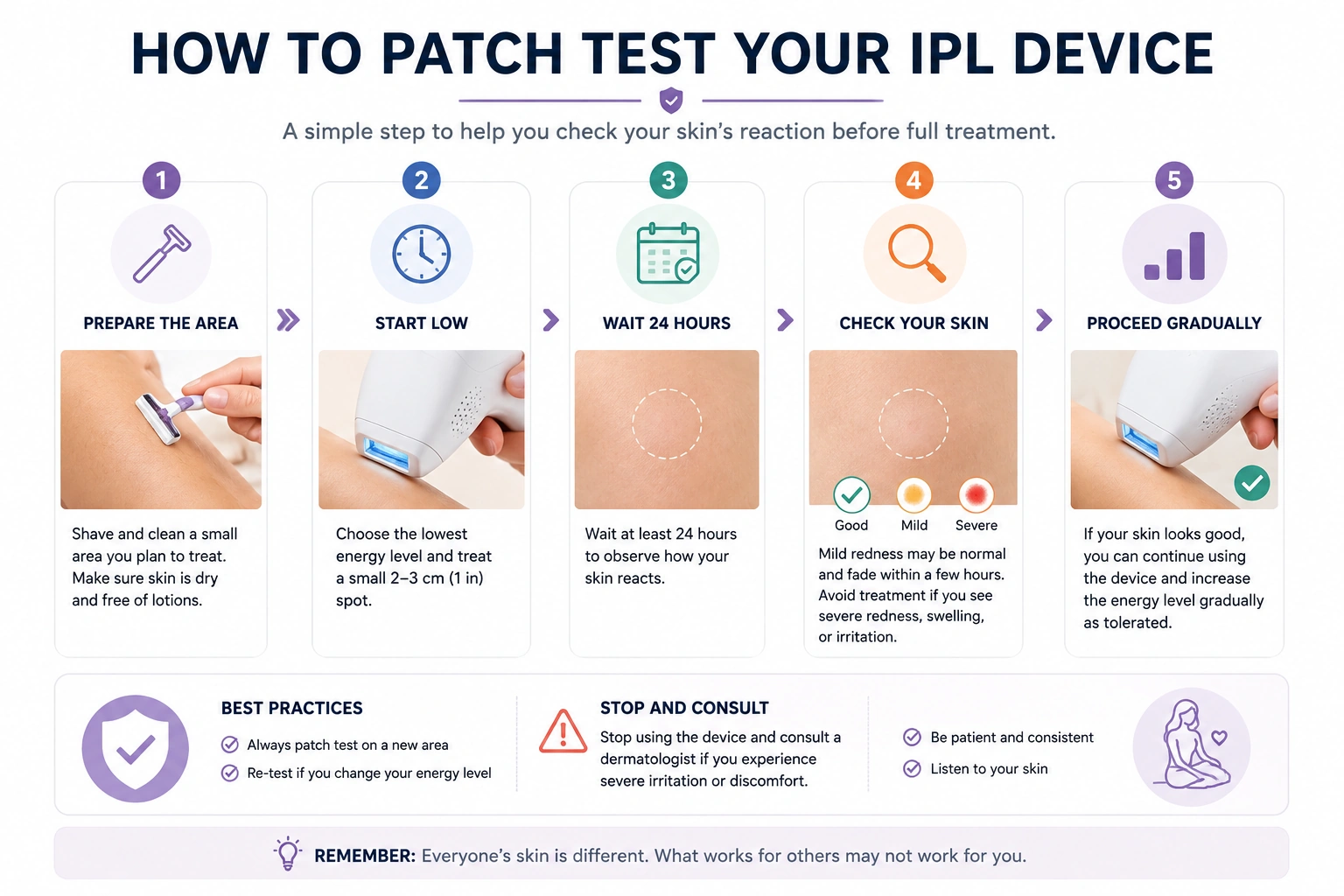
Mild temporary warmth or redness can occur with IPL, but treatment should not be pushed through significant pain, persistent irritation, blistering, or other unexpected reactions.
If you want to understand which reactions may be temporary and which deserve more caution, read What Skin Reactions Are Normal After Using IPL? .
7. Consistency Is More Useful Than Aggressive Treatment
IPL hair reduction happens gradually because hair grows in cycles. Using excessive intensity in an attempt to get faster results is not necessarily better.
For sensitive skin in particular, a treatment level that you can use comfortably and consistently is usually more practical than choosing the highest possible setting and then avoiding future sessions because treatment feels unpleasant.
Follow the schedule provided with your device and adjust only within the manufacturer’s recommended range.
Does More Expensive IPL Mean Better for Sensitive Skin?
Not necessarily.
Higher-priced IPL devices may include better cooling systems, improved ergonomics, more refined controls, skin sensors, or stronger brand support. Those features can be useful, but price alone does not determine whether a device is appropriate for sensitive skin.
A better comparison is whether the device offers the features you actually need:
- Enough adjustable intensity levels
- Clear skin and hair compatibility guidance
- A comfortable treatment window
- Reliable contact with the skin
- Cooling if comfort is a priority
- Clear instructions for patch testing and treatment frequency
If you want a more general buying framework, you can also use the Best IPL Device Fit Quiz to compare which features matter most for your skin tone, hair color, treatment areas, sensitivity, and routine.
Is Sapphire Cooling Worth It for Sensitive Skin?
Sapphire cooling can be useful if heat sensation is one of the main reasons you find IPL uncomfortable.
Sapphire has good thermal conductivity and can be used as a cool-touch contact surface at the treatment window. In a well-designed IPL device, this can help move heat away from the skin surface during treatment.
The main advantage is comfort and treatment consistency — not stronger hair reduction by itself.
If two devices provide appropriate IPL treatment for your skin and hair type, but one allows you to complete sessions more comfortably, that comfort advantage may make it easier to stay consistent over several weeks.
This is one reason devices such as the Mithlux S2 Pulse , which uses a sapphire cooling contact window together with adjustable IPL intensity, may appeal to users who prioritize comfort during regular at-home treatments.
Who Should Be More Cautious With At-Home IPL?
Sensitive skin does not automatically mean you cannot use IPL, but some situations require additional caution.
Do not treat irritated, broken, infected, or sunburned skin. Avoid using IPL over areas or conditions excluded by the manufacturer’s instructions.
Before starting, it is worth reviewing who should and should not use at-home IPL and when IPL hair removal is not recommended .
If you use retinol, acids, exfoliating skincare, or other active products, also review our IPL eligibility guide for retinol, acids, and active skincare before treating sensitive facial areas.
If you have a diagnosed skin condition, unusual photosensitivity, or take medication that can increase sensitivity to light, check with a qualified healthcare professional before using an IPL device.
What About Sensitive Treatment Areas?
Sensitive skin and sensitive body areas are not exactly the same thing. The face, underarms, bikini line, and high-friction areas can feel more intense even in people who do not normally describe their skin as sensitive.
For area-specific precautions, see Is It Safe to Use IPL on Sensitive Areas? .
Which Type of IPL Device Is Best for Sensitive Skin?
There is no single IPL device that is best for every person with sensitive skin. The better choice is the one that matches your skin tone and hair color while giving you enough control over treatment intensity and comfort.
If heat sensation is your main concern, a device with direct contact cooling may be worth prioritizing. If you are new to IPL, multiple adjustable intensity levels and clear treatment guidance may matter more than maximum power.
For users who want both features, the Mithlux S2 Pulse is one option to consider. It combines sapphire contact cooling, six adjustable intensity levels, and face-and-body use in a single at-home IPL device.
It should still be compared with other devices based on your own skin tone, hair color, treatment areas, budget, and comfort preferences rather than chosen on one feature alone.
Bottom Line
The best IPL hair removal device for sensitive skin is not simply the device with the highest energy or the lowest temperature claim.
Look for a balanced combination of adjustable intensity, correct skin and hair compatibility, reliable skin contact, clear safety guidance, and comfort features such as contact cooling.
Most importantly, choose a device and treatment level that allows you to follow a consistent routine without pushing your skin beyond what feels comfortable.
If you are still unsure whether IPL is a good fit, start with the IPL Suitability Checker or browse the Mithlux IPL Knowledge Hub for deeper guidance on safety, results, and at-home use.
Frequently Asked Questions
Can people with sensitive skin use IPL hair removal?
Many people with sensitive skin can use IPL if their skin tone and hair color are suitable and the device instructions are followed. Starting at a lower intensity and performing a patch test is especially important. For a more detailed explanation, see our sensitive-skin IPL safety guide .
Does cooling make IPL safer for sensitive skin?
Cooling can improve comfort, but it does not override skin-tone restrictions, contraindications, or recommended energy settings. It should be treated as a comfort feature rather than a substitute for correct IPL use.
What IPL intensity should sensitive skin start with?
Follow the instructions for your specific device. In general, starting at a lower permitted level and increasing gradually after confirming good skin tolerance is more sensible than immediately using the maximum setting. See the Mithlux energy level and area guide for a practical example.
Is IPL better than waxing for sensitive skin?
It depends on the individual. Waxing removes hair mechanically and can cause temporary redness or irritation, while IPL uses light to gradually reduce regrowth. People can react differently to either method, so suitability and personal tolerance matter.
Can IPL be used on a sensitive face or chin?
Some at-home IPL devices are designed for facial areas below the cheekbones, including the upper lip and chin. Always follow the permitted treatment areas listed by the manufacturer. For a more focused guide, see IPL for the upper lip and chin .
Is sapphire cooling necessary for sensitive skin?
No. Sapphire cooling is not required for IPL to work. Its main purpose is to improve treatment comfort by reducing heat sensation at the skin-contact surface. For users who are particularly sensitive to warmth during IPL, it can be a useful feature to consider.