
MITHLUX · Official IPL Device Store
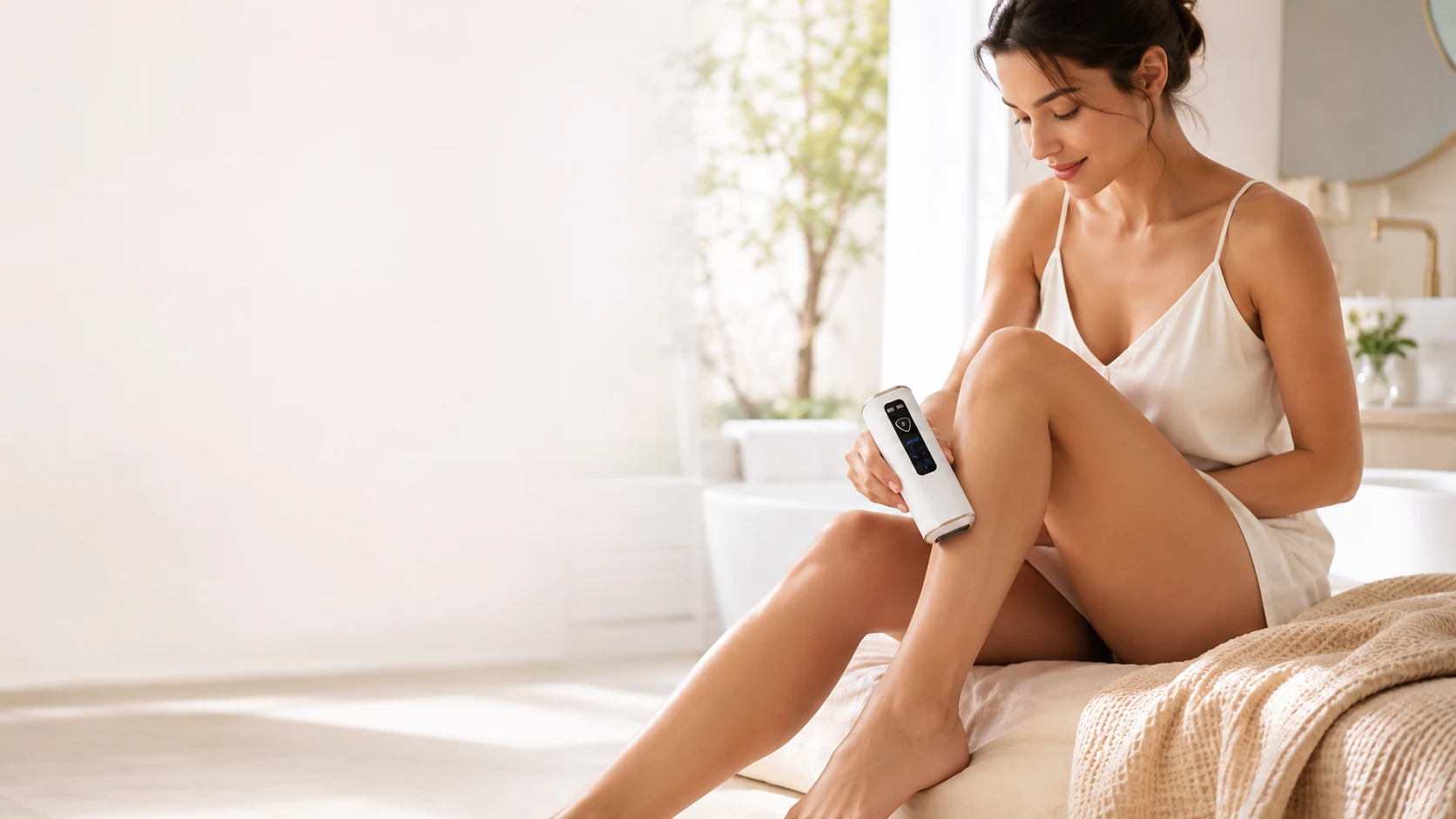
Choosing the best IPL hair removal device for legs is slightly different from choosing one mainly for the face, underarms, or bikini line.
Legs are a much larger treatment area. That means treatment speed, window size, comfort, consistent power, and ease of handling can matter just as much as maximum energy.
Short answer: a good IPL device for legs should offer a practical treatment window, adjustable energy levels, comfortable repeated flashes, reliable output, and a design that makes full-leg sessions manageable.
This guide explains the seven features that matter most before buying an at-home IPL device primarily for leg hair reduction.
What Makes an IPL Device Good for Leg Hair Removal?
The best IPL device for legs is not necessarily the device with the highest advertised power or the largest number of flashes.
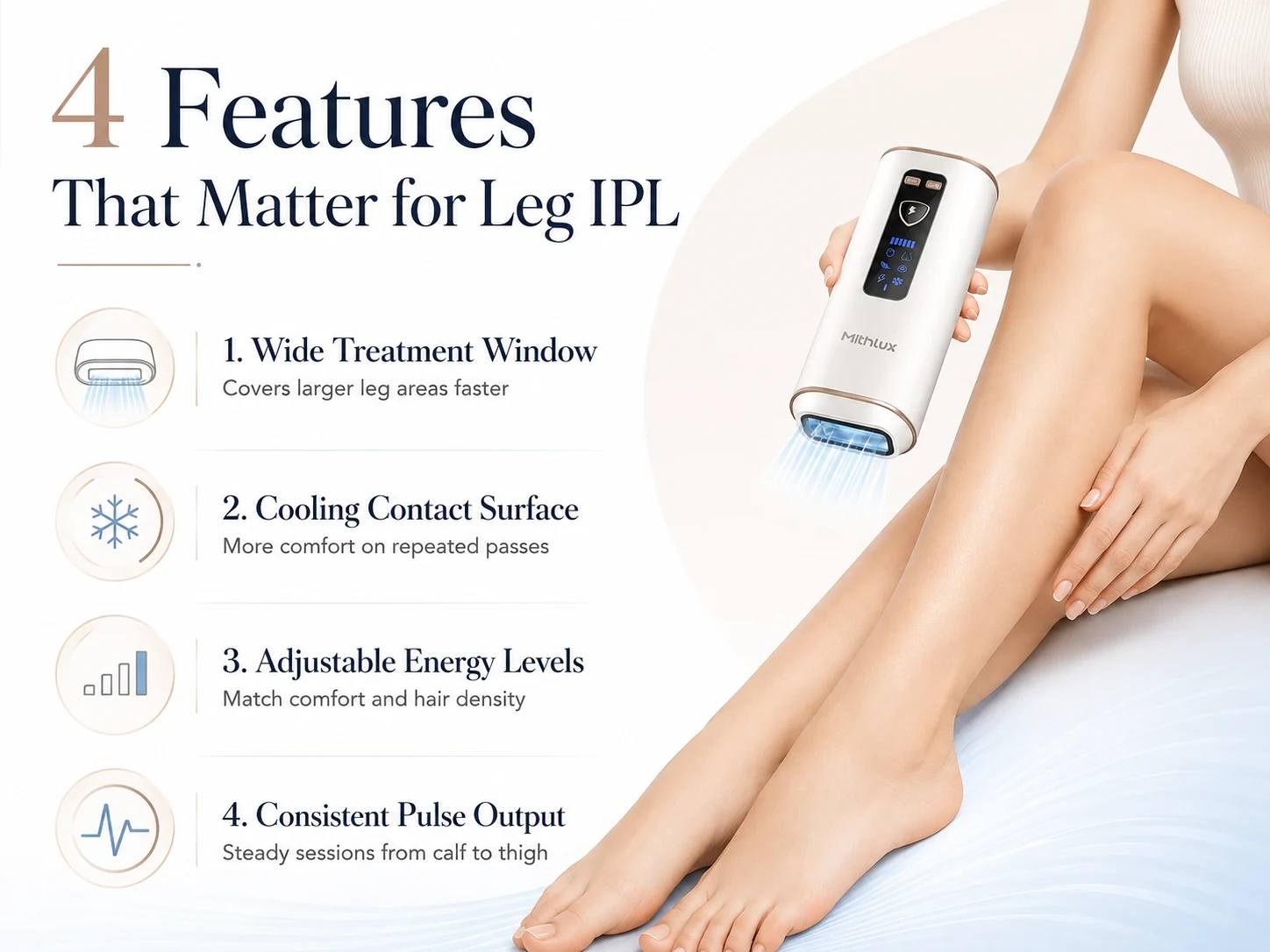
For larger areas such as the thighs and calves, the most useful features are usually:
- a practical treatment window
- consistent flashing across a large area
- adjustable energy levels
- good comfort during longer sessions
- easy positioning around knees and ankles
- reliable power throughout the session
- compatibility with your skin tone and hair color
If you are still deciding whether IPL is the right technology for you, start with our guide to how IPL hair removal works .
1. Look for a Practical Treatment Window for Large Areas
Window size matters more on the legs than it does on smaller areas such as the upper lip or underarms.
A treatment window that is too small may require many more placements to cover the thighs and calves. A reasonably sized window can make it easier to move systematically across the skin without turning a full-leg session into an unnecessarily long routine.
However, bigger is not always automatically better. The window should still be easy to position flat against curved areas such as the knees, ankles, and lower legs.
For users treating several body areas, our guide to choosing an IPL device for full-body use explains how treatment area size changes what features matter most.
2. Treatment Speed Matters More on Legs
Legs require many more flashes than the upper lip, chin, or underarms. For that reason, treatment speed can have a noticeable effect on whether you actually stay consistent with your routine.
A device that feels fast during a small test area may feel much slower when you are treating both thighs and calves.
The important question is not simply:
“How fast can the device flash?”
It is:
“Can it maintain a comfortable and consistent treatment pace across a large area?”
If session duration is important to you, see how long a full-leg IPL session may take .
3. Cooling Can Be More Useful During Longer Leg Sessions
Cooling is not required for IPL to work, but it can improve comfort during repeated flashes.
This can become more noticeable on the legs because the treatment area is large and a session may involve many consecutive placements.
A cooled contact surface may help make repeated treatments feel more manageable, particularly when using higher energy settings that are still appropriate for your skin.
Cooling should not be used as a reason to ignore normal skin reactions or to use an energy level that is too aggressive.
If you are comparing cooled and non-cooled devices, read Ice Cool IPL vs Regular IPL: Is Cooling Worth It?
4. Adjustable Energy Levels Help With Different Parts of the Legs
The skin on the thighs, calves, knees, and ankles does not always feel the same during IPL treatment.
That is why adjustable energy levels are useful.
A device with several levels allows you to start conservatively and adjust based on skin response, rather than forcing the entire leg to use one intensity.
Higher energy is not automatically better. The goal is to use an appropriate level that remains comfortable and suitable for your skin.
For more detail, see: Should You Lower the IPL Level for Knees and Ankles vs Thighs?
You can also review our general IPL starting-level guide before beginning a new treatment area.
5. Consistent Power Matters More Than an Impressive Maximum Number
High energy specifications can look impressive on a product page, but maximum output alone does not tell you how practical an IPL device will be for the legs.
For large-area treatments, consistency matters.
You want a device that can deliver repeated flashes predictably throughout the session rather than making the buying decision based only on the largest advertised energy number.
In practical use, the combination of appropriate energy, good skin contact, consistent placement, and regular sessions matters more than chasing the highest possible setting.
If you are wondering whether more power automatically means better results, see Do More Energy Levels Make an IPL Device Better?
6. Ergonomics Matter During Full-Leg Sessions
A device that feels comfortable for a few flashes may feel very different after treating both legs.
For leg use, consider:
- how securely you can hold the device
- whether the treatment window is easy to see
- whether the controls can be changed accidentally
- whether the device is comfortable to reposition around knees and ankles
- whether the power cord or battery design fits the way you plan to use it
Good ergonomics are not just about convenience. They can also make it easier to cover the leg systematically and reduce the chance of unintentionally missing large patches.
If patchy coverage is a concern, see what to do about missed patches on the legs .
7. Skin Tone and Hair Color Suitability Still Comes First
No IPL device is the best choice for everyone.
IPL works by using light that is absorbed by pigment in the hair. Because of that, the contrast between skin tone and hair color affects both suitability and expected response.
In general, darker hair against lighter skin tends to provide better contrast for IPL. Very light blonde, grey, white, or red hair often contains less pigment for IPL to target effectively.
Skin tone also matters because darker skin contains more melanin, which can absorb more of the light energy.
Before choosing any IPL device, check the manufacturer's skin-tone and hair-color guidance and perform a patch test when instructed.
For more detail, read:
Quick Comparison: What Matters Most for Leg IPL?
| Feature | Why It Matters on Legs |
|---|---|
| Treatment window | Affects how efficiently you can cover thighs and calves. |
| Flash consistency | Helps maintain a practical pace across a large area. |
| Cooling | May improve comfort during longer sessions. |
| Energy levels | Allows adjustment for different areas and skin responses. |
| Ergonomics | Makes repeated positioning easier around the entire leg. |
| Stable power | Supports consistent treatment during longer sessions. |
| Skin/hair suitability | Determines whether IPL is an appropriate option in the first place. |
A Practical Example: Mithlux S2 Pulse
One example of an at-home IPL device designed around several of these characteristics is the Mithlux S2 Pulse .
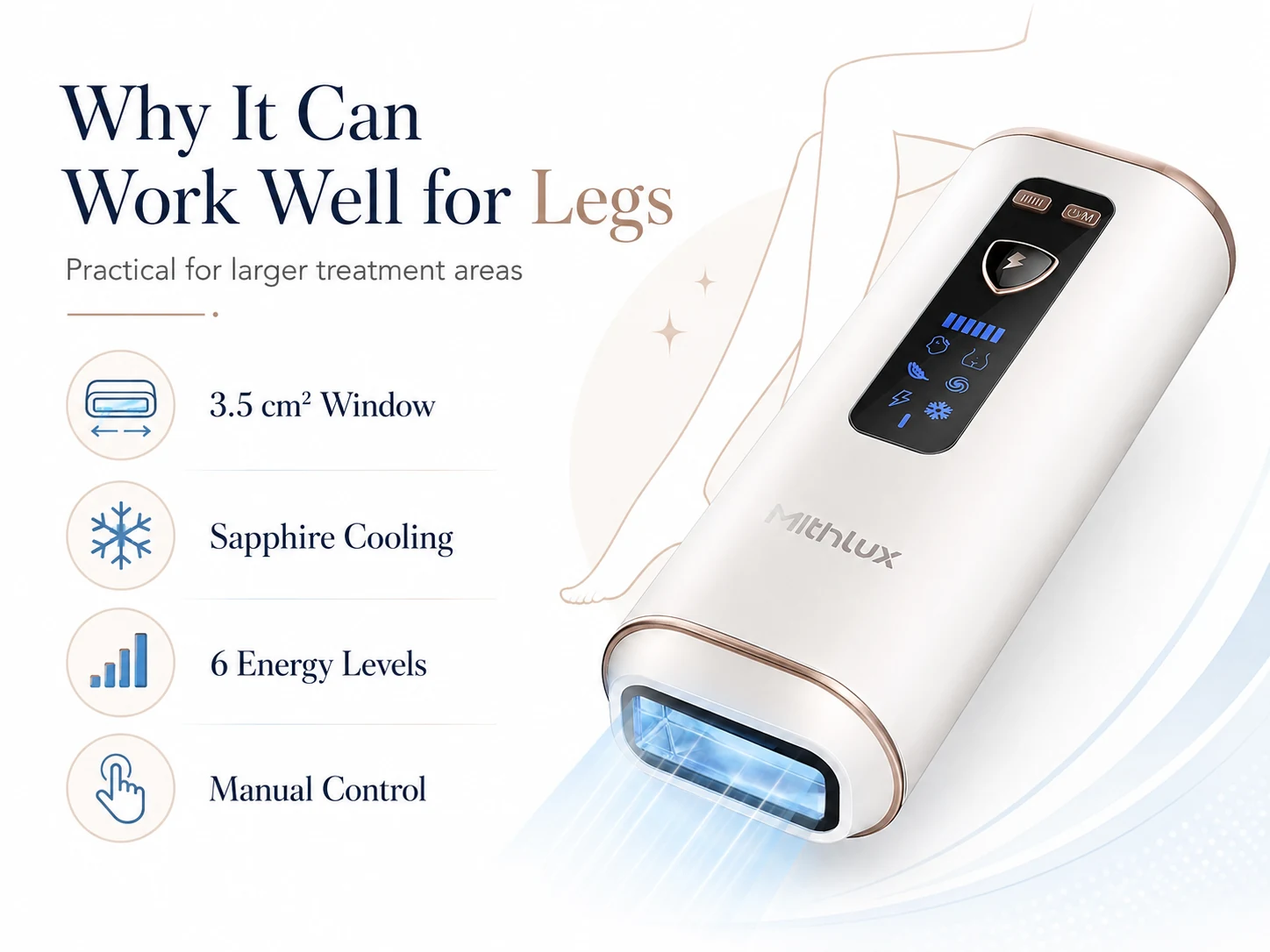
It combines a 3.5 cm² treatment window, six adjustable energy levels, a sapphire cooling contact surface, and up to 18 J of pulse energy.
Those features can be useful for users who want one device for both larger areas such as the legs and smaller areas such as the underarms, bikini line, chin, or upper lip.
The sapphire cooling surface is particularly relevant during longer treatment sessions, while the adjustable levels allow users to begin conservatively rather than treating every part of the leg at the same intensity.
That does not automatically make it the right device for every person. Skin tone, hair color, treatment goals, comfort preferences, session time, and budget should still determine which IPL device makes the most sense for you.
How Often Should You Use IPL on Your Legs?
There is no universal schedule that applies to every IPL device.
Always follow the schedule provided by the manufacturer of the device you are using.
Many at-home IPL routines begin with a more regular starter phase and later move to maintenance treatments as regrowth becomes less noticeable.
For a more detailed explanation, see How Often Should You Use IPL on Legs? Starter vs Maintenance .
How Long Does IPL Take to Work on Legs?
IPL does not normally produce instant hair removal.
Hair grows in cycles, and only part of the hair in a treatment area is in a responsive growth stage at any given time. That is why repeated sessions are normally needed.
Early signs may include slower regrowth, softer-feeling regrowth, or areas remaining smoother for longer between shaves.
For realistic expectations, read our leg IPL results timeline from Week 1 through maintenance .
Should You Shave Before Using IPL on Your Legs?
For most at-home IPL routines, shaving is preferred over waxing or epilating before treatment.
Shaving removes hair above the skin while leaving the follicle structure below the surface available for light-based treatment.
Waxing and epilating remove the hair from the root, which can interfere with the target IPL is intended to act on.
You can learn more in: Can You Shave Between Leg IPL Sessions?
What About Knees, Ankles, Moles, and Freckles?
Legs are not perfectly flat, and some areas need more careful positioning.
Knees and ankles can be more difficult because of their contours. Keep the treatment window flat against the skin whenever possible and avoid repeatedly flashing the same spot simply because contact is difficult.
Do not flash directly over tattoos or clearly dark pigmented areas unless the device manufacturer specifically states that it is appropriate.
See our dedicated guides:
Is IPL Better for Legs Than Shaving or Waxing?
They solve different problems.
Shaving removes visible hair quickly but does not reduce the underlying regrowth cycle. Waxing removes hair from the root but must be repeated as new hair grows.
IPL is different because the goal is gradual hair reduction over repeated treatments.
That means IPL may appeal more to someone who is tired of frequent shaving or waxing and is willing to follow a consistent treatment schedule.
However, IPL requires more patience at the beginning and is not suitable for every combination of skin tone and hair color.
Who Should Prioritize a Leg-Focused IPL Device?
A leg-friendly IPL device may make sense if:
- your legs are one of your main treatment areas
- you currently shave frequently
- full-leg session time matters to you
- comfort during repeated flashes matters
- you want adjustable energy rather than one fixed setting
- you also plan to use the same device on other body areas
If you mainly want to treat smaller areas, you may want to compare our guides for the underarms , bikini line , or face, chin, and upper lip .
FAQ
What is the best IPL device for legs?
The best IPL device for legs is one that combines a practical treatment window, comfortable repeated flashing, adjustable energy levels, consistent power, and suitability for your skin tone and hair color. For large areas, treatment efficiency and comfort are often more useful than choosing a device based only on maximum energy.
Is a larger IPL window better for legs?
A larger treatment window can make leg sessions more efficient because each flash covers more skin. However, the window should still be easy to position around curved areas such as knees and ankles.
Does cooling matter for leg IPL?
Cooling does not determine whether IPL can reduce hair, but it may make repeated flashes more comfortable during a longer leg session. Comfort can also make it easier to remain consistent with a treatment routine.
How many IPL sessions do legs usually need?
There is no single number that applies to every person or device. Hair growth cycle, hair color, skin tone, treatment consistency, energy level, and device specifications can all affect how quickly visible changes appear.
Can you use the same IPL device on legs and bikini line?
Many at-home IPL devices are designed for multiple body areas, but suitability depends on the manufacturer's instructions. The bikini line may require more careful positioning and may feel more sensitive than the legs.
Is IPL good for thick leg hair?
Hair thickness alone does not determine whether IPL will work. Pigment in the hair is especially important because IPL relies on light absorption. Darker, more pigmented hair often provides a clearer target than very light hair.
For more detail, see Does Hair Thickness or Coarseness Affect IPL?
Final Takeaway
The best IPL hair removal device for legs should make a large treatment area practical to manage.
Rather than focusing only on maximum power, compare window size, treatment speed, cooling, adjustable energy, ergonomics, output consistency, and skin/hair suitability.
For leg treatments in particular, a device that is comfortable and easy enough to use consistently may be more useful than one that simply has the most aggressive specifications.
If you are comparing different types of at-home devices, you may also find these guides useful: