
MITHLUX · Official IPL Device Store
Short answer: If you’re taking new medications, it’s essential to assess their impact on IPL safety. Some medications can make your skin more sensitive, increasing the risk of burns or irritation.
Part of this hub: Back to IPL Eligibility (Hub)
IPL Eligibility for Deeper Skin Tones: Safety Reality, Patch Test Rules, and When to Avoid
IPL works by delivering light that is absorbed by pigment. Hair pigment is the target, but skin also contains pigment (melanin). When skin tone is deeper, the skin can compete for light absorption, which increases the chance of:
- Excess heat in the skin (burns, blistering, tenderness)
- Post-inflammatory darkening (PIH: uneven tone after irritation)
- Lingering sensitivity that worsens if you keep “pushing sessions”
Eligibility checklist: start / start cautiously / avoid
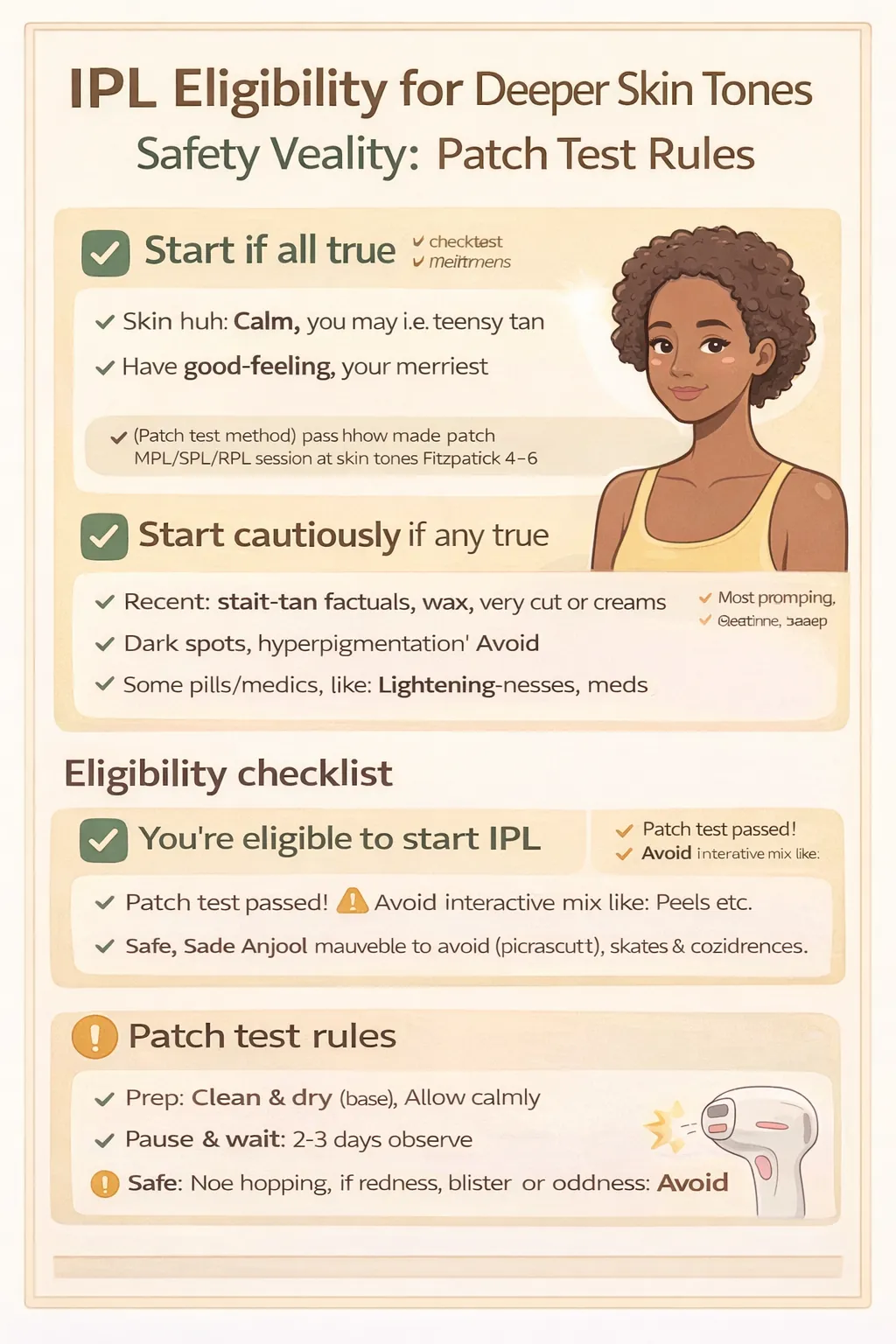
Image: IPL Eligibility for Deeper Skin Tones – Safety Reality, Patch Test Rules
✅ You may be eligible to start if all are true
- Your skin is calm (no active irritation, peeling, rash, or sunburn).
- You are not freshly tanned and can avoid sun exposure around sessions.
- You can commit to patch testing and conservative levels (no “jumping levels”).
- You accept routine-based results (gradual changes over weeks), not instant hair removal.
⚠️ Start cautiously if any are true
- You darken easily after shaving bumps, acne marks, or friction.
- You have uneven tone in the area you want to treat (dark patches, recent marks).
- You get redness easily and it tends to linger longer than a day.
🛑 Avoid or pause if any are true
- You are currently tanned (visible tan lines) or had strong sun exposure recently.
- You have a history of blistering/burning from heat or light-based treatments.
- You cannot control the “stop rules” (you tend to keep going even when skin warns you).
The patch test rule (non-negotiable for deeper tones)
If you do one thing right, do this. Patch testing is your safety gate:
- Choose a small area that represents your real treatment zone (not the lightest patch).
- Use a low level for the patch test.
- Wait 24–48 hours and look for: lingering heat, tenderness, swelling, darkening, or unusual sensitivity.
- If the area stays calm, increase only gradually (never “jump to max”).
Spacing and “overlapping” rules that prevent darkening
- One pass only on higher-risk skin tones until you prove tolerance.
- No stacking flashes on the same spot (missed patches can wait for next session).
- Minimal overlap is fine, but “double overlap” plus higher levels is a common burn recipe.
Stop rules (refined): 3 layers
Layer 1 — Immediate stop (stop now)
- Sharp burning that feels different from warmth.
- Skin whitening/gray patches, blistering, or “glassy” look.
- Fast swelling that develops within minutes to an hour.
Layer 2 — Pause & reset (pause until fully calm; restart lower)
- Redness or heat that lasts into the next day (not just a few hours).
- New darkening/uneven tone after a session (even mild).
- Tenderness that makes you avoid touching the area.
Layer 3 — Adjust only (okay to continue with changes)
- Mild redness that fades within hours.
- Slight dryness that improves with bland moisturizer.
- No escalation from session to session.
Realistic note: “eligibility” is also about your routine behavior
With deeper tones, the main danger is not a single flash. It’s the pattern: people keep chasing faster results. IPL rewards consistency, not force. If you know you’ll be tempted to increase level or do extra passes, starting may not be worth the risk.
Related guides (internal)
- Does at-home IPL work for all skin tones?
- How to perform a patch test before IPL
- How long to wait after sun exposure before IPL
- Darkening or uneven tone after IPL
- Can IPL cause burns or skin damage?
Sources & references (third-party, verifiable)
Back to hub: IPL Eligibility (Hub)