
MITHLUX · Official IPL Device Store
Short answer: If you’re eczema-prone, you may be eligible to start IPL only when your skin is calm and intact — never on active flares, broken skin, or inflamed patches. Start lower than you think, patch test carefully, and follow strict “stop rules” if irritation escalates.
The goal: hair reduction without “borrowing damage” from your skin barrier. With eczema, protecting the barrier is the whole game.
Why eczema changes the IPL eligibility decision
Eczema-prone skin isn’t just “sensitive.” It can be reactive because the barrier gets disrupted more easily. That matters for IPL because any irritation (heat, friction, strong skincare, even shaving) can stack up.
This guide focuses on eligibility and safe boundaries. For broader safety basics, keep this hub bookmarked: IPL Hair Removal Safety.
Eligibility outcomes: Start now vs Pause vs Avoid
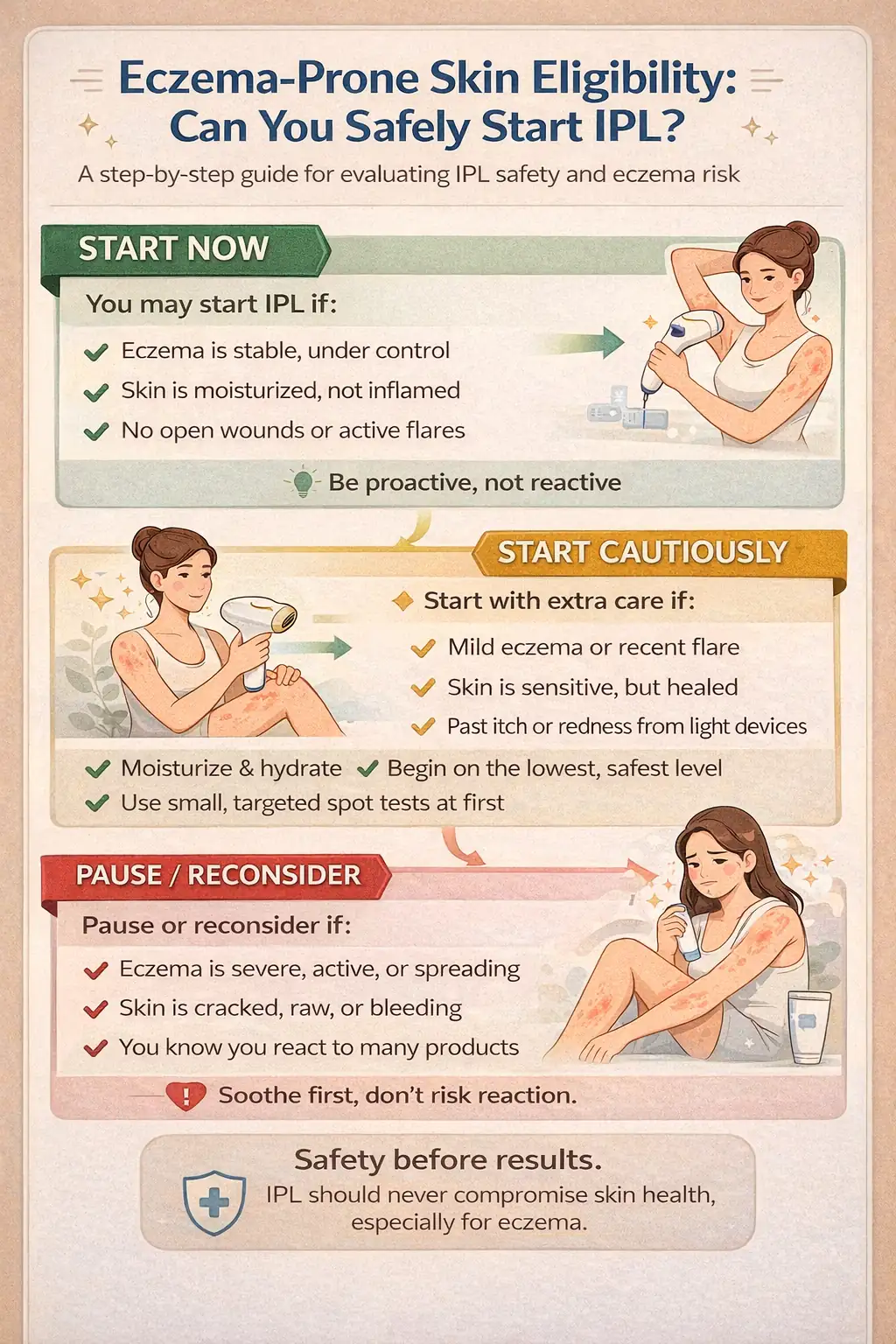
1) Start now (eligible)
- Your skin is calm (no active flare in the area you want to treat).
- Your skin surface is intact (no cracks, weeping, scabs, open scratches).
- You can do a proper patch test and wait to observe.
2) Pause & adjust (not eligible today)
- There is redness, itch, burning, scaling, or new sensitivity in the target area.
- You recently used strong skincare actives and your skin feels “stingy.”
- You’re recovering from friction/irritation (tight clothing rub, aggressive shaving, etc.).
If “stingy skin” is your current state, this decision page helps: If skin feels stingy after IPL, when can you restart?
3) Avoid / get medical guidance first
- Severe or widespread eczema, frequent flares, or history of secondary infection in the area.
- Broken skin, oozing, crusting, or significant inflammation where you want to treat.
- You’re unsure whether a spot is eczema vs another condition (don’t “test” with IPL).
Where you should NEVER flash if you’re eczema-prone
For eczema-prone users, the “no-flash zones” are strict:
- Active eczema patches (red, itchy, inflamed, scaly).
- Broken skin (cracked, bleeding, scabbed, or weeping areas).
- Any area currently irritated from shaving, friction, sun, or strong products.
Simple rule: if you wouldn’t comfortably put a bland moisturizer on it without stinging, don’t IPL it today.
Patch test protocol (eczema-prone edition)
Do not “full send.” Patch testing is your safety brake. Use this guide for the standard steps: How do you perform a patch test before IPL? Then apply these eczema-prone upgrades:
- Choose the calmest area you plan to treat (not a spot that “often flares”).
- Start lower than your ego: use a conservative level for the first test.
- Observe longer: eczema-prone skin can react later. Don’t judge at minute 5 only.
- Track “trend”: if each session makes you more reactive, pause.
Stop rules (clear and non-negotiable)
Stop and pause your routine if you see:
- Redness that escalates session by session, or feels hot and angry.
- New itch + rash-like reaction in the treated area.
- Darkening/uneven tone that appears after treatment.
- Any sign of barrier breakdown (dry cracking, raw feeling).
Use these two pages as your “what now” plan: What should you do if your skin reacts badly to IPL? and Redness after IPL: what’s normal vs when to pause.
Printable boundary guide (eczema-prone eligibility)
This infographic is designed to be shareable: where you can start, where to pause, and the “never flash” zones for eczema-prone skin.
What about skincare products (the hidden eczema trigger)?
Many eczema-prone users aren’t reacting to IPL alone — they’re reacting to the combination of IPL + shaving + actives. If you use retinoids, acids, benzoyl peroxide, or strong vitamin C, read this before you schedule sessions:
- Benzoyl Peroxide and IPL: can you do both safely?
- How long should you wait after retinol before IPL?
- AHA/BHA before IPL: can you do it this week?
Sources & references (third-party, verifiable)
Part of this hub: Back to IPL Eligibility