
MITHLUX · Official IPL Device Store
Short answer: If you have rosacea or easily flushing facial skin, you can be eligible to try at-home IPL on the face only if your skin is currently calm, you start at a low level, and you follow strict pause rules. If you’re flaring, stinging, sunburned, or reacting to skincare actives, it’s safer to pause and reset first.
Rosacea and “redness-prone” skin isn’t automatically a “never.” But it does change how you should decide: the face has thinner skin, more frequent triggers, and less tolerance for “pushing through.” This page helps you make a clean decision: start now, start cautiously, or pause.
Step 1: Confirm what “redness-prone” means for you
People use “sensitive” to describe very different things. Before you start, place yourself in the most accurate bucket:
- Mostly flushing: you turn red with heat, alcohol, spicy food, stress, or exercise, then calm down later.
- Stinging/burning baseline: your skin feels “hot,” tight, or prickly even without a clear trigger.
- Visible broken capillaries/telangiectasia: persistent redness with fine visible vessels.
- Inflammatory bumps: papules/pustules during flare-ups (often mistaken for acne).
If you’re in the “stinging/burning baseline” or “active flare with bumps” category, eligibility usually shifts toward pause until calm.
Step 2: Eligibility decision — start, start cautiously, or pause
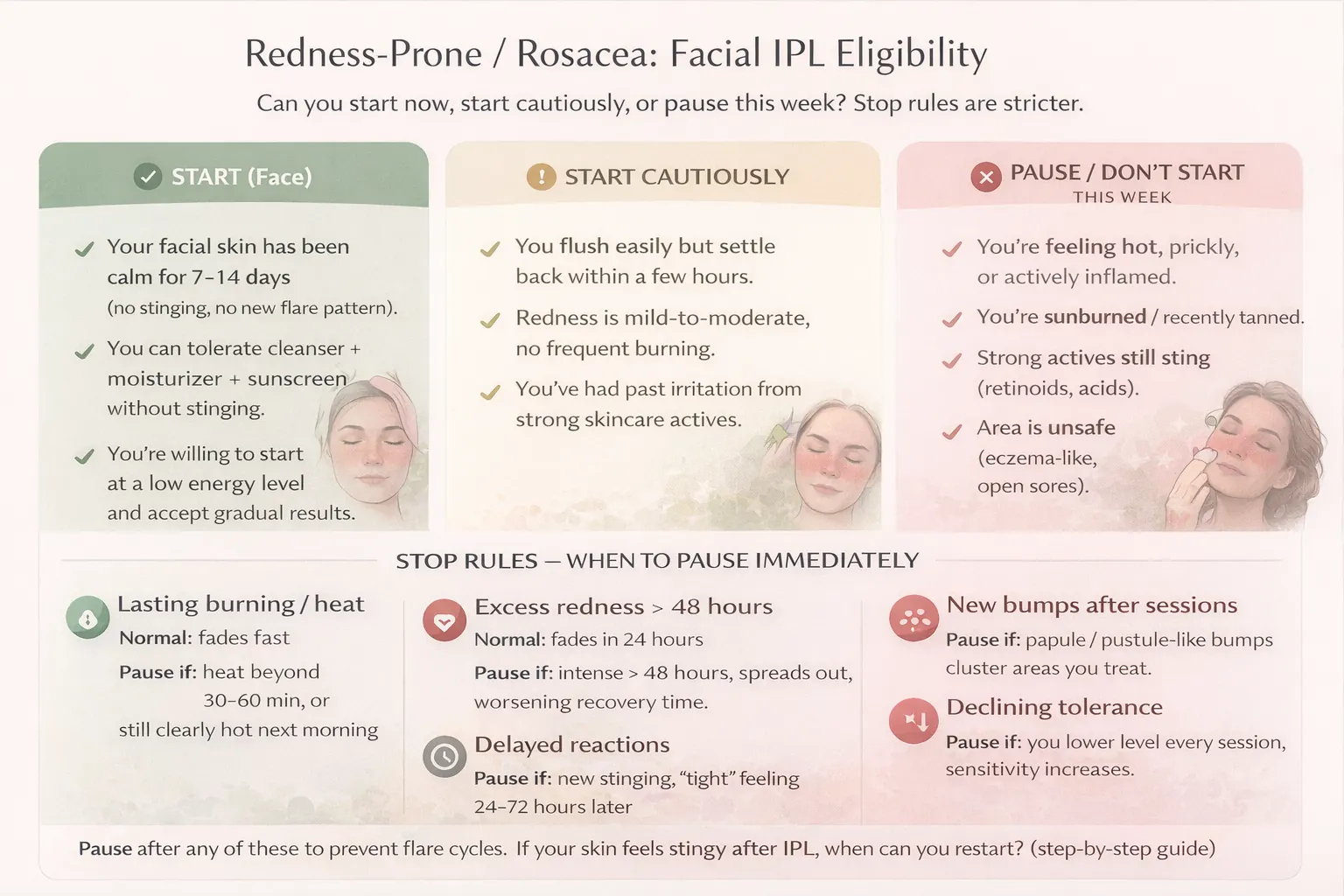
✅ You may be eligible to start (face) if
- Your facial skin has been calm for at least 7–14 days (no stinging, no new flare pattern).
- You can tolerate a simple routine (gentle cleanser + moisturizer + sunscreen) without burning.
- You’re willing to start at a low energy level and accept gradual results over weeks.
- You can avoid common triggers around treatment days (hot showers, saunas, heavy exercise, spicy food, alcohol).
⚠️ Start cautiously if
- You flush easily but settle back within a few hours.
- Your redness is mild-to-moderate, but you don’t have frequent burning.
- You’ve had irritation from skincare actives in the past (even if currently calm).
“Start cautiously” means: smaller test area, lower level, longer spacing, and stricter stop rules.
⛔ Pause / don’t start this week if
- You are currently flaring (hot, prickly, burning, or visibly inflamed).
- You’re sunburned, recently tanned, or your barrier feels compromised.
- You recently introduced or increased strong skincare actives (retinoids, acids, benzoyl peroxide) and feel stingy.
- You have open sores, eczema-like patches on the face, or any area that would be unsafe to treat.
Why facial IPL can “feel worse” for rosacea-prone skin
Redness-prone skin often has a stronger flushing + heat response. Even when IPL is used correctly, some people interpret normal warmth as “too much,” then over-correct (treat too often, chase intensity, or combine with irritating skincare). That creates a flare cycle.
The safer goal is to keep IPL inside a “calm window” so you can stay consistent. Consistency beats force.
A conservative start plan (the safest way to test eligibility)
- Patch test first on a small facial edge zone (not your central cheeks). Use the lowest comfortable level.
- Wait 24–48 hours and watch for delayed reactions (burning, swelling, persistent redness, new bumps).
- Start with a small routine (one facial zone per session). Avoid “full-face” on day 1.
- Keep spacing conservative (weekly is typical; if you react, extend spacing).
Use this step-by-step patch test guide: How do you perform a patch test before IPL?
Stop rules — clear thresholds for redness-prone / rosacea-leaning facial skin
These rules are designed to prevent flare cycles. If any one of the following happens, pause IPL and reset before the next session.
⛔ Pause immediately if you notice any of these
1) Heat or burning that does not settle
- Normal: mild warmth during flashes that fades within minutes.
- Pause if:
- Burning, prickling, or “hot skin” sensation lasts longer than 30–60 minutes, or
- Heat sensation is still clearly present the next morning.
Prolonged heat can signal over-reaction rather than a tolerable routine.
2) Redness that exceeds the normal recovery window
- Normal: light-to-moderate redness that fades within 24 hours.
- Pause if:
- Redness remains intense after 48 hours, or
- Redness spreads beyond the treated area, or
- Each session leaves you red for longer than the previous one.
Worsening recovery time is an early warning that your skin is not tolerating the current setup.
3) Delayed reactions (often missed)
- Pause if:
- New stinging, tightness, or sensitivity appears 24–72 hours later, or
- You feel fine on treatment day but feel irritated days after.
Delayed irritation is common in redness-prone skin and should not be ignored.
4) New inflammatory bumps after sessions
- Pause if:
- Papules or pustule-like bumps appear repeatedly after treatment, or
- Bumps cluster in the same areas you treat with IPL.
This is not “purging.” Repetition usually means your skin is not tolerating the routine.
5) Declining tolerance over time
- Pause if:
- You need to lower levels every session just to stay comfortable, or
- Sensitivity increases even though technique and spacing stay the same.
Tolerance should stabilize or improve over time — not deteriorate.
⚠️ Soft pause (adjust, don’t quit) if you see these early signs
These don’t always require stopping completely, but they do require adjustment:
- Redness resolves within 24 hours but feels more noticeable than before.
- Skin feels “tight” or slightly reactive to products that were previously fine.
- Mild flushing is triggered more easily in the days after IPL.
What to do: lower the level, increase spacing, treat smaller zones, and simplify skincare for one full cycle.
When it’s safe to restart after a pause
You may consider restarting only when all of the following are true:
- Skin feels neutral at baseline (no burning, no stinging at rest).
- Redness has returned to your usual pre-IPL level.
- You can tolerate gentle cleanser + moisturizer + sunscreen without irritation.
- You restart at a lower level or reduced area — not where you left off.
Use this restart guide: If skin feels stingy after IPL, when can you restart?
What to avoid on the face (high-sensitivity zones)
Even if you’re eligible overall, you may not be eligible for every facial zone. Many people do better avoiding:
- Areas that are actively inflamed or sting at baseline.
- Any broken skin.
- Zones you can’t treat consistently without going back over the same spots.
For a simple boundary guide, see: Can IPL be used on the face or sensitive areas?
Sources & references (third-party, verifiable)
Part of this hub: Back to IPL Eligibility