
MITHLUX · Official IPL Device Store
Short answer: If you have tattoos or permanent makeup (PMU), you can still be eligible for at-home IPL — but only if you treat tattoos/PMU as strict “no-go zones.” Do not flash directly on ink. Keep a clear buffer, protect the pigment areas, and follow stop rules if you see unusual heat, whitening, blistering, or sharp pain.
Part of this hub: Back to IPL Eligibility (Start / Pause / Don’t Start)
Why tattoos and PMU change your IPL eligibility
IPL (and laser) devices work by sending light energy that is preferentially absorbed by pigment. In normal hair reduction, the “target pigment” is mostly the hair shaft/follicle. But tattoos and PMU are literally pigment embedded in skin, which can absorb energy and create unpredictable heating.
That’s why the safety approach is simple: don’t treat pigment. Your eligibility isn’t “yes or no” — it’s “yes, with boundaries.”
The simple rule: treat ink as “skin you don’t flash”
- Never flash directly over tattoos. If hair grows inside a tattoo, IPL is not the right tool for that exact patch.
- Never flash directly over PMU (microbladed brows, eyeliner, lip blush, scalp SMP). Treat it as a tattoo zone.
- Don’t try to “lower the level and test.” With ink, the problem is the pigment, not just the level.
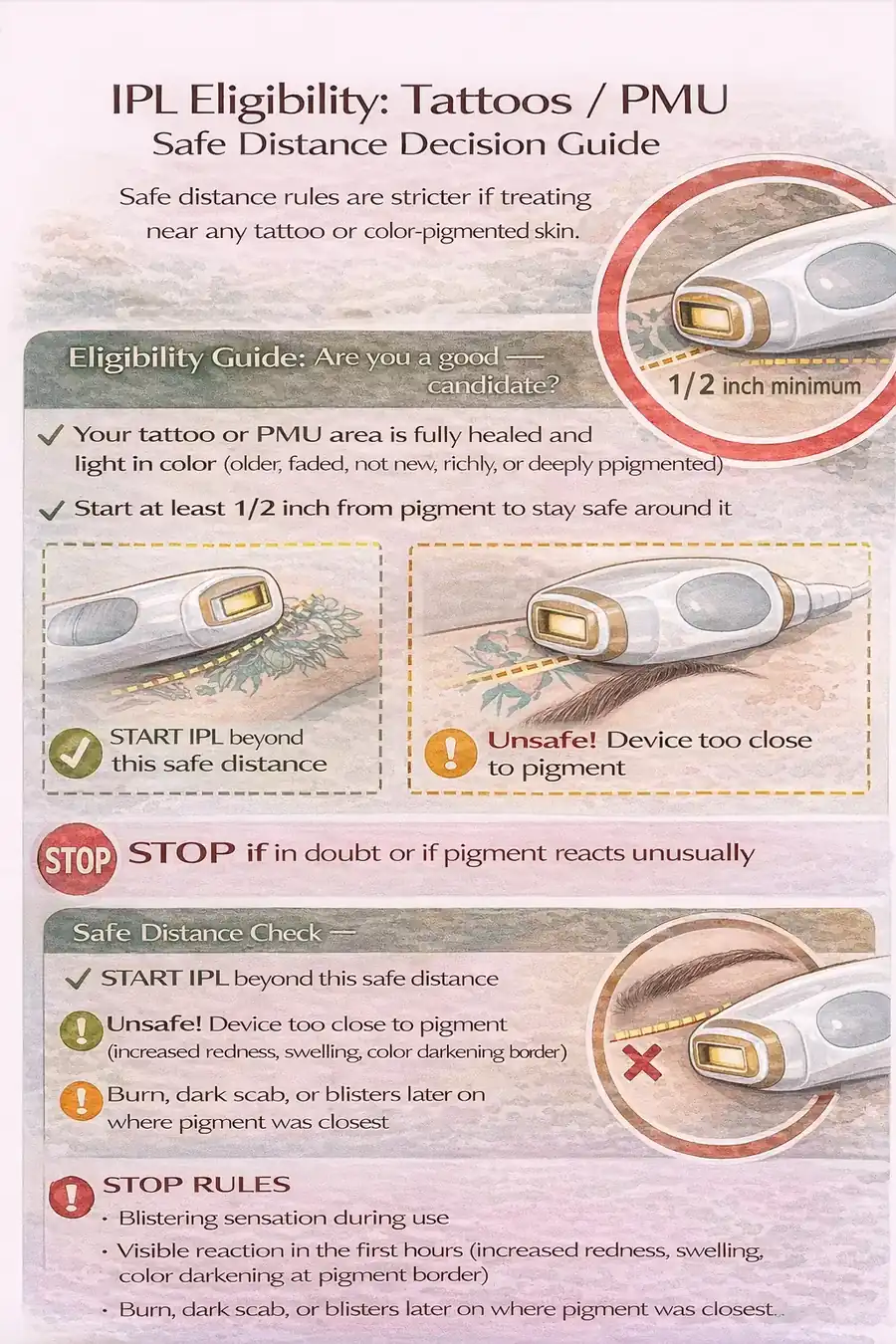
How far away should you stay from tattoos / PMU?
Because home IPL devices have different window sizes and light spread, the safest rule is a practical buffer you can apply at home:
- Minimum buffer: stay at least 1 cm away from any tattoo/PMU edge.
- Preferred buffer (recommended): stay 2 cm away, especially for dense black ink, shaded areas, or older tattoos with blurred edges.
- If the tattoo edge is fuzzy or gradient: treat the whole “fade zone” as tattoo and extend the buffer.
Easy home method: use a white cosmetic pencil (or a removable eyeliner pencil) to outline a “no-go border” around the tattoo. Then shave around it and only treat clean skin outside the border.
Special cases: PMU is often near high-risk areas
- Eyebrows / eyeliner PMU: these are close to the eye. At-home IPL near the eye is not worth the risk. Avoid the entire eye socket region.
- Lip blush PMU: upper lip skin is thin and more reactive. If you have lip blush, keep a generous buffer and do not treat the pigmented area.
- Scalp SMP: pigment + thin skin + curvature makes this a “don’t DIY” combination. Avoid.
Eligibility decision guide: “Start / Pause / Don’t treat”
You can start IPL now if:
- All treatment zones are on clean, non-inked skin with a clear buffer from tattoos/PMU.
- You can comfortably avoid the ink zone every session (no “I might accidentally flash it”).
- Your skin is currently calm (no active irritation, sunburn, or peeling around the area).
Pause and re-check if:
- The tattoo area is healing, recently touched up, scabbed, inflamed, or itchy.
- You can’t create a consistent boundary because the tattoo covers most of the area.
- You recently had laser tattoo removal on that area (skin needs time to normalize).
Don’t treat that area with IPL if:
- Hair grows inside the tattoo/PMU and you cannot avoid flashing over pigment.
- The ink is near the eye region (eyeliner/very close brow PMU) or other high-risk zones.
Stop rules (extra refined): when to stop immediately
When pigment is involved, stop rules are stricter. Use this three-level system:
Level 1 — Stop today (cool down, reassess)
- Unusual heat “under the skin” that feels different from normal warmth
- Sharp, pinpoint pain at the tattoo edge (not just a brief snap)
- White/grey “frosting” look, or sudden darkening directly on/near pigment
Level 2 — Stop and do not resume until fully normal (days to weeks)
- Blistering, scabbing, weeping, or a burn-like patch
- Persistent redness/swelling beyond 24–48 hours
- New rough texture or tenderness that doesn’t settle quickly
Level 3 — Seek medical advice (don’t DIY)
- Expanding blistering, strong pain, signs of infection (oozing, worsening redness, fever)
- Eye-region discomfort, light sensitivity, or vision-related symptoms after facial attempts
What to do instead for hair inside tattoos / PMU zones
- Shaving (most practical, least risk to ink)
- Trimming for ultra-sensitive areas
- Electrolysis (often the “precision” option for small ink-adjacent patches)
Sources & references (third-party, verifiable)
Back to the hub: IPL Eligibility — Should you start IPL now?