
MITHLUX · Official IPL Device Store
IPL for Legs: Safety, Spacing & Results
A practical, routine-based guide for full legs—how to stay safe, keep spacing even, and set realistic expectations.
New to IPL? Start with IPL Basics and confirm suitability with the Skin Tone & Hair Color Guide (or the IPL Suitability Checker).
Short answer (and the safest baseline)
Short answer: Leg IPL can be safe at home when your skin/hair are suitable, you start low, keep spacing even (no “double-hitting”), and follow a consistent weekly schedule—then adjust based on how your skin reacts.
This page is for general education and is not medical advice.
Quick rules
- Patch test first: How to patch test before IPL.
- Confirm suitability: Skin tone & hair color guide (or Suitability Checker).
- Use a routine: IPL Hair Removal Schedule.
- Set your starting level carefully: Starting level guide.
Stop rules (don’t push through)
If discomfort feels unusually high, or irritation keeps worsening, stop and reassess before your next session. Use: What to do if your skin reacts badly.
1) Suitability first
Legs are a large area—suitability matters. Confirm your skin/hair match before increasing intensity. Use the Skin & hair guide or Suitability Checker.
2) Spacing beats “extra flashes”
Patchiness on legs is usually coverage-related. Keep flashes evenly spaced and avoid repeatedly flashing the same spot. Track progress over weeks, not one session.
3) Results are gradual
Legs often look “slower” than small areas early on. Watch for slower regrowth and lower density over several weeks, while keeping your schedule steady.
Realistic note: IPL is routine-based. It’s not instant and not one-time. The fastest path is a consistent weekly schedule + controlled spacing + safe, gradual level adjustments.
Leg IPL safety boundaries (knees, ankles, and pigmented spots)
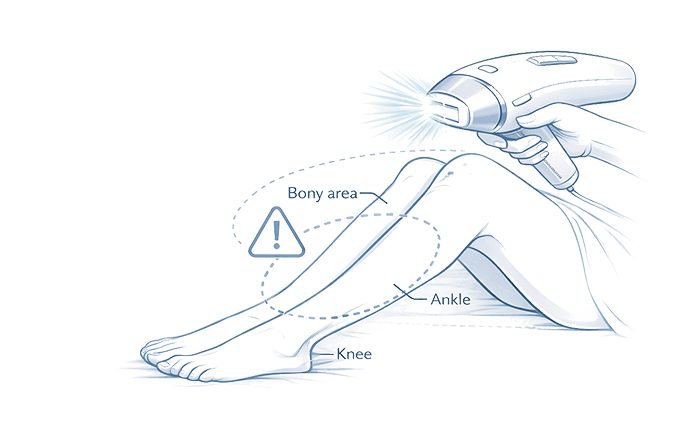
Knees and ankles are bony, curved areas where accidental overlap is common. Stay conservative, slow down, and avoid “chasing corners.” If your legs have freckles, moles, or tattoos, treat around higher-pigment spots and don’t repeatedly flash the same tiny patch.
Spacing & coverage (how to avoid missed patches)
Uneven results on legs are usually coverage-related—especially on calves. Use a repeatable pattern (zones + straight passes), keep spacing even, and avoid double-hitting.
Time cost, split strategy, and consistency
Full legs can take time. Choose a plan you can repeat weekly, even if you split thighs and calves across days. Consistency matters more than rushing one big session.
Summer & sun exposure adjustments
Legs are often sun-exposed. If your skin tone is changing (tanning/sun), it’s usually safer to pause or reduce rather than push intensity. Re-check suitability and restart gradually if you’ve taken a break.
Shop IPL Devices
Realistic note: IPL works best with consistent weekly use over several weeks.
FAQ
How far apart should leg flashes be?
Aim for even coverage with minimal gaps and avoid repeatedly flashing the exact same spot. On bony/curved areas, slow down and keep your pattern controlled.
What if I get missed patches on calves or thighs?
Don’t “catch up” by repeatedly flashing the same spot. Keep your normal schedule, and improve coverage next session using a zone-based pattern.
Can I shave between sessions?
Yes—shaving is commonly used between sessions, especially during the starter phase. Keep skin calm and avoid treating irritated areas.
What timeline should I expect?
Results are gradual. Watch for slower regrowth first, then patchy reduction, then lower overall density—if your routine is consistent.
Sources & references (third-party, verifiable)
References are provided for general education. Always follow your device instructions and stop if your skin reacts unusually.
Related guides
Longer reads that expand on safety, suitability, and routines.
Popular iAsk questions
Quick answers people often search for before starting.
- How long does a full leg IPL session take?
- How far apart should leg flashes be?
- Should you treat thighs and calves on the same day?
- What to do about missed patches on legs?
- Is IPL safe on knees/ankles? Where to stop?
- Why do legs respond slower/faster than underarms?
- Leg IPL results timeline: Week 1–12 + maintenance
- How to adjust leg IPL around sun exposure / summer
- How often should you use IPL on legs? Starter vs maintenance
- Can you shave between leg IPL sessions? What’s okay vs not
- Should you lower the IPL level for knees/ankles vs thighs?
- Can you use IPL on legs with freckles, moles, or tattoos? Where to avoid