
MITHLUX · Official IPL Device Store
Quick answer: You should not flash directly over metal jewelry or immediately against the area where a piercing sits. In practice, “too close” means any spot where the flash window could overlap the jewelry, touch the metal, or make you guess. Remove jewelry first when possible, leave a clear margin around the piercing site, and patch test before treating nearby skin.
Why piercings need extra caution with IPL
IPL works by delivering light energy into the skin surface through a flat treatment window. A piercing changes that simple setup. Metal jewelry, tiny posts, raised edges, and curved skin around the opening can all make treatment less predictable.
The problem is usually not the piercing “existing” by itself. The problem is treating too close to the jewelry or to a spot where the skin is harder to read clearly and harder to keep fully flat. If you are already working through a more delicate routine, guides like Can you use IPL at home on sensitive areas? and Can IPL be used on the face or sensitive areas? help frame the same decision more conservatively.
- The flash window may not sit evenly against the skin.
- You may accidentally overlap part of the jewelry.
- The area may be more sensitive than nearby skin.
- It becomes easier to treat inconsistently from one side to the other.
What counts as “too close” in real life?
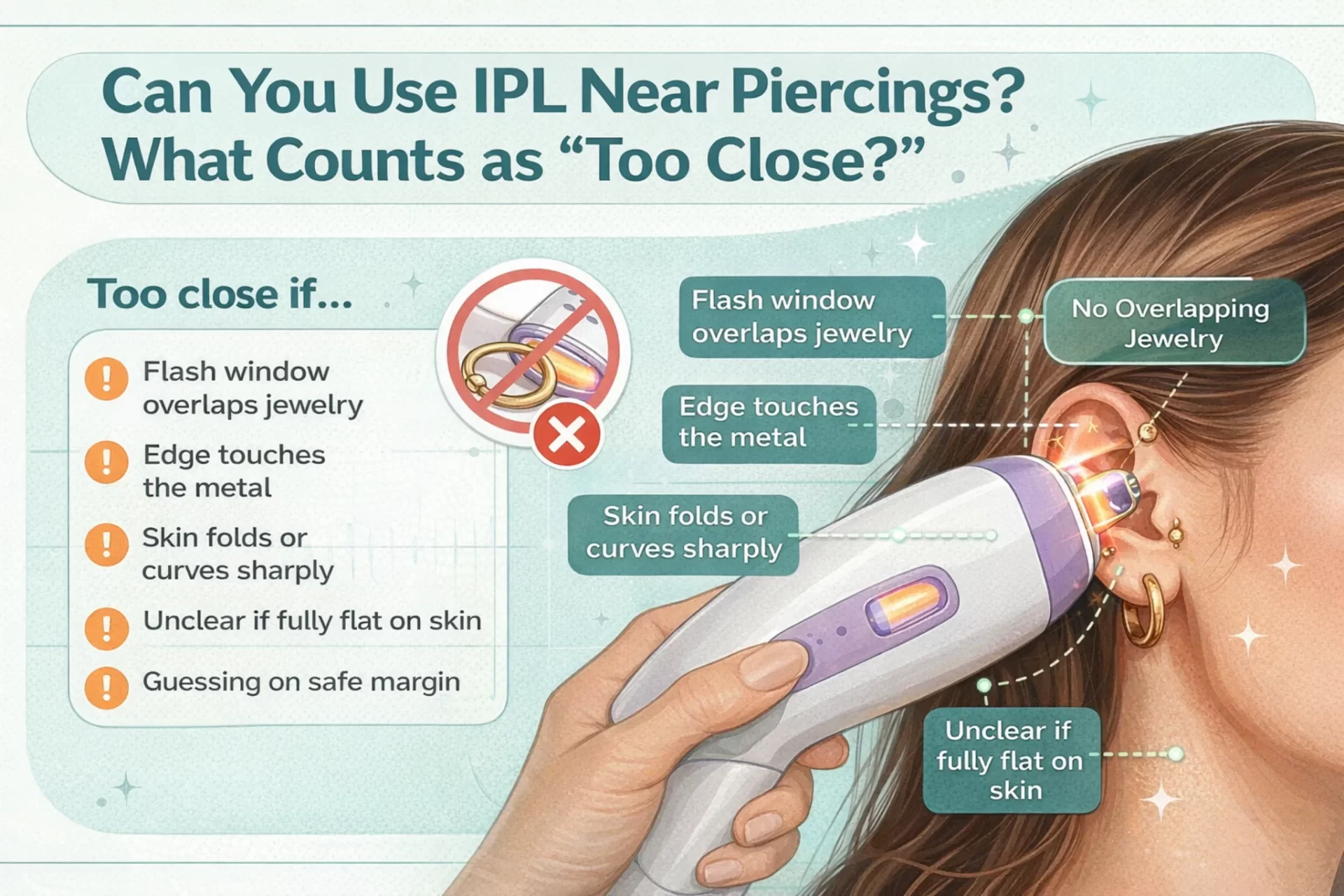
“Too close” is less about an exact number and more about whether the treatment window can stay fully on clear, flat, jewelry-free skin.
A spot is too close if:
- the flash window would partially cover the jewelry,
- the treatment edge would touch the metal,
- the skin folds or curves sharply around the piercing,
- you cannot place the window flat without hesitation,
- you are guessing where the safe edge is.
A good rule is simple: if you have to “sneak” the window into the area, it is already too close. That same logic also applies when treating around moles, freckles, or tattoos, which is why articles like Can you use IPL on legs with freckles, moles, or tattoos? are useful comparison reads.
Should you remove the jewelry first?
Yes, when removal is practical and safe for that piercing, taking the jewelry out makes the area much easier to assess. It lets you see the actual skin, flatten the treatment area better, and avoid accidental overlap with metal.
Even after removal, do not rush to flash directly over the piercing opening itself. You still want calm skin, good contact, and a small buffer around the site rather than treating right up to the hole.
If the piercing is new, irritated, healing, crusted, or easily aggravated, that area is not a good candidate for “testing your luck.” Skip it and return only when the skin is fully settled. If you are unsure whether your skin is calm enough to resume, What skin reactions are normal after using IPL? and What should you do if your skin reacts badly to IPL? are the better next reads.
Areas where extra caution matters most
Some piercing zones are simply trickier than others because the skin is smaller, more curved, or more reactive.
- Upper lip or facial piercings: small treatment area, often more sensitive, and harder to keep perfectly flat.
- Bikini-area piercings: friction, sensitivity, and uneven skin contour make caution more important.
- Underarm piercings: curves, movement, and pressure changes can make positioning inconsistent.
- Body piercings near narrow edges: if the window cannot sit fully flat, stop short.
These are also the kinds of zones where level choice matters more than pride. If the area feels sharper or more reactive than larger flat areas like legs, a more cautious approach is usually better than trying to “match” the same intensity everywhere.
How to treat skin near a piercing more safely
- Remove jewelry first if appropriate for that area.
- Clean and dry the skin so the piercing site is easy to see.
- Choose a conservative level if the area is more sensitive than nearby skin.
- Keep the entire flash window on flat, visible skin only.
- Do not chase hair right up to the piercing edge in the first session.
- Patch test nearby skin before making the full area part of your routine.
This is one of those situations where a tiny untreated border is smarter than trying to make every millimeter “perfect.” If your routine already includes multiple sensitive or uneven zones, What mistakes should you avoid with at-home IPL? and How do you perform a patch test before IPL? are worth revisiting before you add one more difficult area.
What if hair grows right next to the piercing?
That is where people often get too aggressive. If hair sits right beside the piercing opening, it may be better to leave a narrow untreated margin instead of forcing the window into an awkward position.
IPL is routine-based. Missing a tiny ring around a piercing is usually much less important than creating a badly placed flash or irritating the area. Clean spacing beats overconfidence.
How to patch test near a piercing
Patch test on nearby skin that is close enough to represent the area, but not directly on the piercing site itself. Watch for how the skin feels over the next 24–48 hours before expanding treatment.
- Start with a small test spot on flat adjacent skin.
- Do not test over the jewelry or opening.
- Check for unusual lingering sensitivity, swelling, or irritation.
- If the area does not stay calm, keep a wider margin next time or skip the zone.
If you are someone whose skin tone or treatment area already varies from one spot to another, you may also want to read Does skin tone affect IPL safety? and Does at-home IPL work for all skin tones? before treating uneven zones near jewelry.
What do authority sources suggest in principle?
Authority medical sources on light-based hair removal consistently support the same broad safety mindset: avoid unnecessary risk, treat only when the skin and setup are suitable, and stay conservative in harder-to-read areas. The American Academy of Dermatology notes that laser hair removal can cause burns, scarring, or skin color changes when treatment is not handled carefully, which supports being more cautious around metal jewelry and irregular skin surfaces. Mayo Clinic also emphasizes that hair-removal treatment is typically done in repeated sessions rather than through one “perfect” aggressive treatment, which fits the idea of leaving a small untreated buffer if needed rather than forcing the edge. For general safety framing, see: AAD — Laser hair removal FAQs, AAD — Laser hair removal preparation, and Mayo Clinic — Laser hair removal.
When should you skip the area completely?
Pause and leave the area alone if:
- the piercing is new or still healing,
- the skin is red, sore, raised, or irritated,
- you cannot remove the jewelry and still place the window safely,
- the area is too curved or too small for confident placement,
- you already had a bad reaction there before.
With IPL, “not treating today” is often the better decision than forcing a difficult spot into your routine.
Final takeaway
You can sometimes treat near a piercing, but not carelessly and never over jewelry. “Too close” means the moment your treatment window would overlap metal, lose full skin contact, or make you guess. Remove jewelry when possible, keep a clear buffer, patch test first, and stay conservative around small or sensitive areas.
Explore the IPL Hair Removal hub for more practical guides on safe at-home treatment routines.