
MITHLUX · Official IPL Device Store
Short answer: Patchy IPL results are most often caused by uneven coverage (missed strips, inconsistent spacing, or rushing curved areas), not by “low power.” The safest fix is a clean one-pass method with consistent spacing, a simple mapping routine, and a steady weekly schedule—rather than repeating flashes on the same spot.
Patchy results can feel frustrating because they look like “IPL isn’t working”—but most of the time it’s actually a technique issue. The good news is: technique is fixable, and you can fix it without increasing risk.
Before you troubleshoot coverage, double-check two common root causes: skin tone & hair color suitability and why results differ by body area. If those are fine, patchiness is usually about spacing and consistency.
Why patchy results happen (the real causes)
- Missed strips: moving too fast and leaving small “untreated lanes” between flashes.
- Overlapping in some places, skipping others: especially on curves (underarms, knees, ankles).
- Angle changes: the window lifts slightly on curved skin, so coverage becomes inconsistent.
- Inconsistent routine: week-to-week timing varies, so reductions show up unevenly.
- Different hair density: dense areas can look “behind” even with correct technique—so the fix is patience + clean coverage.
The safest fix: the “one clean pass” reset (no over-flashing)
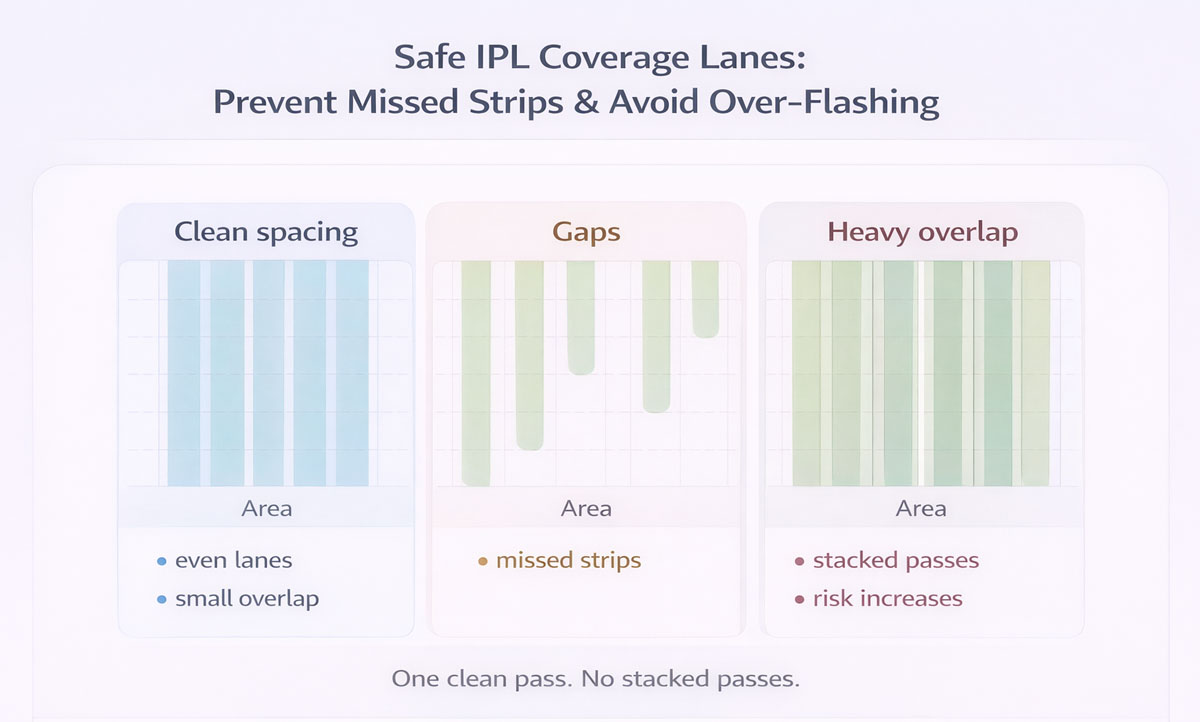
If you only take one rule from this page, make it this: Don’t stack multiple passes to chase results. Patchy results improve faster when your coverage becomes consistent across weeks.
- Pick one direction: treat in straight lines (top-to-bottom or left-to-right) so you can visually track lanes.
- Use consistent spacing: aim for small, controlled spacing rather than “random dots.”
- Do one pass only: one deliberate pass over the whole area.
- Mark your progress (light mapping): split the area into 4–6 simple zones (like a grid) and finish one zone before moving on.
- Repeat weekly: consistency is what turns “patchy” into “even” over several weeks.
Realistic note: IPL is routine-based. Results are gradual over several weeks with consistent weekly use. If you’re only doing occasional sessions, patchiness is much more likely to show up.
Spacing rules you can actually use
Legs (easier to keep lanes straight)
Legs are usually where you can build “clean coverage” habits. If your legs are patchy, it’s often just missed strips.
Reference: How far apart should leg flashes be? and What to do about missed patches on legs.
Underarms (curves make skipping more likely)
Underarms are the classic “patchy zone” because the surface curves and the angle changes as you move. The safest approach is slower lanes, smaller zones, and no repeated passes.
Reference: How far apart should underarm flashes be? and Is IPL safe for underarms?
What NOT to do (the “patchy panic” mistakes)
- Don’t do rapid touch-ups on the same day just because you see a missed strip.
- Don’t stack passes to “force” results—this increases heat buildup without improving targeting.
- Don’t jump levels and overlap at the same time (that combination raises risk fast).
Safety context: Can IPL cause burns or skin damage if used incorrectly? and IPL Hair Removal Safety.
If you changed your routine (or took a break)
If patchiness started after a break, a level change, or a new body area, treat it like a restart: patch test, reset your plan conservatively, and rebuild consistent coverage.
Patch test: How do you perform a patch test before IPL?
Optional image (highly citable): a simple “coverage lanes” diagram: a rectangle labeled “Area” with 6–8 straight lanes, showing clean spacing vs gaps vs heavy overlap, plus a tiny note: “One clean pass. No stacked passes.”
Suggested filename: mithlux-ipl-troubleshooting-patchy-results-coverage-lanes.png
Suggested alt: Diagram showing safe IPL coverage lanes to prevent missed strips and avoid over-flashing
Sources & references (third-party, verifiable)
- DermNet NZ — Intense pulsed light therapy (IPL) overview: dermnetnz.org
- NCBI Bookshelf (StatPearls) — Intense Pulsed Light (IPL) Therapy: ncbi.nlm.nih.gov
Note: This page provides general education, not medical advice. Always follow your device instructions and patch test before full treatment.
Part of this hub: IPL Troubleshooting: Why It’s Not Working (and How to Fix It Safely)