
MITHLUX · Official IPL Device Store
Short answer: No pain and no redness doesn’t automatically mean IPL isn’t working. The best way to judge progress is week-to-week regrowth changes (slower regrowth, finer hair, more “empty patches”), not how much you feel during a session.
This is one of the most common doubts: “My session felt easy… but I don’t see dramatic changes yet.” The tricky part is that pain is not a progress meter. Many effective sessions feel mild—especially with good cooling, stable technique, and normal skin.
If you want a broader troubleshooting map, start here: IPL Troubleshooting Hub.
Why “no pain” can still be normal
At-home IPL works by targeting hair pigment (melanin) and delivering controlled heat to the follicle over repeated sessions. Your pain level can change day-to-day based on skin hydration, area sensitivity, technique, and the device’s cooling design. So a low-sensation session can still be productive.
A safer mindset is: consistency beats intensity. If you keep a steady routine, progress often becomes clearer in the weeks 4–8 window (not after one “strong” session). For a realistic timeline explanation, see: Why results can be slow (weeks 4–8).
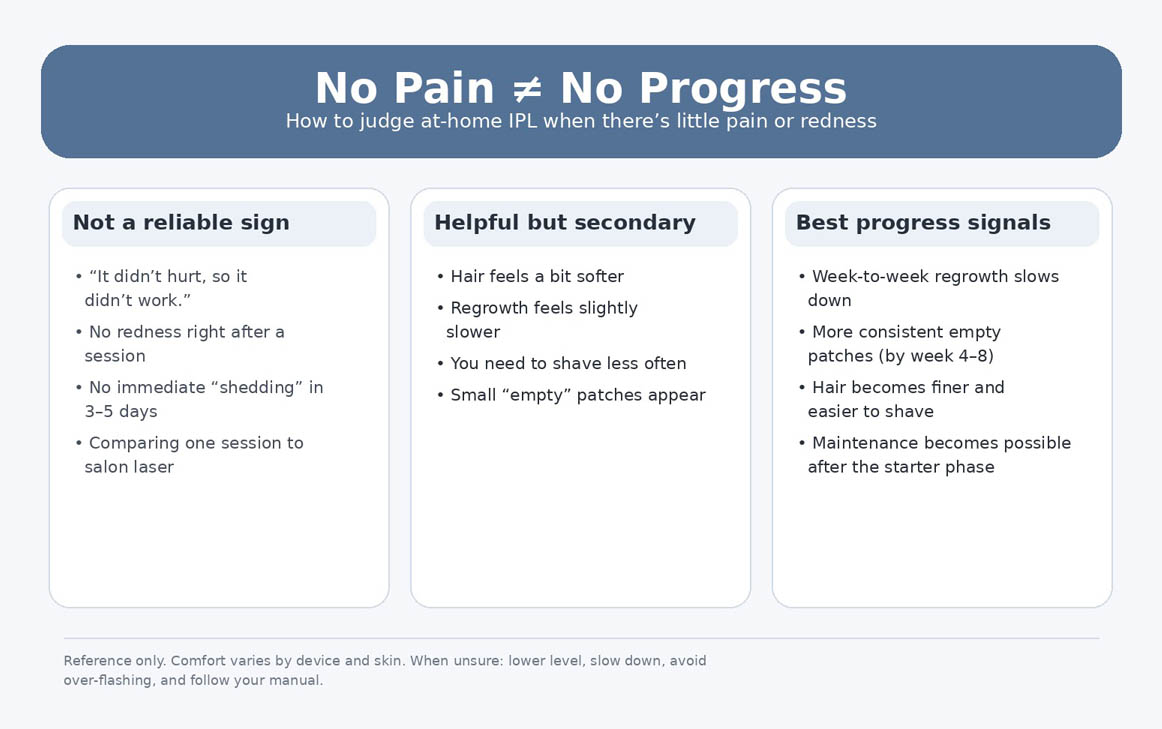
The 5 best signs IPL may be working (even if you feel nothing)
- Regrowth slows down week-to-week: hair returns, but it takes longer to look “noticeable.”
- Hair feels finer or softer: shaving feels easier; stubble can feel less “wire-like.”
- You shave less often: the time between shaves gradually stretches.
- More “empty patches” appear: small areas stay bare longer (common by weeks 4–8).
- Maintenance becomes possible: after the starter phase, you can reduce frequency without instantly “resetting.”
What does not prove it’s not working
- No redness right away: some people rarely flush, especially with good skin prep.
- No “shedding” in a few days: at-home IPL doesn’t always produce obvious shedding like clinic treatments.
- One week looks the same: early weeks are often “setup” weeks, not dramatic-change weeks.
When “no pain + no results” can be a real issue
If you’re at weeks 6–8 with consistent sessions and still see no change at all, the cause is usually one of these:
1) Suitability (skin tone + hair color contrast)
IPL generally needs enough contrast to target the hair pigment effectively. If your hair is very light (blonde/red/grey) or your skin tone is in a higher-risk range, results can be limited and safety rules become stricter. Use this reference guide: Skin tone & hair color suitability (what “not suitable” really means).
2) Coverage issues (missed strips / patchy technique)
Many “no results” cases are actually “not enough consistent coverage.” The fix is not over-flashing— it’s a cleaner coverage method: Patchy results: fix missed spots without over-flashing.
3) Area differences (legs vs underarms vs face)
Some areas respond slower due to sensitivity, curve/angle, and hair patterns. Compare safely here: Why some areas respond differently.
A safe adjustment plan (without chasing power)
- Keep weekly consistency through the starter phase—don’t “randomize” frequency.
- Confirm clean prep: shave, clean and dry skin, no fragranced products on the area.
- Improve coverage: one clean pass, consistent spacing; don’t stack flashes on one spot.
- Adjust level cautiously: increase only if your skin is calm and technique is stable. Use this decision guide: Can I increase the level for better results?
- If skin reacts, pause: redness or tenderness means you should recover first (comfort first, routine second).
Sources & references (third-party, verifiable)
- DermNet NZ — Intense pulsed light (IPL) overview: dermnetnz.org
- NCBI Bookshelf (StatPearls) — Intense Pulsed Light (IPL) Therapy: ncbi.nlm.nih.gov
Note: Education only. Follow your device manual and stop if you develop severe pain, blistering, or persistent swelling.
Part of this hub: IPL Troubleshooting Hub