
MITHLUX · Official IPL Device Store
Short answer: Single flash is usually easier to control and less likely to create gaps. Glide (continuous) mode can work well on large flat areas, but missed spots happen when your pace is uneven or contact breaks for a moment. Choose the mode that keeps your coverage steady—not the one that feels faster.
Patchy results are frustrating because they feel random. Most of the time, they’re not random—they’re a coverage pattern. This page helps you choose between glide and single flash like a calm technician, not like someone rushing a chore.
Why glide mode creates missed spots for some people
- Pace drift: you speed up on “easy” sections and slow down on curves, creating uneven spacing.
- Contact breaks: even a tiny lift on knees/ankles/underarms can interrupt coverage.
- Route chaos: you move in zigzags instead of rows, so strips don’t connect.
When glide mode can be a good choice
Glide mode is most forgiving on large, flatter zones where you can keep consistent contact and pace (like broad areas of the legs). If you get patchiness, treat glide as “advanced mode”: it’s great when your technique is stable.
When single flash is the smarter default
- Curves and tight areas: underarms, knees, ankles, bikini line.
- If you’re prone to irritation: controlled placement helps avoid accidental overlap.
- If you’re new: it teaches spacing discipline faster.
A simple coverage method that works with either mode
The key is not the mode—it’s the map. Use a “mowing the lawn” method: start at one edge, move in straight rows, then come back in the next row with a small overlap. If you need a spacing reference, use: How far apart should leg flashes be? and How far apart should underarm flashes be?.
How to self-check (quick diagnostic)
If you get missed spots, ask:
① Was I moving in rows, or jumping around?
② Did I keep full contact the whole time?
③ Did I accidentally overlap one strip but leave a gap in another?
If any answer is “not sure,” switch to single flash for 2–3 sessions and rebuild consistency.
If you’re tempted to “fix patchiness” by doing two passes
Patchiness is usually a coverage problem. A second pass often becomes a heat-stacking problem. If this is your situation, read: One pass or two passes? and also IPL patchy results.
Glide vs single flash (coverage map)
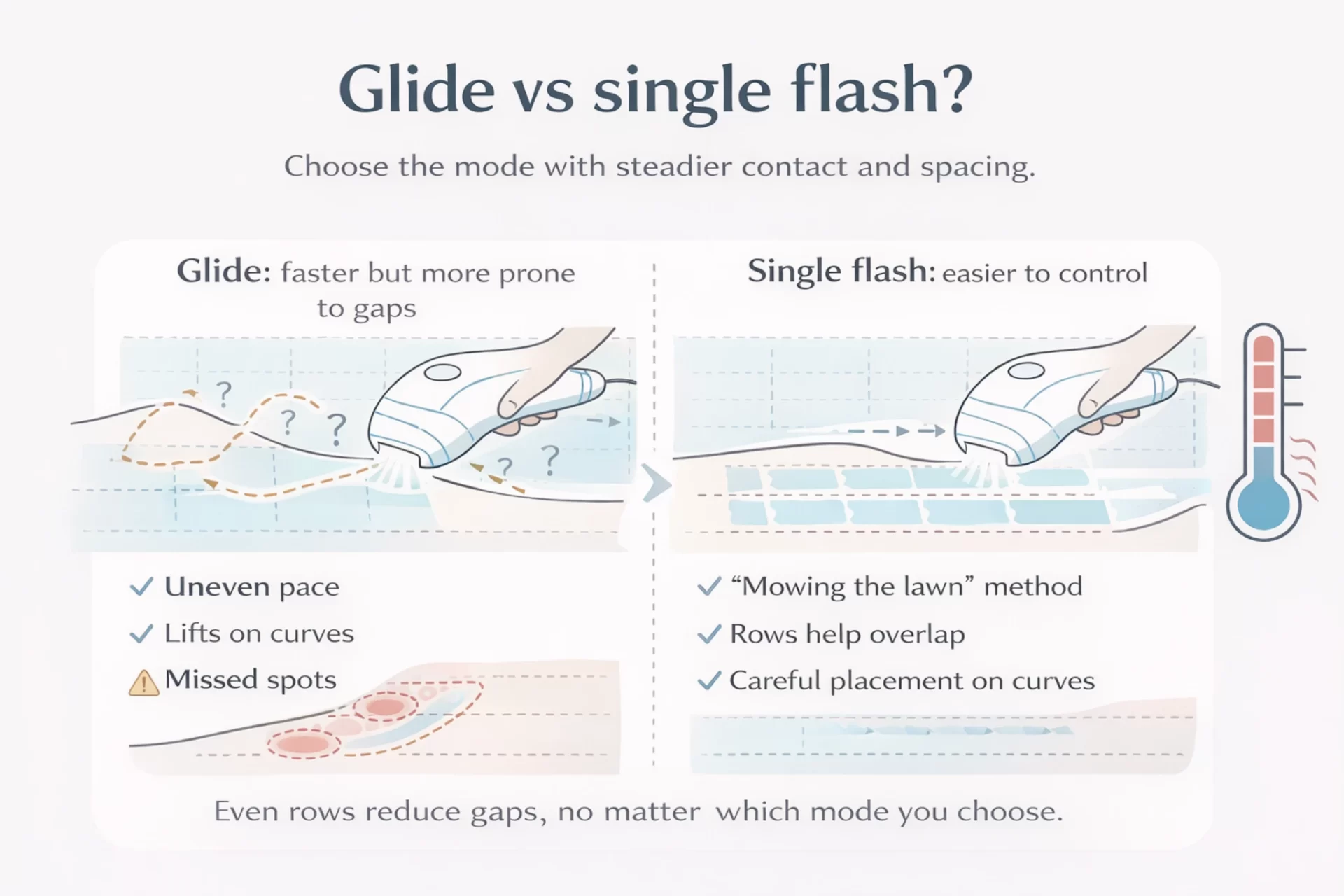
Choose the mode that keeps contact and spacing consistent on your body area.
Sources & references (third-party, verifiable)
- American Academy of Dermatology (AAD) — hair removal and skin irritation guidance
- U.S. FDA — Medical Devices — consumer safety info for devices
- Cleveland Clinic — patient education on skin sensitivity and recovery
Part of this hub: Back to IPL Troubleshooting