
MITHLUX · Official IPL Device Store
Short answer: Treating very large areas in one long IPL session often reduces precision, increases skin stress, and makes missed spots more likely. Shorter, focused sessions usually lead to steadier results than trying to “do everything at once.”
Many people assume that covering more skin in one day means faster progress. In reality, long sessions often turn into fatigue sessions — hands get tired, spacing drifts, contact becomes uneven, and irritation risk rises.
Why long IPL sessions quietly reduce effectiveness
- Technique drifts: rows turn into zigzags, creating gaps.
- Contact weakens: curved areas lift without you noticing.
- Heat accumulates: skin stress increases, forcing longer breaks later.
- Mental shortcuts: you rush the last half instead of mapping it.
Common signs your sessions are too large
- Patchy regrowth that doesn’t match your first few weeks.
- Skin feels more sensitive toward the end of sessions.
- You start overlapping randomly “just to finish.”
- You dread sessions instead of fitting them calmly into routine.
Why smaller sessions usually work better
IPL works through consistency and precision. Smaller zones allow:
- Even rows and controlled spacing.
- Better contact on curves.
- Lower irritation risk.
- Higher long-term adherence.
A safer way to structure large areas
- Split the body. For example: lower legs one day, thighs another.
- Cap your session. Stop while technique is still clean.
- Keep weekly rhythm. Progress comes from cycles, not marathons.
If your goal is to speed things up, fixing coverage usually helps more than extending sessions: Glide vs single flash · One pass or two passes?
Long session vs focused session
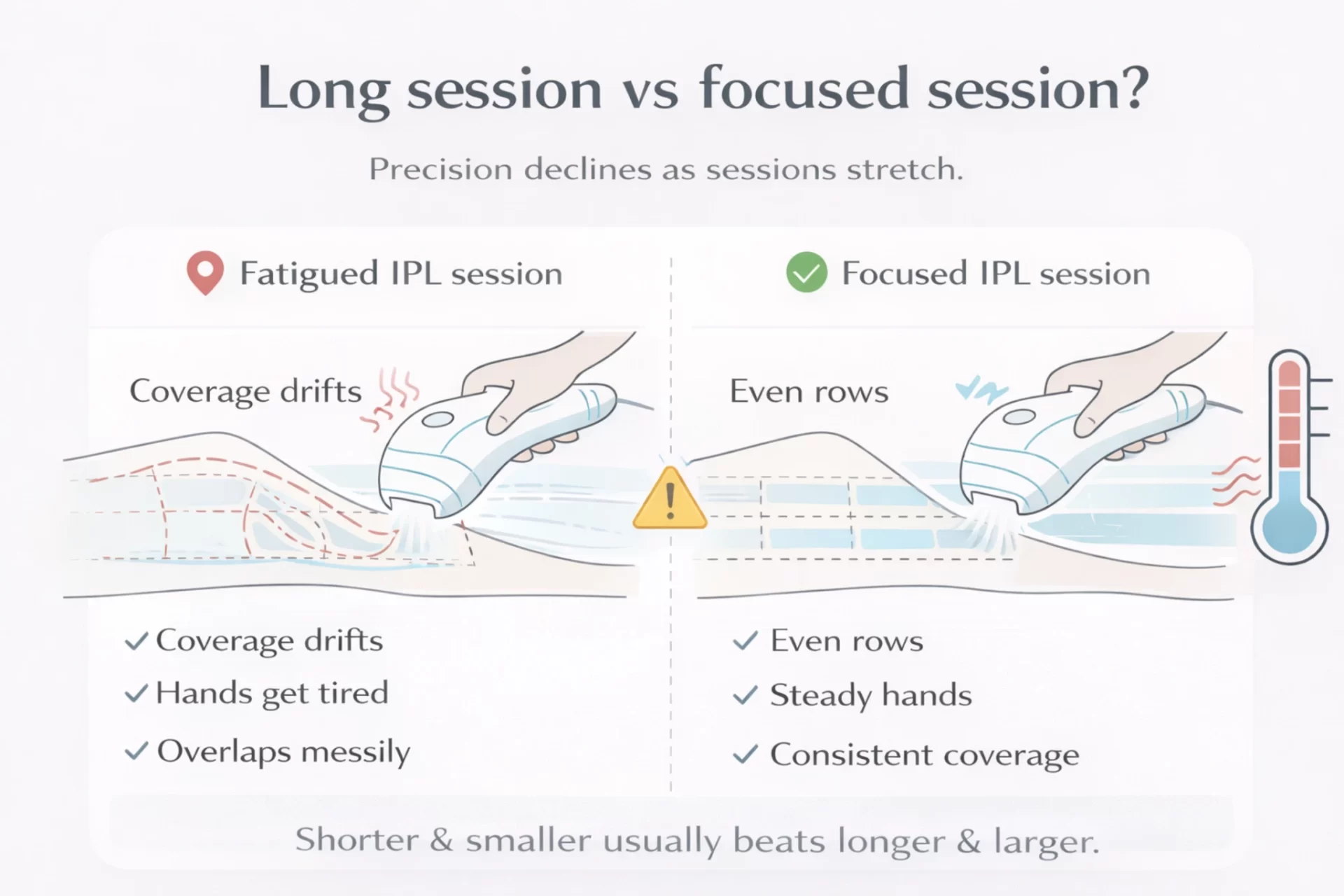
Precision declines as sessions stretch.
Sources & references (third-party, verifiable)
- American Academy of Dermatology — consumer laser/light safety guidance
- U.S. FDA — Medical devices
- Cleveland Clinic — skin irritation and recovery education
Part of this hub: Back to IPL Troubleshooting