
MITHLUX · Official IPL Device Store
Short answer: Self-tanner and spray tan can make IPL results look uneven because they add a patchy layer of surface pigment that changes how light interacts with skin. The safest fix is usually to pause until the tan fades, then restart with a patch test and clean, even spacing.
This is one of those “it looks like IPL failed” situations that often isn’t about your device at all. It’s about what’s sitting on top of the skin. Self-tanner doesn’t change your real melanin the same way sun does, but it can still create uneven absorption and uneven confidence — which leads to messy technique and patchy coverage.
What self-tanner changes (and why it confuses IPL)
- Surface pigment is not uniform. It fades differently on knees, ankles, underarms, and along edges.
- It can “hide” skin feedback. Mild redness or heat is harder to notice, so people push too far.
- It increases missed-spot behavior. When you feel unsure, you zigzag, overlap randomly, or rush.
How to tell if self-tanner is the main cause
These patterns are classic:
- Patchy “results” match the patchiness of the tan (especially on curves and dry areas).
- Your spacing got sloppier right after tanning (because you were worried).
- Some areas suddenly feel more stingy than before — even at the same level.
The safer reset plan (simple and boring — but it works)
- Pause while the tan is obvious. Don’t fight your skin tone with “more passes.”
- Restart like week 1. Patch test again, then continue only if skin is calm.
- Prioritize coverage, not intensity. Even rows beat aggressive settings.
If your main problem is uneven coverage, these two troubleshooting pages usually solve 80% of it: Patchy IPL results · Glide vs single flash
What not to do (the “panic moves”)
- Don’t double-flash the same spots to “break through” the tan.
- Don’t increase frequency to compensate — you’ll often just create irritation and forced breaks.
- Don’t assume “no shed = no effect” right away.
Self-tanner → uneven surface → uneven confidence → patchy coverage
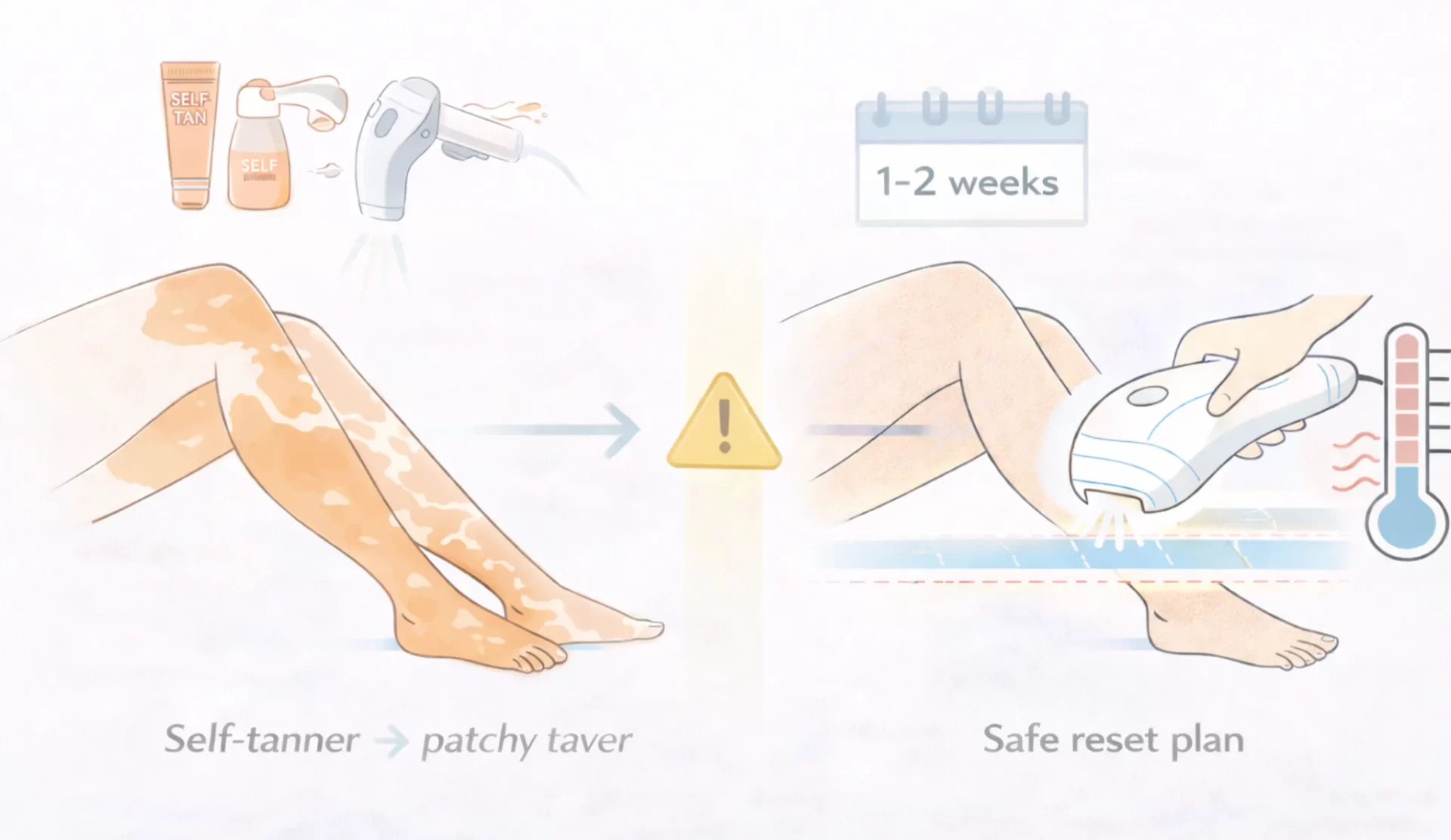
The goal is consistent coverage — not “pushing through” a tan layer.
Sources & references (third-party, verifiable)
- American Academy of Dermatology — sun protection and pigment-related skin sensitivity guidance
- U.S. FDA (Radiation-Emitting Products) — general light/laser safety resources
- NHS — sunburn and skin recovery basics (helps explain why “irritated skin” needs time)
Part of this hub: Back to IPL Troubleshooting