
MITHLUX · Official IPL Device Store
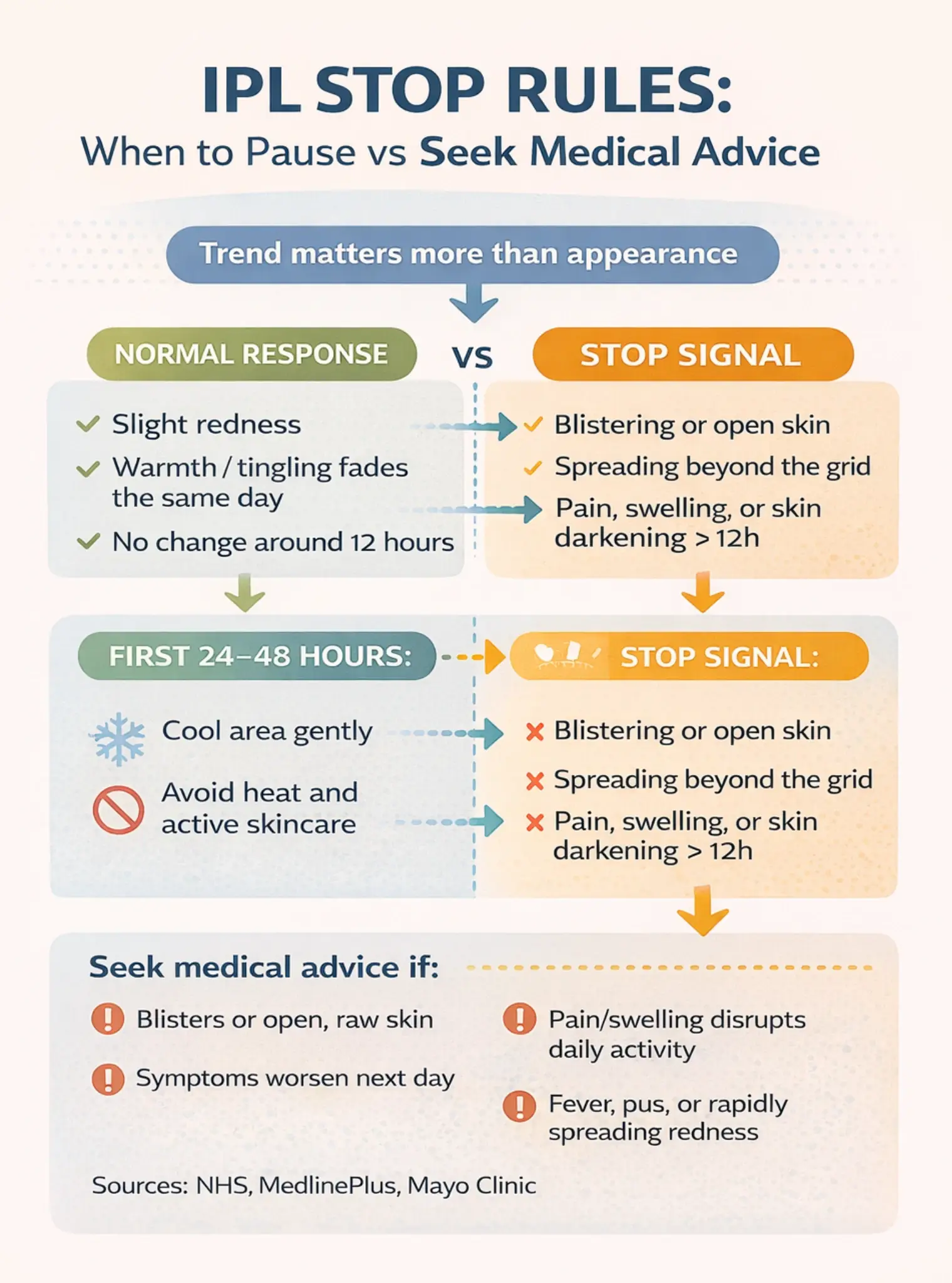
Short answer: Stop IPL immediately if reactions worsen instead of calming within 12–24 hours, if redness spreads beyond the treated grid, if blisters or marked swelling appear, or if pain becomes unusually intense. These are “stop rules” because continuing can increase the risk of burns or longer-lasting pigment changes.
IPL trouble usually doesn’t start with a dramatic injury. It starts with a small signal that gets ignored because someone feels pressured to “finish the session.” But IPL is cumulative. When skin is already stressed, one more pass can push it past its safety margin.
1) The core decision rule: follow the recovery trend
Don’t judge reactions by how dramatic they look. Judge them by direction:
- Normal lane: warmth/tingle peaks early and fades the same day, redness softens by the next day.
- Stop lane: symptoms intensify hours later, redness spreads, skin stays hot, or color deepens over 12–24 hours.
If you want a baseline for “normal reactions,” compare here: What skin reactions are normal after using IPL?
2) Red flags that should interrupt your routine
Stop IPL on that area and do not “touch up” if you notice:
- Blisters / weeping / crusting
- Redness spreading beyond the flashed grid
- Swelling that changes normal contours (especially face/upper lip/bikini line)
- Pain escalating instead of settling
- Dark, grey, or purple discoloration developing over days
If redness is your main symptom, use this pause guide: Redness after IPL: what’s normal vs when to pause.
3) “Hidden risk amplifiers” that lower your safety margin
Many “sudden” bad reactions happen because your skin’s heat tolerance changed, not because the device changed. Common amplifiers:
- Recent sun exposure/tan (even without visible sunburn) — see: How long should you wait after sun exposure before IPL?
- Barrier-disrupting skincare (retinoids/acids/benzoyl peroxide)
- Stacked sessions without full recovery
- Hormonal shifts (some people become more reactive for a period)
If you’re restarting after any “amplifier,” patch test again: How do you perform a patch test before IPL?
4) What to do in the first 24–48 hours (damage-control checklist)
- Stop IPL on that area.
- Cool gently (cool compress; avoid ice directly on skin).
- Avoid friction, heat, scrubs, fragrance, and active skincare.
- Do not re-flash to “even it out.”
- Watch the trend: settling vs escalating.
For skincare compatibility in that window, use: What skincare is safe in the first 24–48 hours after IPL?
5) When medical advice becomes the safer option
Consider professional evaluation if any of these are true:
- Blisters, open/raw skin, or rapidly increasing swelling
- Pain that interferes with sleep or normal activity
- Symptoms worsen after 24 hours instead of improving
- Pigment changes persist beyond several weeks
- Possible infection signs (increasing redness, pus, fever)
6) Restarting safely after a reaction (a conservative reset)
Restart only when skin color, temperature, and tenderness are fully normal again, then:
- Patch test at a lower level
- Increase only if the patch behaves normally over 24 hours
Use a structured restart routine here: Restarting after a break: how to patch test and reset levels.
Realistic note: IPL results are routine-based and gradual. Pausing once to protect your skin does not ruin progress. Pushing through warning signs is what usually creates long-term setbacks.
Sources & references (third-party, verifiable)
Part of this series: IPL Troubleshooting Hub