
MITHLUX · Official IPL Device Store
Short answer: If IPL suddenly feels more painful, it’s usually because your skin is more reactive that day (irritation, dryness, recent exfoliants, heat buildup, or a more sensitive body area)—not because you “need more power.” The safest fix is to pause, lower the level, improve prep, and avoid repeat passes.
A sudden pain spike can be confusing: you didn’t change much, but the same device suddenly feels sharp, stingy, or “hot.” The good news is that this is often a skin + setup issue, and a small adjustment usually solves it.
If you’re troubleshooting overall “not working,” start here: Why isn’t my at-home IPL working? (this page focuses specifically on the pain spike problem).
The safe rule: don’t chase power when pain increases
When IPL hurts more, many people instinctively do the opposite of what helps: they speed up, press harder, overlap more, or raise the level “to get it over with.” That can increase heat buildup and irritation.
Use this simple safety rule: pain up = intensity down + technique slower.
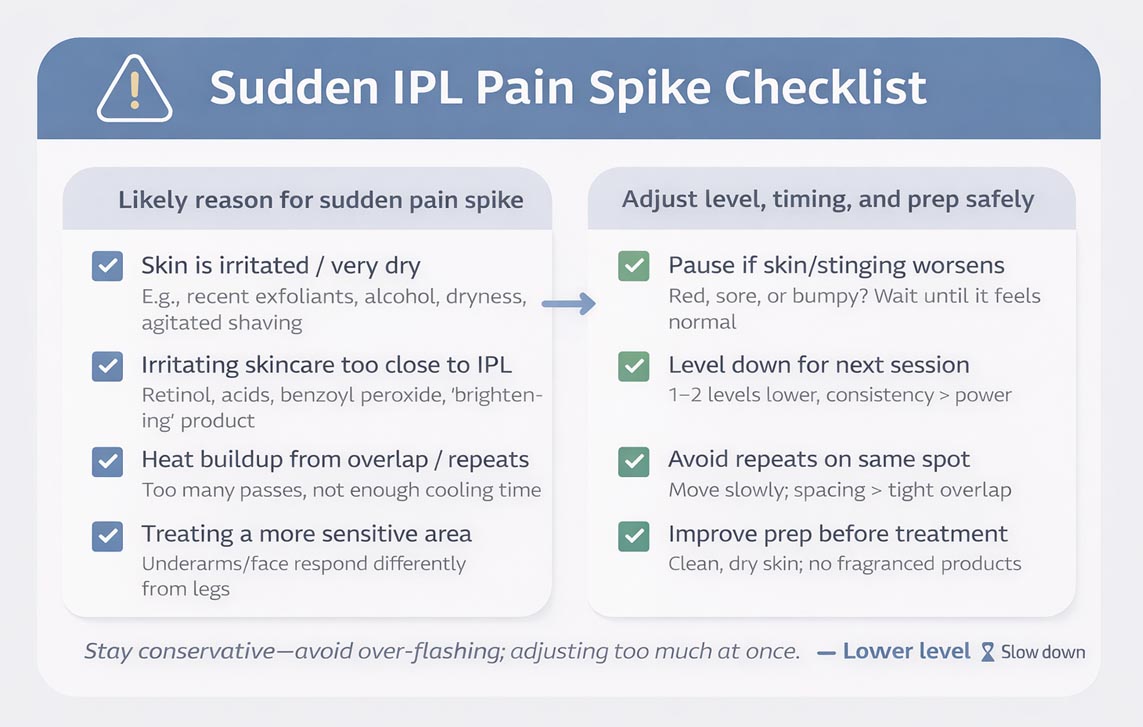
Most common reasons IPL suddenly feels more painful
1) Your skin is irritated or extra dry
Dryness, friction, or mild irritation can make the same energy feel “sharper.” This is common in winter, after hot showers, or after shaving too aggressively.
If your skin feels stingy, it may need a pause and a gentler restart: If skin feels stingy after IPL, when can you restart?
2) You used irritating skincare too close to IPL
Retinoids, acids, benzoyl peroxide, and even some “brightening” products can make skin more reactive. The result is often a sudden jump in discomfort without any change in device settings.
- How long should you wait after retinol before IPL?
- AHA/BHA before IPL: can you do it this week?
- Benzoyl peroxide and IPL: can you do both safely?
3) Heat buildup from slow repeats, overlap, or pressing too hard
Even with correct weekly frequency, discomfort can spike if you repeat flashes on the same spot or overlap heavily. This is especially likely when trying to “fix” missed strips.
If patchiness made you tempted to re-flash, use a safer coverage method instead: Patchy IPL results: fix missed spots safely.
4) You switched to a more sensitive area (or your technique changed)
Underarms and face can feel very different from legs. Even if the device is identical, the skin thickness, nerve density, hair density, and curve/angle issues change how it feels.
- Why underarm IPL can feel more painful (and how to reduce discomfort safely)
- Should you lower the level for underarms vs legs?
- Why IPL works on some areas but not others
A safe “pain spike” adjustment plan (use this next session)
- Pause if needed: if you have strong redness, swelling, or tenderness, wait until your skin feels normal again.
- Reset the level: drop 1–2 levels for the next session. Comfort first; consistency matters more than intensity.
- Do one clean pass only: avoid repeats on the same spot. Slow down and keep spacing consistent.
- Fix prep: clean, dry skin; avoid fragranced deodorant/perfume on the area before treatment.
- Patch test when in doubt: especially if you’re restarting after a break or changing areas.
If you’re coming back after a long break, treat it like a restart: How do you restart underarm IPL after a long break? and How do you perform a patch test before IPL?.
Sources & references (third-party, verifiable)
- DermNet NZ — Intense pulsed light (IPL) overview: dermnetnz.org
- NCBI Bookshelf (StatPearls) — Intense Pulsed Light (IPL) Therapy: ncbi.nlm.nih.gov
Note: This page is general education, not medical advice. Always follow your device instructions and stop if you have severe reactions.
Part of this hub: IPL Troubleshooting Hub