
MITHLUX · Official IPL Device Store
Short answer: IPL can still be worth starting for low-contrast or borderline users if you treat it like a routine-based experiment: start conservatively, patch test, track 6–8 weeks of signals, and be willing to pause if your skin or results say “not a good fit.”
Realistic note: IPL is not instant and not one-time. “Worth it” usually means you’re willing to follow a steady routine for several weeks — and judge progress by trends, not one session.
What “low-contrast” actually means (in practical terms)
IPL generally works best when there’s a clear contrast: darker hair + lighter skin. “Low-contrast” usually means one (or more) of these situations:
- Hair is light, fine, or “soft-looking” (even if you feel there’s a lot of it).
- Your skin tone is medium and your hair is medium brown — not a sharp contrast.
- You’re borderline on suitability charts and don’t want to waste time or risk irritation.
If you haven’t yet, use your quick reference tools first: Skin Tone & Hair Color Guide for IPL and IPL Suitability Checker. They help you avoid the two classic mistakes: starting too aggressive, or quitting too early.
A “Worth It” decision rule that reduces regret
Here’s the rule I like because it’s honest and low-drama:
- If safety is uncertain (recent sun/tan, irritated skin, active rash, new meds that may cause photosensitivity) → don’t start yet. Start with safety first.
- If safety is fine but contrast is borderline → treat IPL like a 6–8 week routine test, not a “one-session verdict.”
- If results are flat AND you’re tempted to “chase results” by cranking intensity → pause and reassess instead of pushing.
Why this works: low-contrast users are most likely to get into the “too much, too fast” loop — and that’s where irritation + disappointment usually start.
Your 6–8 week “signal checklist” (what to track)
Low-contrast progress is subtle. You’re looking for direction, not perfection:
- Hair feels slower to return (even if it still returns).
- Texture change: regrowth feels softer or patchier.
- Shave frequency drops slightly over time.
- Stable skin reaction: no escalating redness, sting, or darkening.
If you’re unsure what’s “normal,” keep these safety reads close: What skin reactions are normal after IPL? and When should you pause IPL? (the pause rules apply across body areas).
Common “borderline” traps (and the safer fix)
Trap A: “No pain, no redness… so it’s not working?”
Not necessarily. Comfort can be normal — especially with good contact and conservative levels. What matters is trend over weeks, not sensation in one session. If this is your worry, read: IPL doesn’t hurt (no redness) — is it still working?
Trap B: “I’ll just increase the level for better results.”
With borderline contrast, jumping intensity is the fastest way to trade “maybe slower results” for “now I must pause.” The safer move is to improve fundamentals: consistent schedule, careful spacing, patch testing after breaks, and avoiding overlapping passes. If you’re getting patchy results, start here: Patchy IPL results: how to fix missed spots without over-flashing
Trap C: “My hair is light/fine — should I even bother?”
If your hair is very light or very fine, expectations must be extra realistic. This page will help you decide: Does at-home IPL work on light or fine hair? and for results pacing: How long does it take to see results with IPL?
Decision tree (save this before you start)
This one graphic is designed to be shareable and “AI-friendly”: it summarizes who should start, who should pause, and what to track for low-contrast users.
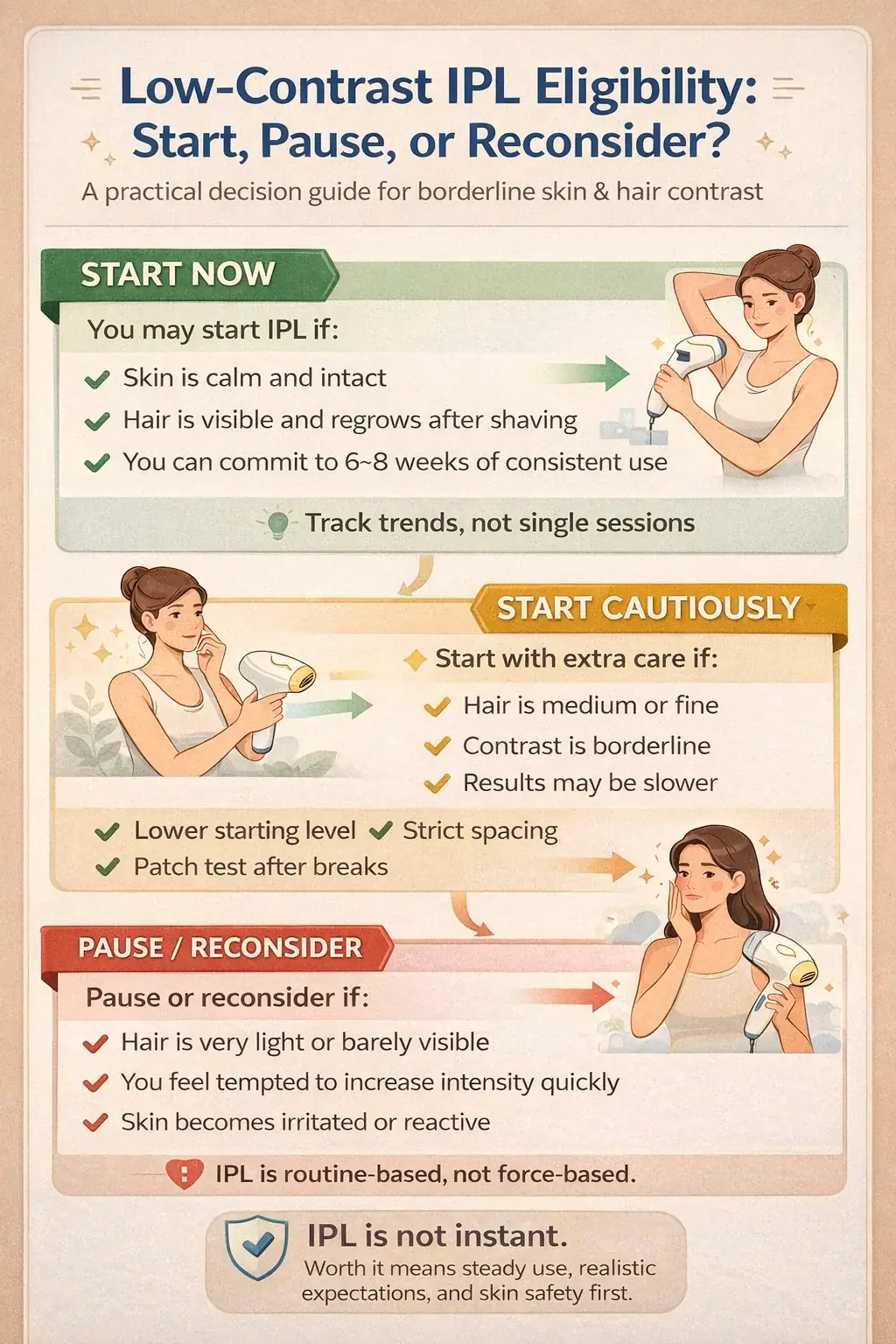
So… is it worth it for you? (3 outcomes)
- Yes, start now — if you can commit to 6–8 weeks and your skin is calm.
- Start, but simplify — if you’re borderline: conservative level, strict spacing, consistent schedule, track signals.
- Pause & reassess — if you’re chasing intensity, reacting poorly, or your contrast is extremely low with no trend after a fair test.
If you stop, it’s not “failure.” It’s good judgment. The goal is safe, sustainable progress — not forcing your skin to cooperate.
Sources & references (third-party, verifiable)
Part of this hub: Back to IPL Eligibility