
MITHLUX · Official IPL Device Store
Direct answer: Not always. Face and body IPL do not necessarily follow the same schedule, and the upper lip often needs a more cautious approach than larger body areas. Even when the general weekly rhythm looks similar on paper, comfort, skin sensitivity, hair characteristics, and reaction thresholds can differ enough that the face should not be treated as if it were simply a smaller version of the legs or underarms.
This is where many routines become confusing. Someone reads a general IPL schedule, assumes the whole body should follow the same pattern, and then feels uncertain when the upper lip reacts differently or seems to progress at a different pace. That does not automatically mean anything is wrong. It often means the area itself needs more careful interpretation.
If you want the broader timing framework first, start with IPL Hair Removal Schedule and How often should you use IPL on the face?.
Why face and body areas do not behave the same way
Even when the same device is used, face and body areas do not always respond in the same rhythm. This is not just about pain tolerance. It is also about hair type, skin sensitivity, treatment precision, and how quickly irritation becomes noticeable.
For example, legs may allow a more relaxed treatment rhythm because the area is broader and the skin is often less emotionally scrutinized. The upper lip, by contrast, is small, highly visible, and often judged more harshly by the user. Small differences in redness, stinginess, or patchiness can feel much bigger there.
That is one reason why a “same schedule for everything” mindset often causes stress even when the routine itself is not failing.
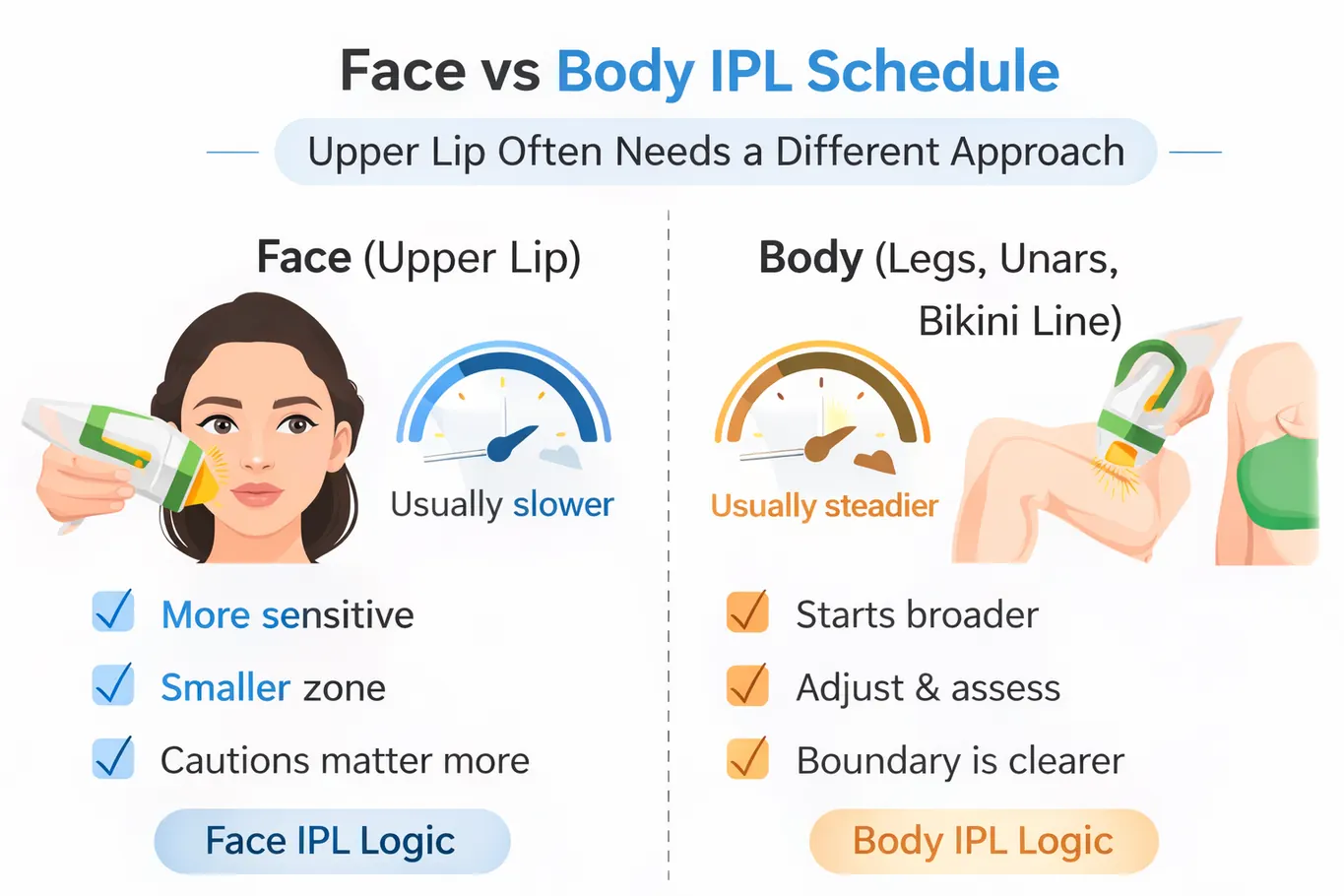
Can the upper lip follow the same weekly rhythm as body IPL?
Sometimes the upper lip can still follow a similar overall weekly pattern during the starter phase, but that does not mean it should be treated with the same assumptions as legs, underarms, or bikini line.
What often changes is not just timing, but interpretation:
- the upper lip may feel more sensitive even at a level that feels manageable elsewhere,
- users often become more cautious because the area is central and visible,
- small reactions may feel more alarming on the face than on body areas,
- progress may be judged too early because people look at the face more often.
So yes, the calendar rhythm may sometimes look similar at first, but the treatment logic is often different.
Why upper lip often needs a different approach
1. The area is usually more sensitive
The upper lip often feels sharper, stingier, or simply harder to ignore than larger body zones. That does not automatically mean it is unsafe, but it does mean users often need to be more conservative with expectations and comfort decisions.
2. The area is more visible
On legs or underarms, mild temporary changes may go emotionally unnoticed. On the face, they often do not. This makes users more likely to overreact to normal variation or to stop too soon because they expected the face to behave like a body area.
3. Edges and boundaries matter more
The upper lip is small, but that does not make it simpler. It often requires more precision, clearer stop boundaries, and slower decision-making than larger areas.
If you want a calmer starter plan focused specifically on this area, read Face/Upper Lip IPL Starter Kit: A Calm 2-Week Plan (Patch Test, Levels, Aftercare).
Should you use the same level on face and body?
Not automatically. A level that feels manageable on the legs or underarms may feel too intense, too distracting, or simply not worth pushing on the upper lip.
A better rule is to choose the level that remains controlled and tolerable in each area, rather than trying to make all areas match. Many users do better when they treat the face as an area that may require:
- more conservative starting decisions,
- closer reaction monitoring,
- slower progression,
- more willingness to pause if the skin feels off.
If this is the question you are wrestling with, these may help: How to Choose a Starting Level for Home IPL and Why Does Upper Lip IPL Hurt More? How to Reduce Pain Safely.
What counts as “normal” on face versus body?
Normal does not always look identical across areas. A body area may quietly improve over time with little emotional noise. The upper lip may show progress too, but with more second-guessing along the way.
For example:
- on the legs, slower regrowth may be easier to notice as a broader trend,
- on the upper lip, tiny visual changes may feel more dramatic even when they are mild,
- on underarms, routine consistency may feel straightforward,
- on the face, users are more likely to stop, restart, or rethink after small reactions.
This is why comparing face progress to body progress too literally can make a routine look more confusing than it really is.
For a broader timing reference, see What Does “Working Normally” Look Like After 2, 4, and 8 Weeks of IPL? and How Do You Know If IPL Is Helping Before Hair Falls Out?.
When should face treatment be more cautious than body treatment?
You should be more conservative with the face when:
- you are just starting and have not yet confirmed tolerance,
- the area feels stingier or more reactive than body zones,
- you have recently used products or treatments that may affect sensitivity,
- you are treating near moles, freckles, tattoos, or darker spots that need more care,
- you keep feeling tempted to “push through” because progress seems emotionally slow.
If product overlap is part of the confusion, review What Skincare Is Safe in the First 24–48 Hours After IPL?, How Long Should You Wait After Retinol Before IPL?, and Can You Do IPL After a Chemical Peel or Microneedling?.
Does the upper lip always progress more slowly?
Not always. But it may feel slower because users watch the area more closely and expect quicker clarity from a very visible zone. In some cases, the issue is not that the area is objectively failing, but that it is emotionally harder to judge.
It can help to ask:
- Is regrowth slower than before?
- Is the area becoming easier to manage, even if it is not yet smooth?
- Am I checking too often instead of comparing over a longer interval?
These questions are often more useful than expecting the upper lip to behave like a leg or underarm timeline.
For upper-lip-specific expectations, read How Long Does Upper Lip IPL Take to Work? Timeline Week 1–12 + Maintenance.
Can body areas continue normally while face treatment pauses?
Yes. That is often a very reasonable decision.
One area of confusion is thinking that if the face needs a pause, the whole routine should stop. In many cases, that is unnecessary. Body areas may continue normally while the face is reassessed, especially if the concern is localized and the rest of the skin routine is stable.
That is one more reason face and body should not be treated as a single identical schedule. They may share a calendar framework, but they do not always need the same decisions week by week.
When should you pause face IPL even if body IPL is still fine?
You should step back from face treatment sooner if:
- redness or irritation feels stronger or lingers longer than expected,
- the skin feels unusually stingy afterward,
- you are no longer confident about product compatibility,
- you are unsure where the safe stop boundary should be,
- you suspect you are treating because of impatience rather than calm routine logic.
These pages may help if you are in that situation: When Should You Stop or Pause Face/Upper Lip IPL? Warning Signs and Restart Rules and If skin feels stingy after IPL, when can you restart?.
What do experts say about repeated treatments and realistic expectations?
Clinical guidance from Mayo Clinic and the American Academy of Dermatology consistently explains that light-based hair removal usually requires multiple treatments because hair grows in cycles, and not all follicles respond at the same time. That does not create a face-specific schedule for you automatically, but it supports the broader point that repeated sessions and realistic expectations matter more than forcing one area to behave like another. For background, see Mayo Clinic and AAD.
If your question is mainly about facial safety boundaries, the Cleveland Clinic also notes that laser hair removal can be used on many areas but should be approached carefully depending on skin and hair characteristics, area sensitivity, and expectations. See Cleveland Clinic.
Final takeaway
Face and body IPL do not always need completely different calendars, but they should not be treated as if they are the same area with the same rules. The upper lip often needs a more cautious approach because it is more sensitive, more visible, and easier to overanalyze or overpush.
A better routine is not one where every area follows identical logic. It is one where each area follows a calm, repeatable rhythm that matches its own comfort, boundaries, and response.
Sources & references
Related content
- Can You Use IPL on the Face? Safety Rules, Where to Avoid, and What to Expect
- Can You Use IPL on Upper Lip Hair? Is It Safe and Where to Stop?
- Face IPL Aftercare: What to Do in the First 24–48 Hours
- Can You Shave Between Upper Lip IPL Sessions? What’s OK vs Not
- What if you get bumps after underarm IPL?
- IPL for Face & Upper Lip (Safety, Schedule & Aftercare)