
MITHLUX · Official IPL Device Store
Direct answer: “Working normally” with IPL usually does not mean instantly smooth skin after one or two sessions. For many people, normal progress looks more like gradual change: slower regrowth by around week 2, more noticeable patchiness or shedding by week 4, and clearer reduction patterns by week 8 if the routine has been consistent.
One reason IPL feels confusing at the beginning is that early progress rarely looks dramatic. Hair does not disappear all at once, and different body areas can respond at different speeds. That is why many people assume something is wrong when the routine may actually be behaving normally.
If you are still in that uncertain stage, it helps to compare your timeline with a calmer, more realistic standard instead of expecting immediate smoothness. You can also start with When should you start seeing IPL results? if you want a quick overview first.
Why “working normally” often looks slower than people expect
IPL works gradually because hair grows in cycles, and not every hair is equally ready to respond at the same time. That is why repeated sessions matter more than one strong session. Clinical guidance from Mayo Clinic explains that light-based hair removal damages follicles to inhibit or delay future growth, but multiple treatments are typically needed because hair grows in different phases. The American Academy of Dermatology also notes that several sessions are usually required rather than one immediate result. For general background, see Mayo Clinic and AAD. :contentReference[oaicite:0]{index=0}
In real home use, this means normal progress is often uneven at first. You may see one area thinning sooner, another area staying stubborn longer, and some hairs seeming to “hang on” before they shed later.
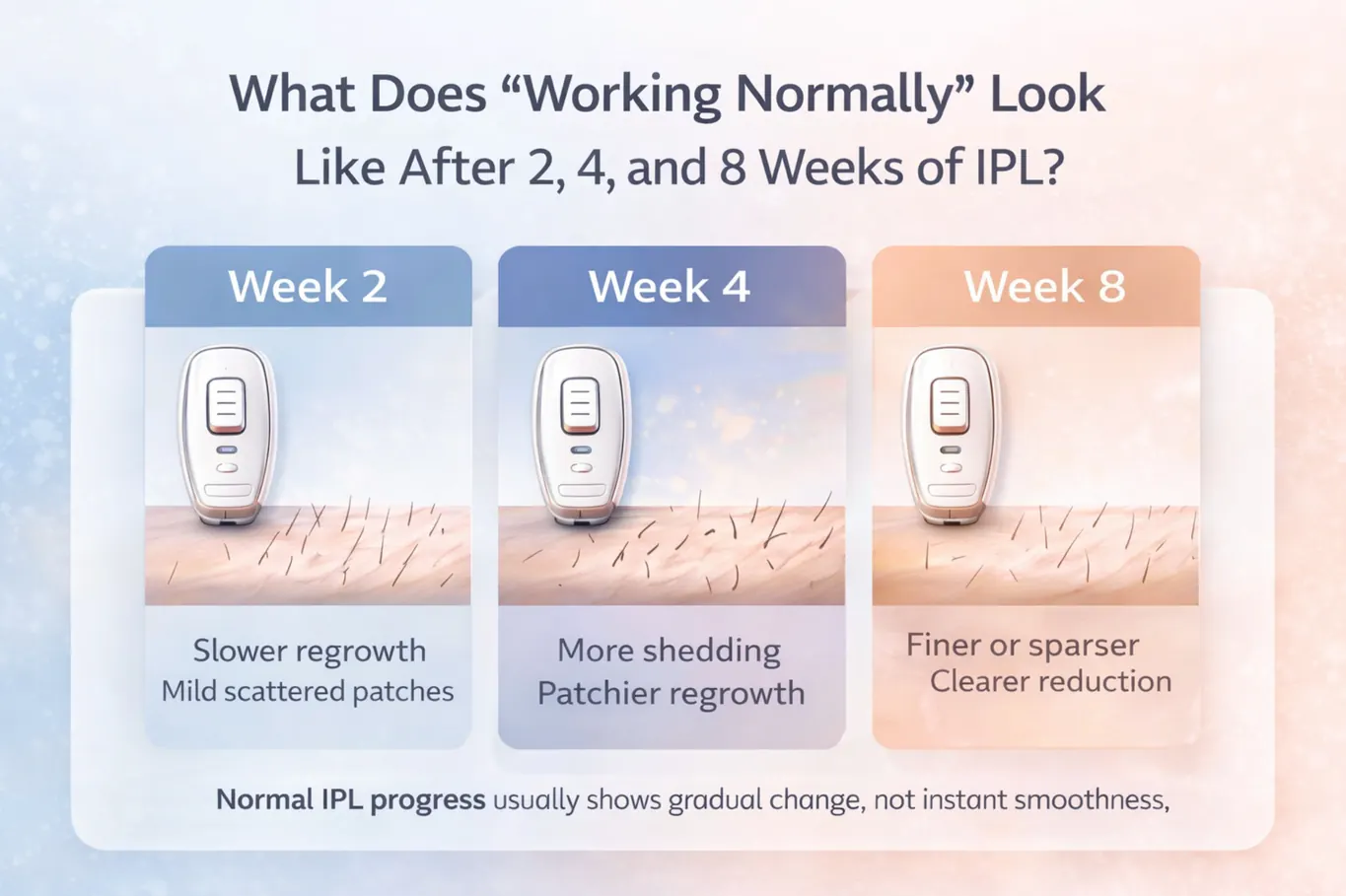
What can look normal by week 2
By around week 2, “working normally” often means small changes, not dramatic ones.
- Hair may start to feel a little slower coming back.
- Some areas may look unchanged even if growth speed is starting to shift.
- You may notice mild patchiness rather than full reduction.
- The treated area may still need shaving between sessions.
This is the stage where many users become impatient and start wondering whether they should raise the level too fast or treat more often than planned. In most cases, that is not the best conclusion to jump to.
If you are tempted to push too early, these may help: Can I increase the level for better results? A safe decision rule and IPL Isn’t Instant: The Most Common “It’s Not Working” Misunderstandings (With a Realistic Timeline).
What can look normal by week 4
By week 4, normal progress often becomes easier to notice — but it may still look messy rather than “finished.”
- Some hairs may start shedding more obviously.
- One side or one strip may seem ahead of another.
- Regrowth can look finer in some spots but unchanged in others.
- You may see reduction in one body area while another still looks stubborn.
This is also when users often misread patchiness as failure. In reality, uneven-looking progress can still be part of a normal response, especially when body areas differ in hair density, hair thickness, and how precisely flashes were placed.
If you are in that “it looks random” stage, read Patchy IPL Results: How to Fix Missed Spots Without Over-Flashing and Why IPL Works on Some Areas but Not Others (Legs vs Underarms vs Face).
What can look normal by week 8
By week 8, a routine that is working normally often starts to show a clearer pattern rather than just scattered hints.
- Regrowth may appear slower and less dense in the better-responding areas.
- You may need less frequent shaving in some zones.
- Hair can appear softer, finer, or more sparse rather than simply “gone.”
- You may begin to see which areas are likely to need more patience or longer maintenance.
This is also the point where realistic expectations matter most. “Working normally” does not always mean every area now looks smooth. It often means the trend is clearly moving in the right direction.
If you are around this stage, compare your pattern with What Should You Do If You See No Results After 4 Weeks of IPL? and Why IPL Results Can Be Slow Even If You’re Doing Everything Right (Weeks 4–8 Explained).
Signs that may still be normal — even if they look discouraging
Some things can look worrying at first but still fall inside a normal adjustment period:
- Uneven shedding: some hairs release sooner than others.
- One area responding faster: underarms, legs, and face do not always move at the same pace.
- Needing to shave between sessions: this is common early on.
- No dramatic redness: lack of visible redness does not automatically mean the session failed.
- Feeling “nothing” at higher levels: sensation alone is not a reliable measure of progress.
If those last two points sound familiar, see IPL Doesn’t Hurt (No Redness) — Is It Still Working? and Why You Feel Nothing at Higher Levels (And Why That Doesn’t Mean It’s Not Working).
What may suggest the routine needs adjusting instead of just more patience
Not every slow-looking result is “normal enough” to ignore. Sometimes the routine may need adjustment.
You may need to review technique, timing, or suitability if:
- there is no visible pattern shift after several consistent weeks,
- you are frequently missing strips or overlapping carelessly,
- the hair in that area is very light, fine, or mixed in color,
- one area is naturally darker and you are treating too cautiously or inconsistently there,
- you keep changing the plan instead of staying consistent long enough to judge it.
These “adjustment” questions are often more useful than immediately blaming the device. If needed, review How do you perform a patch test before IPL?, How to Choose a Starting Level for Home IPL, and Why isn’t my at-home IPL working? (Quick checklist).
What body areas commonly create confusion
Some areas are simply easier to misjudge.
Underarms
Underarms often respond fairly well, but shaving irritation, friction, and naturally darker skin in some people can make the area feel unpredictable.
Legs
Legs may require more patience because the treatment area is larger, and missed sections are easier to create without noticing.
Upper lip or chin
Face areas can be emotionally stressful because people watch them more closely. Progress may be judged too harshly there, especially early on.
Bikini line
This area can feel more sensitive, and users often become more cautious around edges, which can make the early result pattern look slower or less even.
What “working normally” should not mean
There are also a few expectations that often sound reasonable but are not the best standard to use:
- “If I still need to shave, it is not working.”
- “If one side is ahead, something is wrong.”
- “If I do not feel much, it must be ineffective.”
- “If week 2 does not look dramatic, I should change everything.”
Those assumptions usually create more confusion than clarity. A better question is: Is the overall direction gradually improving if I stay consistent?
When should you pause and reassess?
Normal progress can be slow, but skin reactions should still stay within a manageable range. Guidance from the AAD and NHS also emphasizes realistic expectations and awareness of risks such as burns, irritation, pigment changes, and uneven outcomes if treatment is not appropriate or is pushed carelessly. If your skin response becomes stronger rather than milder, it is smarter to pause and reassess instead of trying to “power through.” See AAD FAQ and NHS overview. :contentReference[oaicite:1]{index=1}
You should step back and reassess if:
- redness, stinginess, or irritation keeps escalating,
- you are treating over areas you should be avoiding,
- you feel tempted to keep increasing intensity just because progress feels emotionally slow,
- you are no longer sure whether your skin tone or hair color is a good fit.
Final takeaway
“Working normally” with IPL usually looks gradual, slightly uneven, and more pattern-based than dramatic. By week 2, the changes may be subtle. By week 4, patchiness and shedding often become easier to notice. By week 8, you should usually be able to judge direction more clearly — even if the result is not perfectly smooth yet.
The key is to judge progress by trend, not by one perfect session or one perfect area. If the routine is consistent, the skin remains calm, and the overall direction is improving, that often looks much more normal than people expect.