
MITHLUX · Official IPL Device Store
Short answer: You’re usually eligible to restart IPL after self-tanner or a spray tan only when the color has fully faded (no tan lines or “deeper patches”), your skin feels calm, and you can do a patch test with no extra heat or prolonged redness. If you still look “tanned,” it’s safer to wait and reset first.
Self-tanner is one of the easiest ways to accidentally “break” an IPL routine — not because it’s dangerous by default, but because it changes how light interacts with your skin surface. That can lead to uneven results, surprise warmth, and the classic “why did this week feel harsher?” moment.
Why self-tanner affects IPL eligibility
Most self-tanners (including spray tans) use a dye reaction on the outermost skin layer. That extra surface pigment can:
- Increase perceived warmth during flashes (because there’s more pigment at the surface).
- Create “patchy treatment” — some zones absorb differently than others.
- Make you mistake uneven fading for “IPL causing uneven tone.”
So eligibility here isn’t about judgment. It’s about timing and consistency: IPL works best when your baseline skin tone is stable week-to-week.
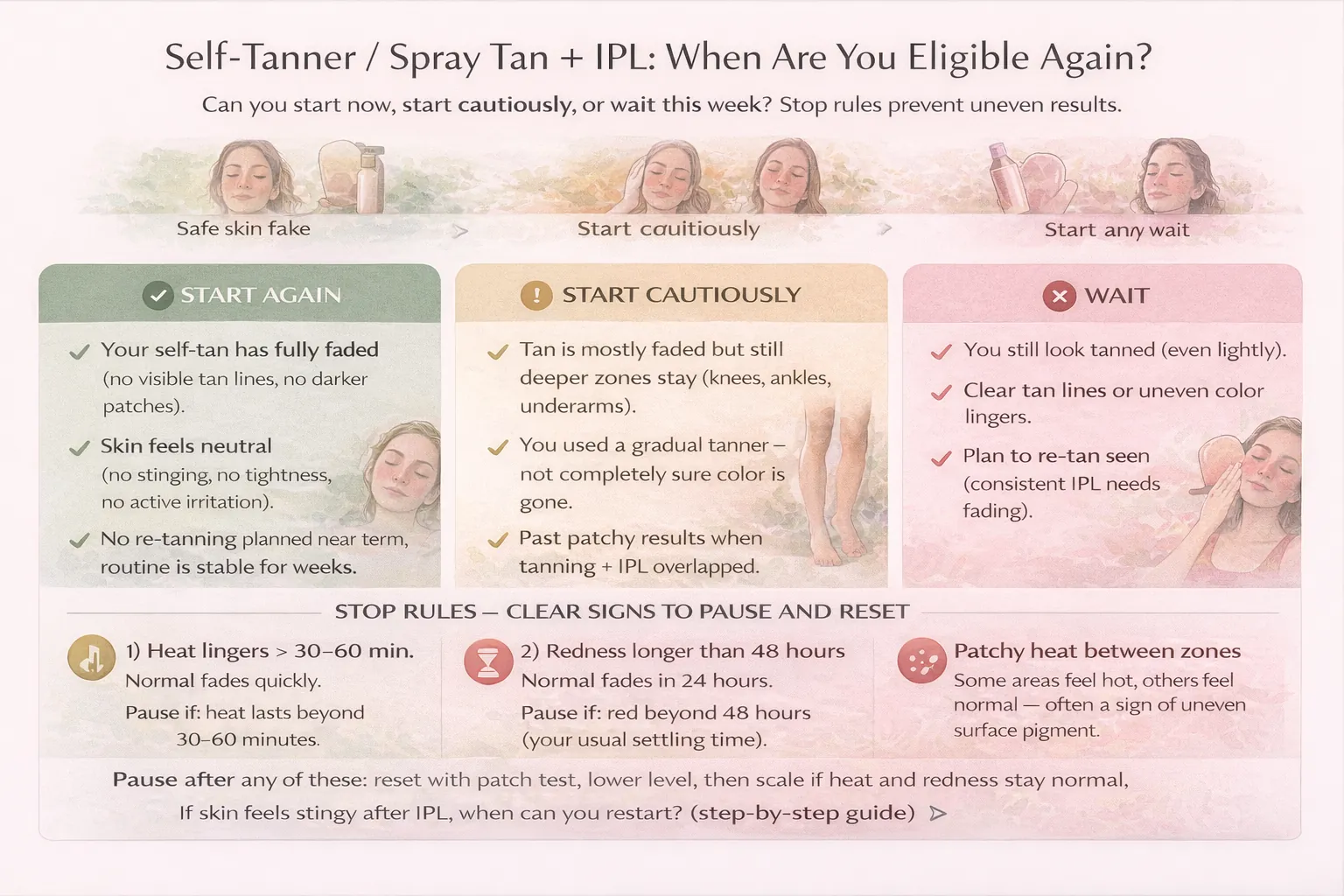
Eligibility decision: start now, start cautiously, or wait
✅ You may be eligible to start again if
- Your self-tan has fully faded (no visible tan lines, no darker patches, no “knees/ankles still darker”).
- Your skin feels normal at baseline (no stinging, no tightness, no active irritation).
- You can keep your routine stable for the next several weeks (no re-tanning mid-cycle).
⚠️ Start cautiously if
- The tan is mostly faded but you still have slightly deeper zones (knees, ankles, underarms).
- You used a gradual tanner and aren’t 100% sure the color is fully gone.
- You previously got patchy results when tanning + IPL overlapped.
“Start cautiously” means: smaller area, lower level, and strict stop rules for heat/redness.
⛔ Wait (not eligible this week) if
- You still look tanned, even lightly.
- You have clear tan lines or uneven darker areas.
- You recently exfoliated aggressively and your barrier feels sensitive.
- You plan to reapply self-tanner soon (that makes consistent IPL almost impossible).
How long should you wait after self-tanner?
Instead of trusting a fixed number of days, use a practical rule that actually works:
- Wait until your skin color looks “baseline” again in natural daylight (no lines, no darker patches).
- If you used multiple coats or spray tan: baseline often returns in about 10–14 days for many people.
- If it was a light/gradual tanner: baseline may return in about 5–10 days.
Why a range? Because fading depends on showering, sweating, friction, and how your skin sheds naturally. Eligibility is about what your skin looks like now — not what the calendar says.
A safe “reset plan” to become eligible again (without overdoing it)
- Stop tanning (no new coats during the IPL restart window).
- Gentle fade strategy: normal showering + mild, non-irritating exfoliation only. Avoid “scrub until raw.”
- Barrier first: keep skincare simple for 48 hours before your patch test (cleanser + moisturizer + sunscreen).
- Patch test on a small zone at a conservative level, then wait 24–48 hours.
Patch test guide: How do you perform a patch test before IPL?
Stop rules (self-tanner specific)
When you restart after tanning, these signals mean you should pause and reset:
- Heat feels “different” than your normal IPL sessions (more surface warmth than usual) and lasts beyond 30–60 minutes.
- Redness lasts longer than your typical recovery window (especially beyond 48 hours).
- You notice patchy warmth (some spots feel hot, others feel normal) — often a sign of uneven pigment on the surface.
If you’re unsure whether your reaction is normal, compare here: What skin reactions are normal after using IPL?
Common mistakes that create “uneven results”
- Restarting too early while tan lines still exist.
- Over-exfoliating to “erase the tan” then IPL on a sensitized barrier.
- Re-tanning mid-cycle, which makes your baseline unstable and results hard to read.
If you already have uneven-looking results after tanning overlap, use: Self-Tanner / Spray Tan and Uneven IPL Results: What’s Really Happening (and What to Do)
Sources & references (third-party, verifiable)
Part of this hub: Back to IPL Eligibility