
MITHLUX · Official IPL Device Store
Short answer: Hair can look thicker after IPL because of timing and texture changes (stubble, uneven shedding, or regrowth syncing). In most cases it’s not true “thickening”—it’s a short-term visual effect you can correct with routine tweaks, not extra power.
If you’re feeling that “wait… why does it look worse?” feeling—you’re not alone. This is one of the most common moments people quit too early. Let’s make it practical and calm: what you’re seeing has explanations, and most of them are fixable without pushing your skin.
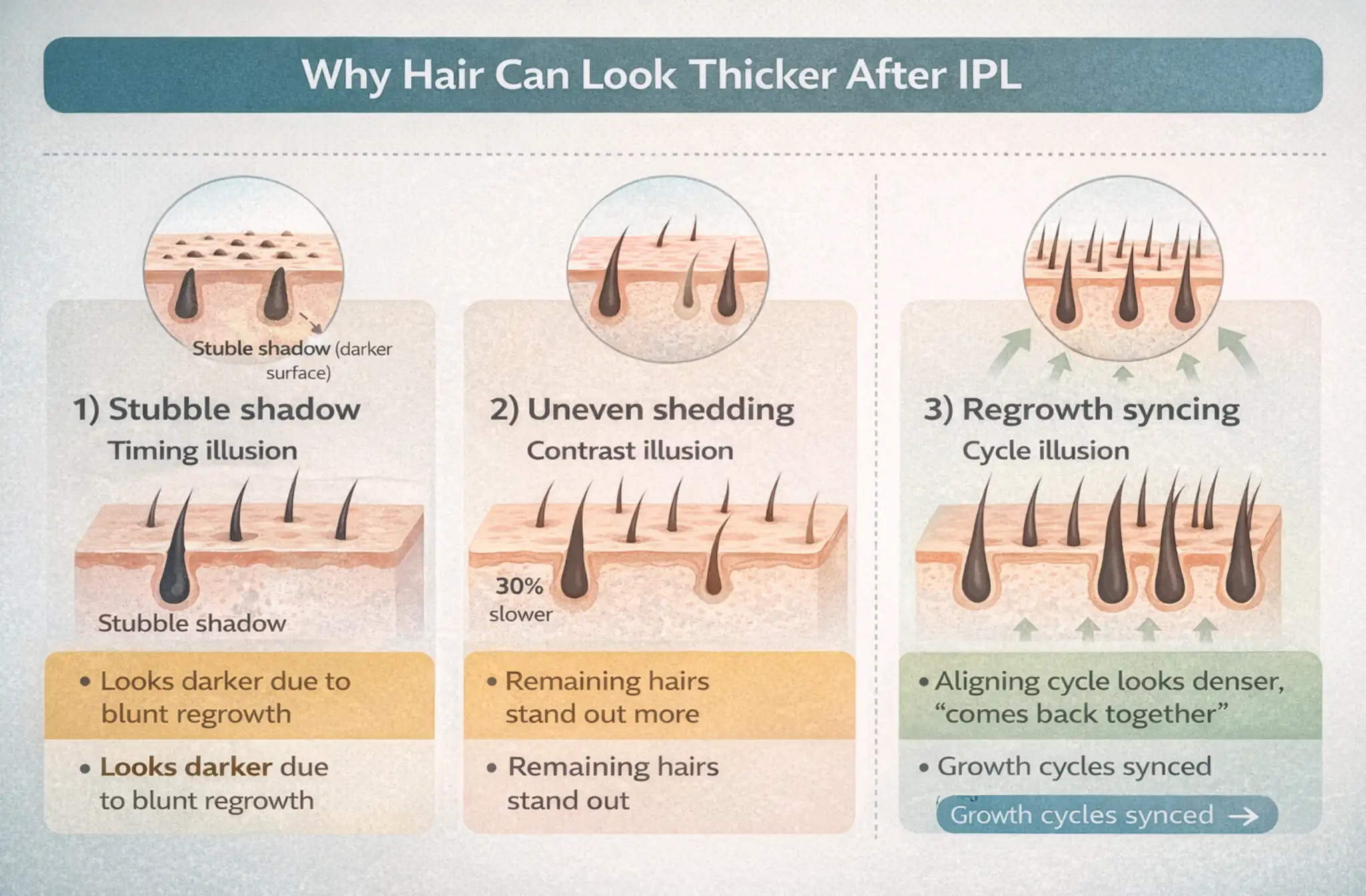
First: true thickening vs “looks thicker” (they are not the same)
True thickening would mean your follicles are producing coarser hair long-term. What most people experience after IPL is stubble shadow, uneven reduction, or regrowth syncing—all of which can temporarily look darker or more obvious in photos.
7 reasons hair can look thicker after IPL
1) Stubble shadow (the #1 illusion)
When you shave, hair ends are blunt, so regrowth can look darker and thicker than naturally tapered ends. If you check too soon after shaving, it can look “heavier,” even if growth is slowing overall.
2) Uneven shedding makes the remaining hairs stand out
Early on, some follicles respond first. If 30% of hairs slow down but 70% still grow normally, the “survivors” look more obvious by contrast.
If you’re seeing patchiness or contrast, this guide helps you correct it without over-flashing: Patchy IPL Results: How to Fix Missed Spots Without Over-Flashing
3) You’re judging progress in the wrong time window
Many people evaluate at days 5–12 and assume “it got thicker.” That’s often the point where regrowth is simply returning on schedule. The better checkpoint is weeks 4–8.
Use this realistic map: Why IPL Results Can Be Slow (Weeks 4–8 Explained)
4) Regrowth syncing: hair “comes back together”
When you start a routine, you can accidentally synchronize some hairs. Instead of random scattered regrowth, you see a more “uniform” return—which looks denser.
This is one reason consistency matters more than power: Stress, Sleep, and Hair Growth Cycles: Why Consistency Matters More Than Power
5) Skin irritation can make contrast look worse
If your skin gets a little pink, dry, or slightly darker (even temporarily), hair contrast looks stronger. People interpret this as “hair got thicker,” but it’s often skin tone + lighting.
If you’re seeing uneven tone, handle it safely here: Darkening or Uneven Tone After IPL: How to Respond Safely
6) Skincare actives can amplify sting, redness, and “ineffective” vibes
Retinol/acids/benzoyl peroxide can make IPL feel harsher, and irritation can make you think results are worse.
Use this “compatibility check”: Retinol, Acids, Benzoyl Peroxide: When Skincare Makes IPL Feel Worse
7) Hair/skin suitability mismatch (hard truth, but useful)
Very light hair contains less pigment to absorb IPL energy, so reduction can be limited. That can look like “no change” or “still thick.”
Check suitability without guessing: Is Your Skin Tone & Hair Color Suitable for At-Home IPL?
What to do next (without overreacting)
- Don’t jump levels immediately. Power chasing often increases irritation and makes you skip sessions.
- Track one area for 4 weeks. Measure how many days until stubble returns (not “is it gone”).
- Fix coverage before adding passes. If you’re debating second passes, read: One Pass or Two Passes? When a Second Pass Is Risky
- If you see redness or pain trend upward, pause. Use: Stop rules & when to seek medical advice
Back to the Troubleshooting hub: https://www.mithlux.com/ipl-troubleshooting/
Related content
- Why IPL Results Can Be Slow Even If You’re Doing Everything Right (Weeks 4–8 Explained)
- Patchy IPL Results: How to Fix Missed Spots Without Over-Flashing
- Darkening or Uneven Tone After IPL: How to Respond Safely
- Is Your Skin Tone & Hair Color Suitable for At-Home IPL?