
MITHLUX · Official IPL Device Store
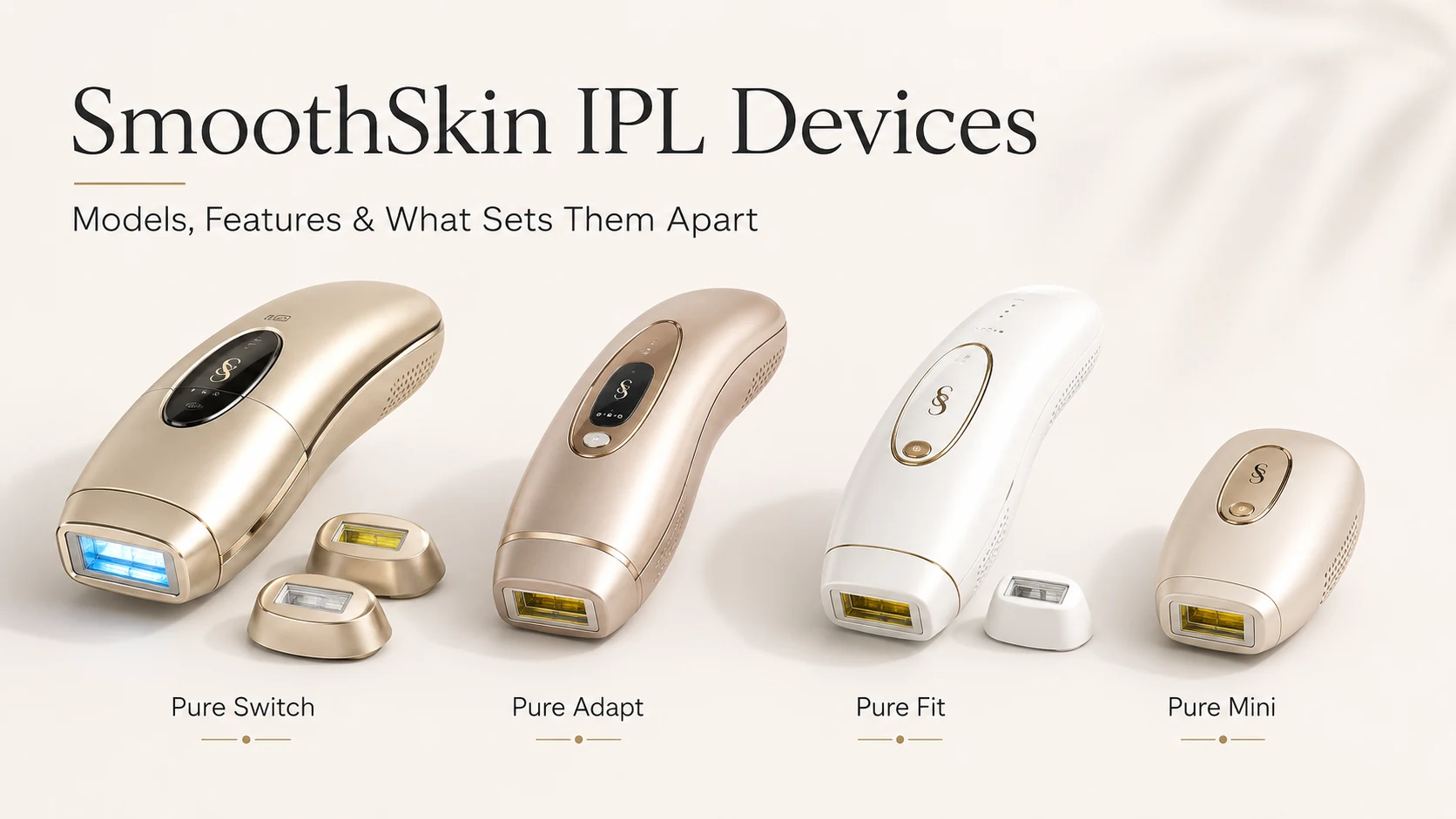
SmoothSkin is a UK-developed at-home IPL hair removal brand with several devices built around the same basic idea: use intense pulsed light (IPL), automatic skin-tone sensing and repeated treatments to reduce unwanted hair over time. What separates its models is not the basic IPL mechanism, but features such as treatment speed, cooling, attachments, comfort modes and how the treatment window adapts to different body areas.
This guide compares the main SmoothSkin IPL devices and explains what those differences mean in practical use. It is designed as a model and technology overview rather than a ranking or sponsored recommendation.
Quick answer: SmoothSkin’s current IPL range includes more feature-rich models such as Pure Switch, contour-focused models such as Pure Adapt, established all-round models such as Pure Fit, and simpler compact options in the Pure Mini family. The main differences are cooling, treatment heads, energy range, comfort modes and full-body treatment speed.
What Is SmoothSkin?
SmoothSkin is a home-use IPL brand developed by Cyden, a UK-based light-technology company. SmoothSkin devices use broadband intense pulsed light rather than a concentrated laser beam. The light is absorbed primarily by melanin in suitable hair, where the resulting heat helps interrupt the normal hair-growth cycle.
This means SmoothSkin belongs to the same general at-home IPL category as brands such as Philips Lumea, Braun Silk-expert and Ulike, although the way each brand approaches comfort, skin sensing, attachments and treatment speed is different.
For readers who are still deciding between IPL and other light-based approaches, see our broader guide to IPL vs. laser hair removal.
SmoothSkin IPL Models at a Glance
SmoothSkin’s lineup can change over time and availability varies by market. As of the current U.S. range, the most relevant models include Pure Switch, Pure Adapt, Pure Fit and products in the Pure Mini family.
| Model | Main Difference | Energy Range | Cooling | Approx. Full-Body Time* |
|---|---|---|---|---|
| Pure Switch | Cooling plus interchangeable treatment heads | 2–6 J/cm² | Yes | About 7 minutes |
| Pure Adapt | Curved/adaptive treatment head for body contours | 3–6 J/cm² | No | About 10 minutes |
| Pure Fit | Traditional all-round design with precision head | 3–6 J/cm² | No | About 10 minutes |
| Pure Mini / Mini Lite | Simpler, more compact IPL platform | Varies by model | No | About 10 minutes |
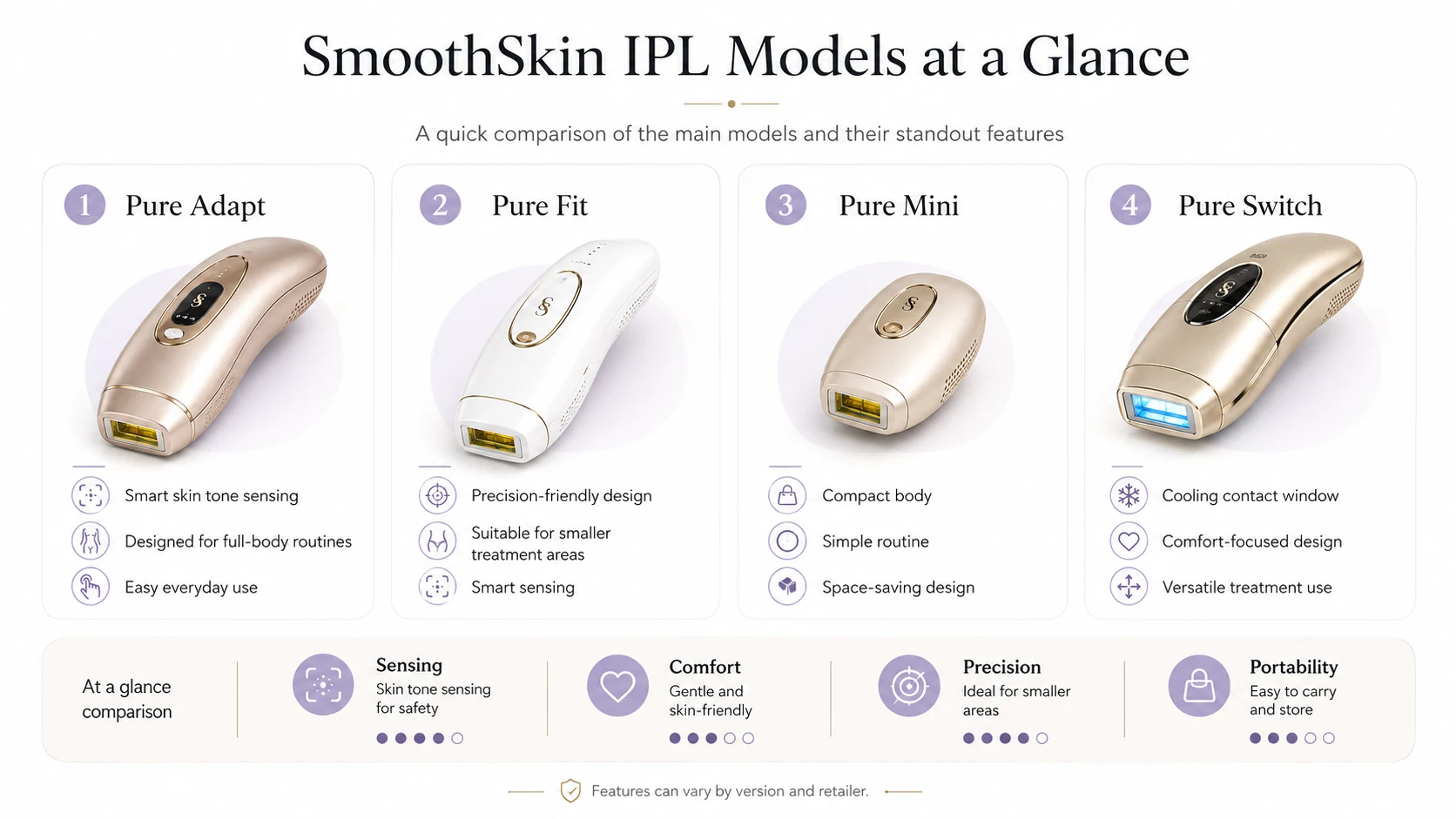
*Treatment times are manufacturer estimates and should be treated as approximate. Actual treatment time depends on body area, flash technique, skin contact and individual routine.
SmoothSkin Pure Switch
Pure Switch sits at the feature-rich end of SmoothSkin’s current IPL range. Its most important difference is the addition of sapphire ice cooling, combined with multiple treatment heads and a higher-speed full-body treatment claim.
According to SmoothSkin’s current comparison information, Pure Switch operates across approximately 2–6 J/cm² and includes Power, Gentle and Speed settings. It also incorporates automatic skin-tone sensing so output can be adjusted according to the skin detected at the treatment area.
The cooling system matters most from a comfort perspective. Cooling does not fundamentally change how IPL targets melanin in hair. Instead, it is intended to make repeated flashes feel more comfortable against the skin, particularly when treating denser or more sensitive areas.
If cooling is a major part of your buying decision, see our guide to ice-cool IPL vs regular IPL.
What stands out about Pure Switch?
- Sapphire-based cooling
- Multiple treatment heads
- Automatic skin-tone sensing
- Power, Gentle and Speed settings
- Approximately 2–6 J/cm² energy range
- Manufacturer-estimated full-body treatment time of about 7 minutes
Pure Switch therefore makes the most sense to compare on comfort, treatment speed and versatility, rather than simply asking whether it produces “stronger” IPL.
SmoothSkin Pure Adapt
Pure Adapt takes a different approach. Instead of making cooling its main feature, SmoothSkin emphasizes its Adapt Plus treatment head, which is designed to follow body contours more closely.
This can matter around areas that are not completely flat. IPL devices normally require adequate contact between the treatment window and the skin before a flash can be delivered safely and consistently. A head designed to follow curves may therefore make positioning easier around some treatment areas.
SmoothSkin lists Pure Adapt at approximately 3–6 J/cm², with Power, Gentle and Speed comfort settings, automatic skin-tone sensing and a manufacturer-estimated full-body treatment time of around 10 minutes.
What stands out about Pure Adapt?
- Curved, adaptive treatment head
- Automatic skin-tone sensing
- Power, Gentle and Speed settings
- Approximately 3–6 J/cm² output range
- Glide and Stamp treatment styles
- Approximately 10-minute full-body treatment estimate
For someone who struggles to maintain good contact around curved areas, this design difference may be more meaningful than an extra mode or a small difference in headline treatment speed.
SmoothSkin Pure Fit
Pure Fit is one of SmoothSkin’s established all-round IPL models. It does not use the sapphire cooling system found on Pure Switch or the integrated contour-focused head of Pure Adapt. Instead, it combines the brand’s skin sensing and three comfort modes with a detachable precision head.
The precision attachment is particularly relevant for smaller treatment zones where a large treatment window can be harder to position accurately.
SmoothSkin lists Pure Fit with approximately 3–6 J/cm² output, Power, Gentle and Speed settings, automatic skin-tone sensing and a full-body treatment estimate of around 10 minutes.
What stands out about Pure Fit?
- Detachable precision adaptor
- Automatic skin-tone sensor
- Power, Gentle and Speed comfort settings
- Approximately 3–6 J/cm² energy range
- Designed for both larger and smaller treatment areas
Pure Fit therefore represents a more conventional premium IPL configuration: skin sensing, adjustable treatment behavior and a dedicated precision accessory without a built-in cooling system.
SmoothSkin Pure Mini and Pure Mini Lite
The Pure Mini family simplifies the SmoothSkin concept. These models are intended for people who do not necessarily need the full feature set of Pure Switch, Pure Adapt or Pure Fit.
The standard Pure Mini is compact and supports Glide and Stamp treatment styles. SmoothSkin currently lists it with a maximum optical output in the approximately 3–4 J/cm² range, along with Power and Gentle comfort modes.
Pure Mini Lite is positioned even more simply in SmoothSkin’s current comparison materials, with a single Power setting and a lower fixed energy specification than the premium models.
This does not automatically make a Mini model “worse.” It means there are fewer controls and fewer hardware features. For a beginner who values simplicity more than maximum customization, that tradeoff can be reasonable.
For a broader beginner-focused checklist, see Best IPL Hair Removal Device for Beginners: 7 Features That Matter.
Pure Switch vs Pure Adapt vs Pure Fit vs Pure Mini
The easiest way to understand the SmoothSkin range is to ignore marketing hierarchy and ask what physical or functional difference each model adds.
| If You Prioritize... | Model Most Relevant to Compare | Why |
|---|---|---|
| Cooling and comfort | Pure Switch | Adds sapphire ice cooling |
| Body contours | Pure Adapt | Adaptive curved treatment head |
| Traditional premium all-round use | Pure Fit | Precision attachment plus three modes |
| Simple, compact IPL | Pure Mini family | Fewer settings and simpler hardware |
How SmoothSkin Skin-Tone Sensing Works
Automatic skin sensing is one of the recurring technologies across the SmoothSkin range. The purpose is to evaluate skin tone at the treatment area and adjust or restrict IPL output accordingly.
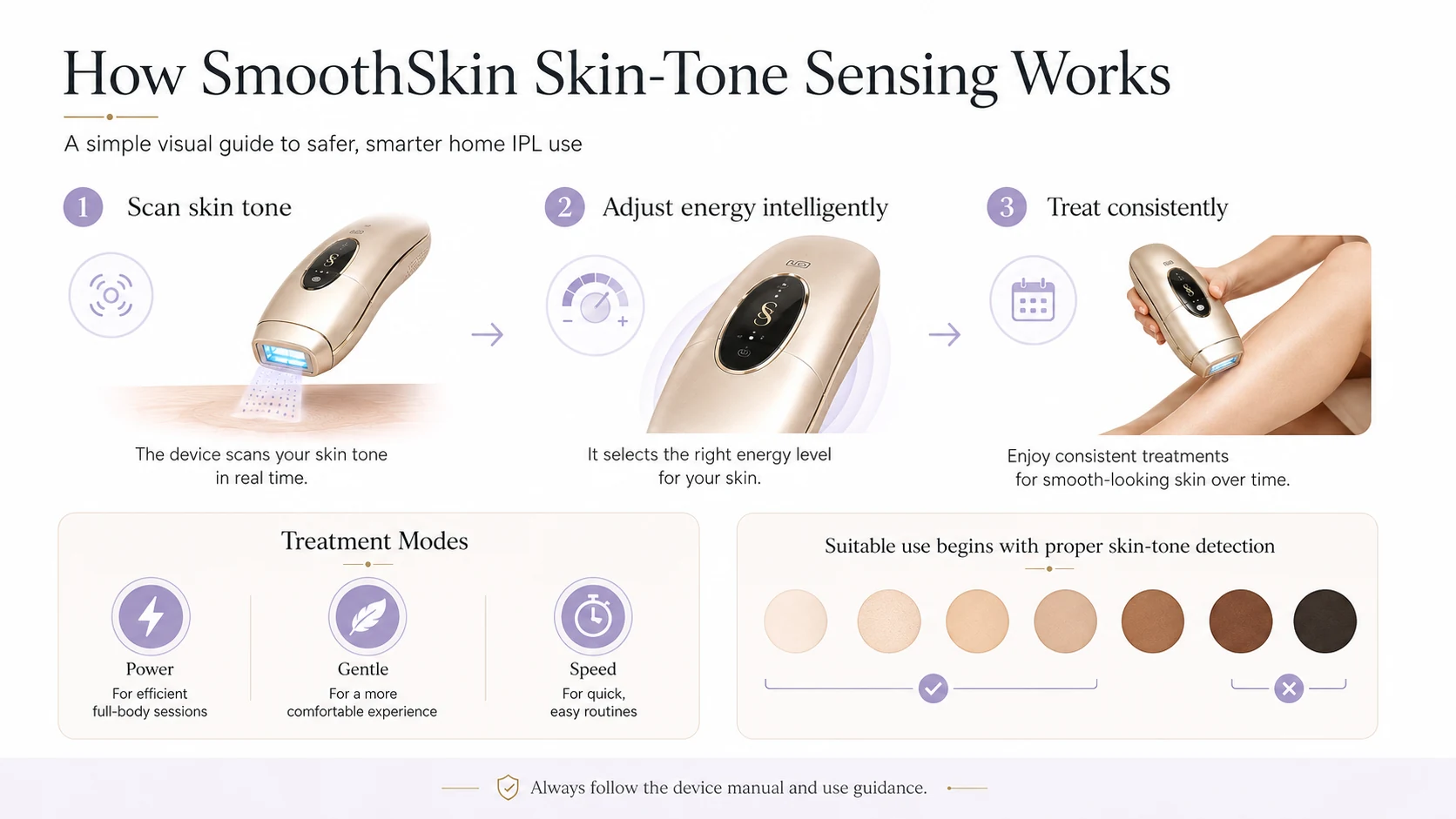
This matters because IPL relies on melanin absorption. The device needs enough contrast between hair pigment and surrounding skin for light energy to preferentially target the hair while limiting unnecessary absorption by the skin.
Automatic sensing should therefore be viewed primarily as a safety and dose-selection feature. It does not make every skin tone or hair color suitable for IPL.
People with very light, red, grey or white hair may respond poorly because those hair colors contain too little of the type of melanin IPL depends on. Deeper skin tones can also absorb more light energy at the skin surface, which can limit suitability for some home IPL devices.
For more detail, see Is Your Skin Tone & Hair Color Suitable for At-Home IPL? and Best IPL Hair Removal Device for Dark Hair.
Does Higher IPL Energy Automatically Mean Better Results?
No. Joules per square centimeter are useful when comparing technical specifications, but a higher maximum number does not automatically make one IPL device better.
Actual treatment performance also depends on factors such as:
- hair and skin contrast;
- how consistently the device can be used;
- treatment-window contact;
- flash repetition speed;
- coverage and missed spots;
- treatment schedule;
- comfort at usable energy levels.
A theoretically powerful device is not especially useful if discomfort causes someone to skip treatments or use it inconsistently.
That is why features such as cooling, adaptive heads and comfort modes can matter even though they do not directly increase IPL energy.
Which SmoothSkin Model Is Better for the Face?
For facial use, the most important questions are not simply device size or headline power. Look at whether the model provides good contact on small areas, whether an appropriate precision attachment is available, whether your skin tone and hair color are suitable, and whether the manufacturer allows use on the intended facial area.
Pure Fit includes a precision adaptor, while Pure Switch uses multiple treatment heads. These features can make positioning easier on smaller external facial zones than relying only on a larger body-oriented window.
IPL should not be treated as a general-purpose facial light treatment. Follow the manufacturer's permitted treatment zones and avoid eyes, eyebrows and other areas excluded in the instructions.
For a more detailed facial buying guide, read Best IPL Hair Removal Device for Face, Chin & Upper Lip.
Which SmoothSkin Model Is Better for Legs and Full-Body Use?
For legs or regular full-body treatments, speed and coverage become more important. A difference of a few seconds on the upper lip means very little; over two legs, underarms and the bikini line, repetition rate and ease of gliding can have a much larger effect on the overall routine.
Pure Switch has the fastest current manufacturer-estimated full-body treatment time in the SmoothSkin comparison range, while Pure Adapt and Pure Fit are listed at around 10 minutes.
Those numbers should not be read as guarantees. Real treatment time changes with body size, treatment technique and how frequently the device needs to be repositioned.
See also Best IPL Hair Removal Device for Full Body Use and Best IPL Hair Removal Device for Legs.
Which SmoothSkin Model Is Better for Underarms or Bikini Line?
Underarms and the bikini line often have denser, coarser hair and more curved treatment surfaces than the legs. That makes comfort, contact and precise positioning particularly relevant.
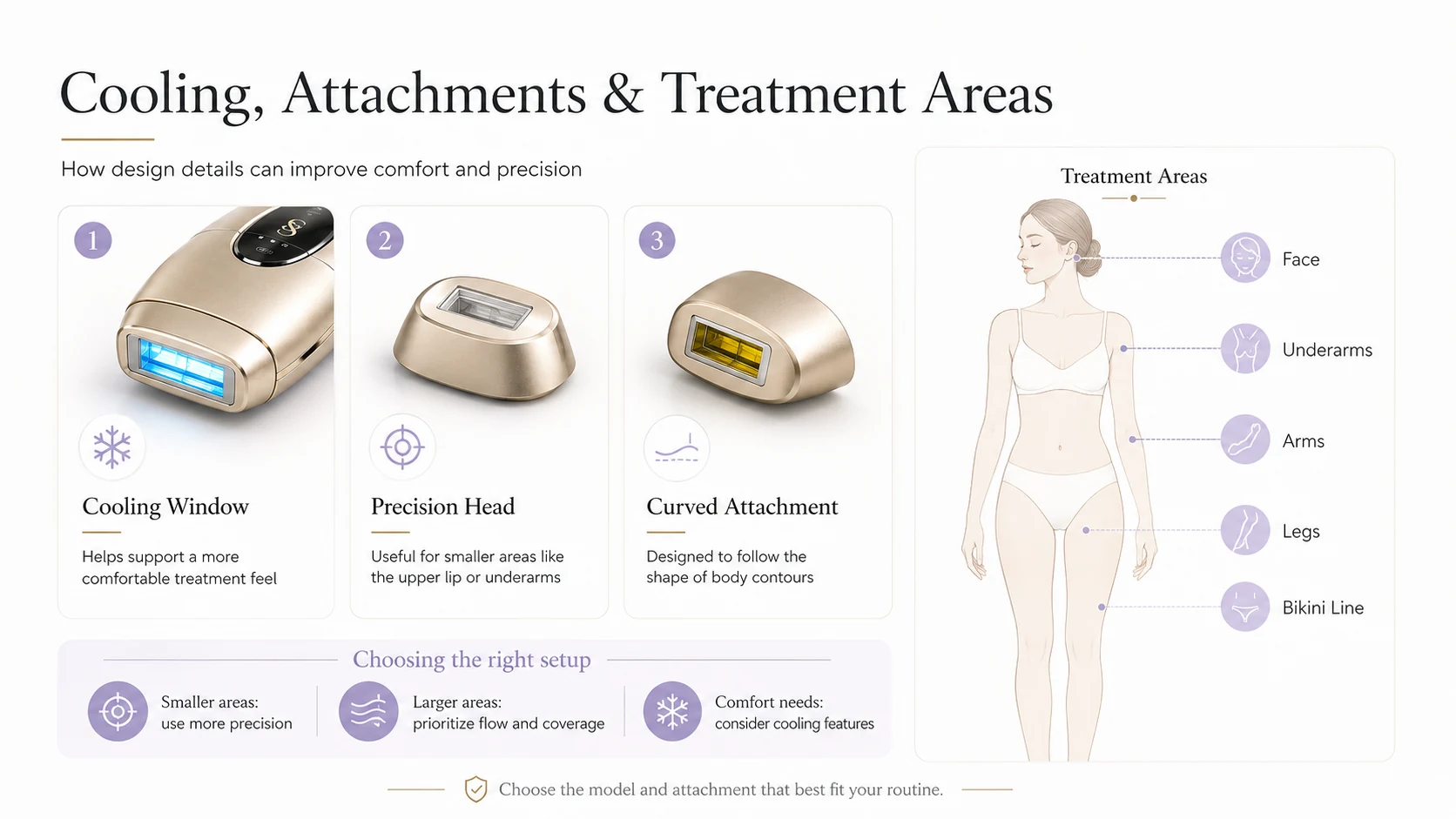
Pure Switch may be worth comparing if cooling is the priority. Pure Adapt is relevant if maintaining contact on curved areas is more important. Pure Fit may appeal to users who prefer a separate precision attachment.
None of those features removes the need to follow normal IPL suitability rules.
For these treatment areas, see:
- Best IPL Hair Removal Device for Underarms
- Best IPL Hair Removal Device for Bikini Line
- Does IPL Work on Coarse Hair?
How Often Do You Use SmoothSkin IPL?
SmoothSkin currently recommends an initial treatment schedule of approximately once per week for 12 weeks on several of its models, followed by maintenance treatments as needed. Pure Adapt guidance, for example, describes maintenance top-ups approximately every 4–8 weeks after the initial course.
The reason IPL requires repeated treatment is biological rather than brand-specific. Hair follicles are not all in the same growth phase at the same time, so a single session cannot effectively target every hair that may later become visible.
For more context on scheduling and early progress, see When Should You Start Seeing IPL Results? and How Long Should You Do Weekly IPL Sessions Before Switching to Maintenance?.
What Results Does SmoothSkin Claim?
SmoothSkin publishes clinical-performance claims for several devices. For example, the company states that some current Pure models can show visible reduction after the first few treatments and reports higher percentage reductions after a complete 12-week course.
These figures should be interpreted carefully. Clinical study results describe outcomes under defined study conditions and do not mean every person will experience exactly the same percentage of hair reduction.
Real-world response can vary with:
- hair color;
- skin tone;
- hair density;
- body area;
- hormonal factors;
- treatment consistency;
- energy level tolerated and used.
A more useful way to judge progress is to watch for slower regrowth, fewer visible hairs and longer periods of smoothness rather than expecting all hair to disappear immediately.
See How Do You Know If IPL Is Helping Even Before Hair Falls Out?.
Is SmoothSkin FDA Cleared?
SmoothSkin describes its U.S. IPL range as FDA cleared. The U.S. Food and Drug Administration's 510(k) database also lists SmoothSkin BARE+ under clearance K192010, classified as a light-based over-the-counter hair-removal device and submitted by Cyden Limited.
It is important not to treat one 510(k) record as proof that every later model is cleared under that exact number. FDA regulatory status should always be checked for the specific device or regulatory pathway when that information matters to a purchasing or compliance decision.
SmoothSkin vs Braun, Philips and Ulike: What Is the Main Difference?
There is considerable overlap between premium home IPL brands, so comparing only maximum energy or the number of modes can be misleading.
A more useful comparison is each brand's design emphasis:
- SmoothSkin: automatic skin sensing, fast treatment, contour/precision options and, on Pure Switch, cooling.
- Braun Silk-expert: strong emphasis on automatic skin-tone adaptation and guided treatment accessories.
- Philips Lumea: multiple body-specific attachments and a large model family with feature differences across series.
- Ulike: cooling is a major part of the product experience across several recent models.
These differences do not establish a universal winner. The better device depends on treatment areas, skin and hair suitability, comfort preferences, budget and how likely the user is to follow the treatment schedule consistently.
Who Might Prefer SmoothSkin?
SmoothSkin may be especially relevant to compare if you value one or more of the following:
- automatic skin-tone sensing;
- fast repetitive flashing for larger areas;
- a relatively simple weekly treatment routine;
- precision or contour-focused treatment heads;
- cooling on higher-end models;
- a UK-developed IPL platform with a long history in home light-based hair reduction.
Someone who mainly wants the lowest possible purchase price, a cordless design or a device specifically engineered for skin tones outside the permitted SmoothSkin range may need to compare other options.
What to Check Before Choosing Any SmoothSkin IPL
Before choosing between SmoothSkin models, check these factors in this order:
- Skin-tone and hair-color compatibility. If the combination is not suitable, extra features do not solve the basic limitation.
- Treatment areas. Small facial areas and full legs place very different demands on window shape and speed.
- Comfort. Cooling or Gentle modes may matter if discomfort prevents consistent use.
- Contact and coverage. Missed spots reduce consistency even when the device itself is powerful.
- Routine. Choose a device you can realistically use repeatedly over the initial treatment period.
- Current price. SmoothSkin pricing and promotions change, so compare current prices rather than treating MSRP as fixed.
For a brand-neutral checklist, see What Should You Look For in the Best At-Home IPL Device?.
Frequently Asked Questions
Is SmoothSkin a laser hair removal device?
No. SmoothSkin home hair-removal devices discussed in this guide use IPL, or intense pulsed light. IPL uses broadband light rather than the more concentrated wavelength approach associated with a true laser device.
Which SmoothSkin IPL has cooling?
Pure Switch is the current SmoothSkin model distinguished by sapphire ice-cooling technology. Pure Adapt, Pure Fit and the Pure Mini models do not use the same built-in cooling system.
What is the difference between Pure Adapt and Pure Fit?
Both are premium SmoothSkin IPL devices with automatic skin-tone sensing and multiple comfort settings. Pure Adapt's defining feature is its curved adaptive treatment head, while Pure Fit uses a more traditional main treatment window with a detachable precision adaptor.
Is Pure Switch more powerful than Pure Adapt?
Both currently list a maximum energy level around 6 J/cm². Pure Switch adds a broader stated energy range beginning around 2 J/cm², cooling and different treatment heads. The practical difference is therefore not simply maximum power.
Can SmoothSkin be used on facial hair?
Certain SmoothSkin devices can be used on permitted external facial treatment areas when the user's skin tone and hair color are suitable. Users should follow the model-specific instructions carefully and avoid prohibited areas such as around the eyes.
Does SmoothSkin work on grey, white or red hair?
IPL generally performs poorly on grey and white hair because there is insufficient melanin for the light to target effectively. Red hair contains a different melanin profile and may also respond poorly. SmoothSkin advises users to check its hair-color and skin-tone suitability guidance before treatment.
Do SmoothSkin IPL devices have unlimited flashes?
SmoothSkin markets several current Pure models as having unlimited flashes. In practical terms, this removes the need to compare products primarily by a fixed flash-counter number.
How long does a SmoothSkin treatment course take?
SmoothSkin commonly recommends weekly treatment for around 12 weeks during the initial phase, followed by maintenance treatments. Individual progress varies, so the schedule should not be interpreted as a guarantee that everyone reaches the same result at week 12.
Other IPL Brand Guides
If you are comparing SmoothSkin with other established home IPL brands, these guides cover their model structures and technology in the same brand-neutral format:
- Philips Lumea IPL Hair Removal Devices: Models, Features and What Sets Them Apart
- Braun IPL Hair Removal Devices: Models, Features and What Sets Them Apart
- Ulike Laser Hair Removal Devices: IPL Models, Features and What Sets Them Apart
Related Reading
- Best IPL Hair Removal Device for the Money: What Matters at $50, $100 and $300+
- Best IPL Hair Removal Device for Beginners: 7 Features That Matter
- Best IPL Hair Removal Device for Full Body Use: 7 Features That Matter
- Best IPL Hair Removal Device for Face, Chin & Upper Lip: 7 Features That Matter
- Best IPL Hair Removal Device for Sensitive Skin: 7 Features That Matter
- Best IPL Hair Removal Device for Dark Hair: 7 Features That Matter
- Does IPL Work on Coarse Hair? A Complete Guide for Thick Hair Users
- Ice Cool IPL vs Regular IPL: Is Cooling Worth It for At-Home Hair Removal?
- IPL vs. Laser Hair Removal: What’s the Difference?
Sources and Reference Documents
This article prioritizes manufacturer documentation and regulatory records for model specifications. Product availability, pricing and specifications can change, so always check the current model page and user manual before purchase or use.
- SmoothSkin — Compare IPL Devices
- SmoothSkin — Pure Switch
- SmoothSkin — Pure Adapt
- SmoothSkin — Pure Fit
- SmoothSkin — Pure Mini
- SmoothSkin — User Guides
- U.S. FDA — SmoothSkin BARE+ 510(k) K192010
Editorial note: Mithlux does not use one specification, maximum energy number or manufacturer claim as proof that one IPL device is universally better than another. Model comparisons should consider suitability, treatment area, comfort, coverage, treatment speed, safety features and the user's ability to follow a consistent routine. Manufacturer-reported clinical results describe study populations and should not be interpreted as guaranteed individual outcomes.