
MITHLUX · Official IPL Device Store
Direct answer: Yes, IPL can be helping even before hair visibly falls out. Early signs often look less dramatic than people expect: slower regrowth, softer or finer-looking hair, slightly patchier return, or the feeling that you need to shave a little less often. In many routines, visible shedding comes later than these earlier signs.
That delay is one reason people get discouraged too early. They expect “working” to mean obvious hair release right away, when in real home use it often means the area is beginning to change before it looks impressively different. Hair may still be present, but its return pattern can already be shifting.
If you are still judging your routine mainly by whether hair has fallen out yet, it helps to use a broader standard. This guide looks at the small but meaningful clues that can suggest your IPL routine is moving in the right direction before shedding becomes obvious.
If you want the bigger timeline first, start with When should you start seeing IPL results? and How long after IPL does hair fall out?
Why hair does not always fall out right away
IPL does not usually create one instant “release moment” for every hair. Light-based hair removal works gradually, and repeated sessions are often needed because hair grows in cycles rather than all at once. Mayo Clinic notes that treated hairs often shed over a period of days to weeks, not immediately, and that repeated treatments are usually necessary because hair growth and loss happen in a cycle. The American Academy of Dermatology also notes that multiple sessions are commonly needed rather than one dramatic treatment. For general background, see Mayo Clinic and AAD.
That means “no obvious fall-out yet” does not automatically mean “nothing is happening.” Sometimes the earlier clue is not shedding itself, but a slower or weaker-looking regrowth pattern.
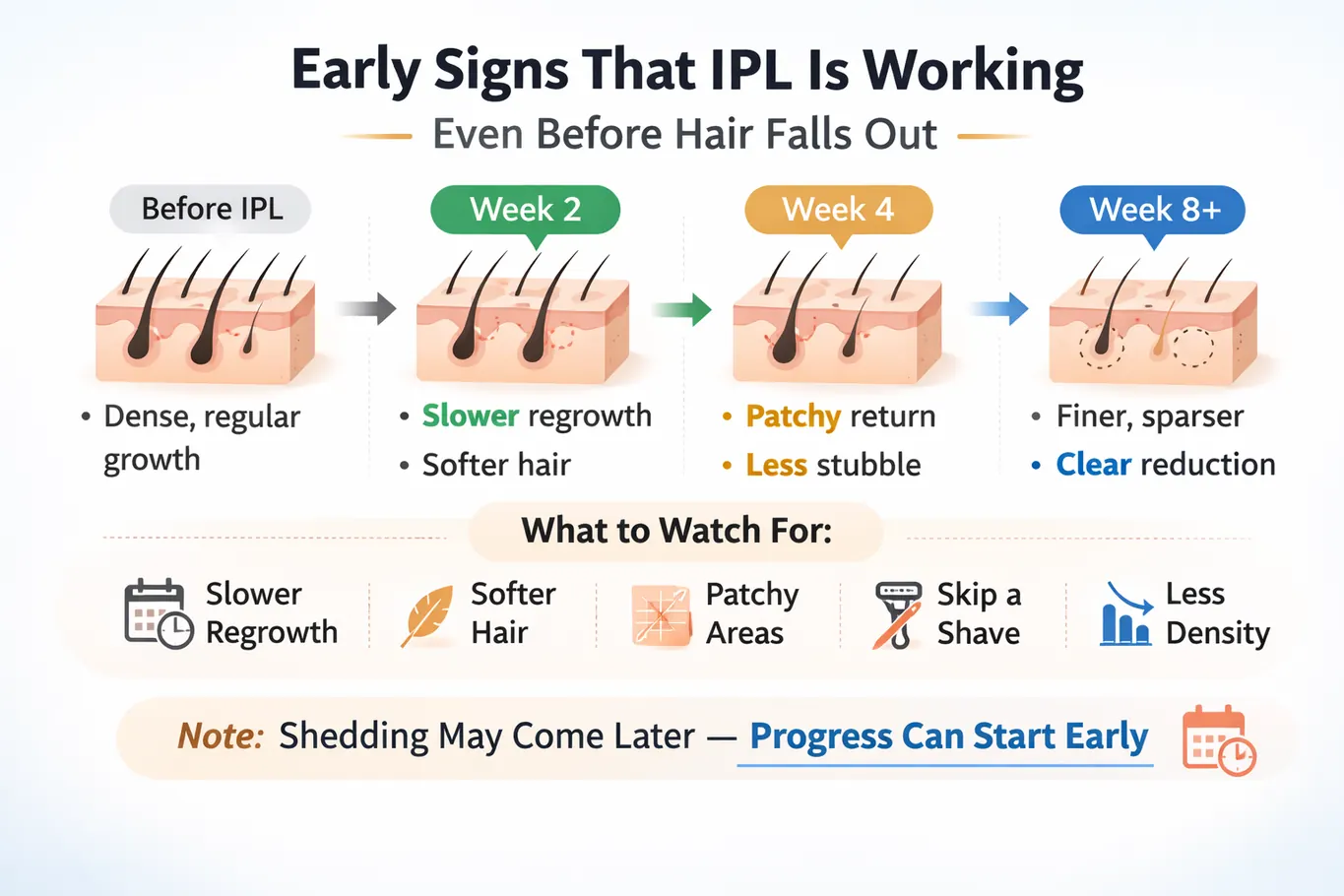
Early signs IPL may be helping before shedding starts
Before hair visibly falls out, many people notice smaller signs first. These signs are easy to miss because they do not always look dramatic.
- Slower regrowth: the area still grows hair, but it seems to come back more slowly than before.
- Softer return: some hairs may look a little less coarse or feel less “stubbly” than usual.
- Patchier comeback: hair may return unevenly rather than in a uniform way.
- Less urgency to shave: you may still shave, but the area may feel a little less “immediately overgrown.”
- Clearer differences between areas: one body area may start changing before another.
None of these signs prove a perfect long-term result on their own. But together, they often suggest the routine is doing something before visible hair release catches up.
What slower regrowth can look like in real life
Slower regrowth is one of the easiest early signs to overlook because people often expect shedding, not timing changes.
In practice, slower regrowth can mean:
- the area looks “about the same,” but the stubble takes longer to become obvious,
- you notice a little more smooth time between shaves,
- the area still grows hair, but not with the same speed or density as before.
This is especially easy to miss if you are checking every day. Daily checking can make normal gradual progress feel invisible. Looking at the area over a longer gap often tells you more than staring at it constantly.
If you tend to feel stuck in this stage, read IPL Isn’t Instant: The Most Common “It’s Not Working” Misunderstandings (With a Realistic Timeline).
Can finer or softer-looking hair be a good sign?
Sometimes, yes. Hair does not always go straight from “normal” to “gone.” In some routines, a useful early sign is that regrowth seems less coarse, less dense, or easier to manage.
This does not happen in every area at the same pace, and it is not a guarantee that all hair will continue improving quickly. But if you notice that the area is becoming a little less stubborn before shedding becomes obvious, that can still fit a normal improvement pattern.
If hair looks strange or seems different in a confusing way, compare it with Why Hair Can Look Thicker After IPL (And Why It Usually Isn’t).
What patchy return may mean before visible shedding
Patchiness often makes people nervous, but it can be one of the clearest early signals that the area is not behaving exactly as it did before.
Patchy return may look like:
- one strip or side filling in faster than another,
- some hairs staying firm while others look delayed,
- certain spots seeming “behind” or “ahead” instead of everything changing evenly.
That does not always mean your technique was perfect. Sometimes missed spots are real. But some unevenness can also happen because body areas differ in density, hair thickness, and responsiveness.
If this is what you are noticing, these pages may help: Patchy IPL Results: How to Fix Missed Spots Without Over-Flashing and Why IPL Works on Some Areas but Not Others (Legs vs Underarms vs Face).
How soon should you expect these early signs?
There is no single perfect timeline for everyone, but many users start looking for these earlier clues in the first few weeks rather than waiting only for major shedding.
- By around week 2: you may notice slower return, subtle patchiness, or a slight change in hair texture.
- By around week 4: the pattern may become easier to judge, even if the area is still far from smooth.
- By around week 8: clearer trend direction usually matters more than one dramatic moment.
If you want a fuller week-by-week perspective, read What Does “Working Normally” Look Like After 2, 4, and 8 Weeks of IPL?
What does not automatically mean “it’s working”?
It is also worth being realistic. Not every small change proves that your routine is on track.
Be cautious about overreading things like:
- one good-looking day after shaving,
- changing levels constantly and mistaking irritation for “stronger effect,”
- judging by sensation alone,
- assuming that visible heat or redness is the same thing as progress.
For example, not feeling much does not automatically mean failure, but feeling more does not automatically mean success either. If that question is on your mind, see Why You Feel Nothing at Higher Levels (And Why That Doesn’t Mean It’s Not Working) and IPL Doesn’t Hurt (No Redness) — Is It Still Working?.
Why different areas can show early progress differently
One reason people doubt their routine too early is that they compare two body areas as if they should behave identically.
That is rarely how it works. Legs, underarms, upper lip, chin, and bikini line may all show early “helping” signs differently. One area may show slower regrowth first. Another may show patchy return. Another may show very little visible change early on but improve later.
This is especially common when:
- hair thickness varies by area,
- skin tone is not perfectly even everywhere,
- your flash placement is more controlled in one area than another,
- you are naturally more cautious in one zone than another.
If you want a useful comparison example, read Can You Treat Underarms and Bikini Line on the Same Day? Spacing, Levels, and What to Adjust.
What if you still see no shedding after several sessions?
If shedding is still not obvious after several consistent sessions, that does not always mean failure — but it does mean you should assess more than just your patience.
Check whether:
- you are following a consistent interval,
- the area is actually suitable for IPL,
- you are placing flashes methodically rather than rushing,
- the hair in that area is dark and responsive enough,
- you are changing your plan too often to judge it properly.
If needed, review How do you perform a patch test before IPL?, How to Choose a Starting Level for Home IPL, and Why isn’t my at-home IPL working? (Quick checklist).
When should you stop waiting and reassess?
Waiting patiently is useful, but not forever. AAD and Mayo Clinic both emphasize that light-based hair removal generally requires multiple sessions and realistic expectations, but they also treat it as a procedure that should be approached carefully rather than pushed blindly. If you are seeing ongoing irritation, very poor suitability signs, or no useful trend after consistent routine use, it may be smarter to reassess rather than simply keep repeating the same plan. For general patient guidance, see AAD overview and Mayo Clinic.
You should step back sooner if:
- the area repeatedly reacts badly,
- you are treating near places you should avoid,
- your skin tone or hair color fit is questionable,
- you keep escalating intensity without a clear reason.
In those cases, “waiting for shedding” is not the real issue. Suitability, technique, or routine quality may be the bigger question.
Final takeaway
IPL can be helping even before hair visibly falls out. Early signs often show up as slower regrowth, softer return, patchier comeback, or simply a clearer sense that the area is becoming easier to manage. Visible shedding matters, but it is not the only early sign that your routine may be moving in the right direction.
The best way to judge progress is not to wait for one dramatic “success moment.” It is to look for gradual direction: slower return, calmer routine, better manageability, and a more obvious pattern over time.
Sources & references
Related content
- What Should You Do If You See No Results After 4 Weeks of IPL?
- Why IPL Results Can Be Slow Even If You’re Doing Everything Right (Weeks 4–8 Explained)
- Underarm IPL results timeline: when does hair start reducing?
- IPL Bikini Line Results Timeline: What to Expect Week by Week
- How Long Does Upper Lip IPL Take to Work? Timeline Week 1–12 + Maintenance
- IPL Hair Removal Schedule