
MITHLUX · Official IPL Device Store
Short answer: Mild darkening or uneven tone after at-home IPL is often temporary—especially if it looks like “shadowing” from stubble or mild irritation. The safest response is to pause, calm the skin, and fix the likely trigger (over-flashing, sun exposure, or irritating skincare). If you have blistering, strong heat, swelling, or a tender dark spot, stop sessions and seek medical advice.
“My skin looks darker” can mean a few different things: leftover stubble shadow, a mild irritation response, or (less commonly) a burn-related pigment change. The key is not to panic—and not to “test again” with more flashes. In troubleshooting, more flashing is usually the wrong move.
If you want the full map of common issues, start here: IPL Troubleshooting Hub.
First, identify what you’re seeing (shadow vs irritation vs warning)
A simple way to sort it: Shadowing often looks speckled and follows hair follicles. Irritation often looks like diffuse redness or patchy tone and improves as skin calms. Warning signs usually involve escalating pain, heat, swelling, blistering, or marks that don’t improve.
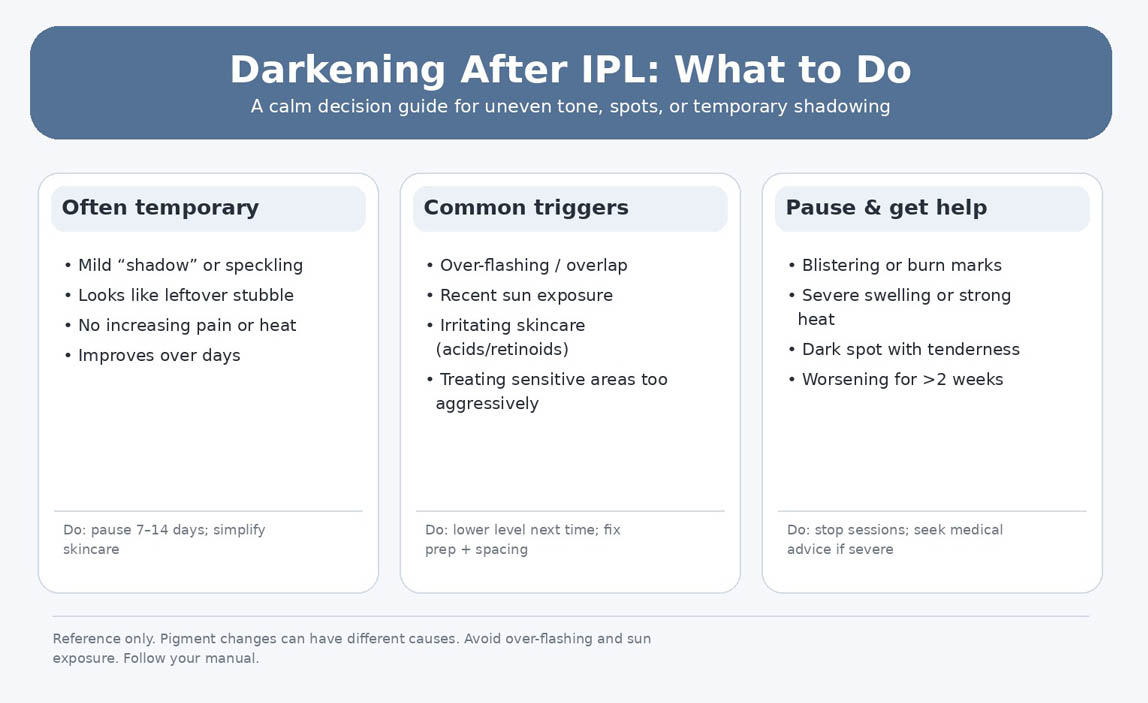
What’s often temporary (and usually improves)
- Follicle “shadow” (speckled look that matches hair follicles, especially underarms or bikini)
- Mild uneven tone after a session that improves over a few days
- Light redness that fades and does not build
If your skin is calm (no increasing pain/heat), the safest move is to pause and let the surface fully settle. A simple aftercare guide is here: What skincare is safe in the first 24–48 hours after IPL?
Common triggers that cause darkening or uneven tone
Most “tone issues” are a predictable combo of heat + irritation. The most common triggers are:
- Over-flashing / overlap: repeating passes on the same spot to “fix” missed areas
- Sun exposure: treating recently tanned or sun-exposed skin increases risk
- Irritating skincare too close to sessions: acids, retinoids, benzoyl peroxide, strong “brightening” products
- Using the same approach on a more sensitive area: underarms/face often need lower levels and slower technique
If patchiness caused you to overlap, use a safer coverage method instead of repeats: Patchy results: fix missed spots without over-flashing.
A safe reset plan (simple, conservative, effective)
- Pause first: give the area time to calm (commonly 7–14 days for mild irritation; longer if still tender).
- Keep skincare boring: gentle cleanse + basic moisturizer. Skip actives until fully normal.
- Avoid heat stacking: no “extra test flashes” to check if it’s working.
- Reduce risk next time: restart 1–2 levels lower, slow technique, and avoid tight overlap.
- If you’re unsure, patch test: treat a small area and wait 24 hours before resuming full coverage.
For how to restart safely, use: How to perform a patch test before IPL and When should you pause IPL?
When to pause and seek help
Stop sessions and get medical advice if you have:
- Blistering, crusting, or burn-like marks
- Severe swelling or skin that feels very hot
- A dark spot that is tender or painful to touch
- Symptoms that worsen or don’t improve over 2+ weeks
Sources & references (third-party, verifiable)
- DermNet NZ — Intense pulsed light (IPL) overview: dermnetnz.org
- NCBI Bookshelf (StatPearls) — Intense Pulsed Light (IPL) Therapy: ncbi.nlm.nih.gov
Note: Education only. Follow your device manual and avoid over-flashing. Seek medical advice for severe or persistent symptoms.
Part of this hub: IPL Troubleshooting Hub