
MITHLUX · Official IPL Device Store
Short answer: If IPL “isn’t working,” the most common hidden issue isn’t power—it’s consistency. Hair grows in cycles, and missed weeks (or frequent stop-start resets from irritation) can delay visible reduction even when your device is fine.
Here’s the calm truth: IPL is a routine-based device. If your schedule has been chaotic lately—poor sleep, high stress, lots of “I’ll do it tomorrow,” or frequent breaks because your skin felt irritated—your results can look slower even when you’re doing the steps correctly.
This page helps you diagnose the “consistency problem” and build a routine that survives real life—without over-flashing or chasing higher levels.
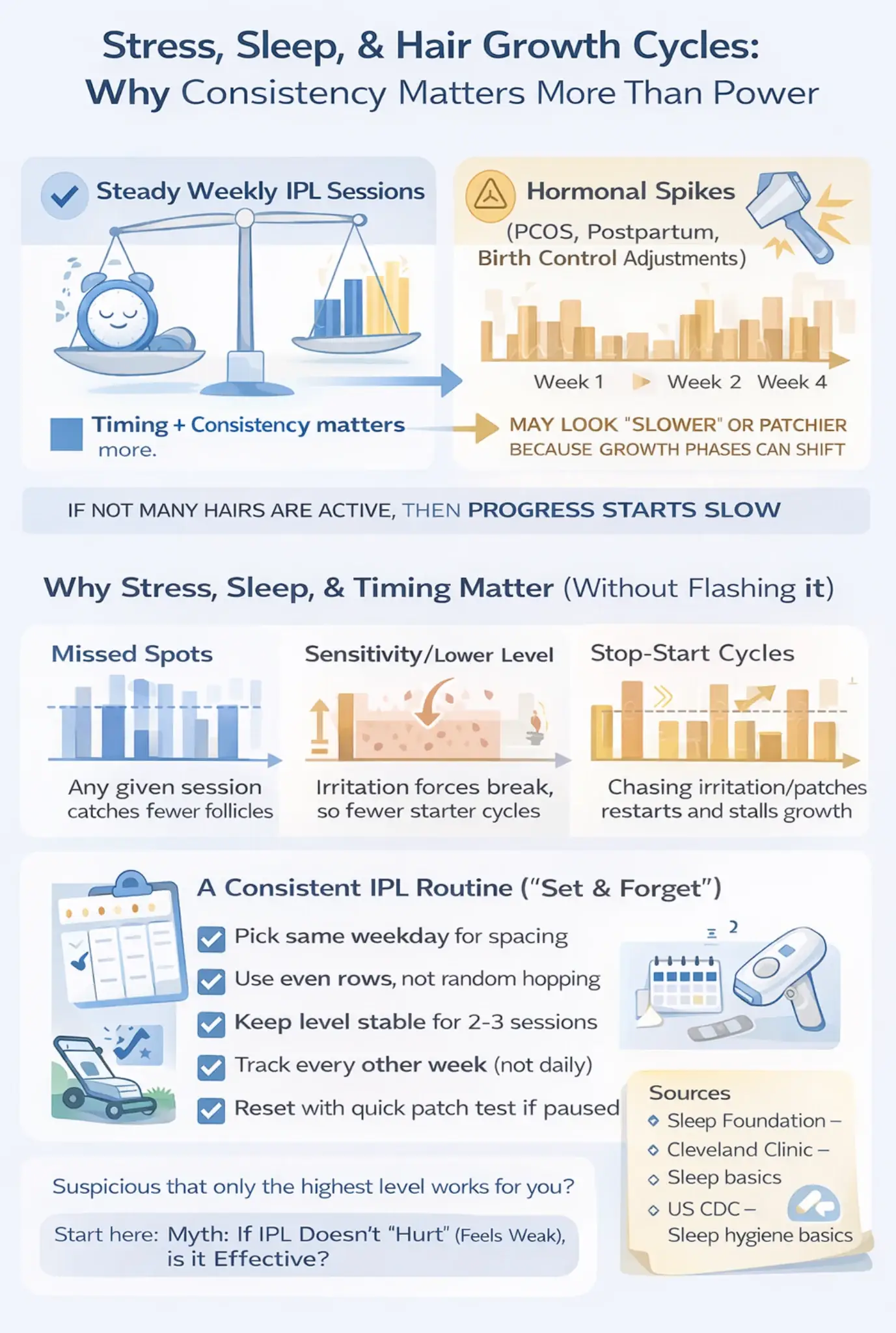
Why “life changes” can make IPL feel slower
IPL works best when you repeatedly treat hair in the right growth phases over multiple weeks. That’s why you’ll often see the most noticeable progress after you’ve built steady sessions over time. If your routine is inconsistent, you can accidentally keep “missing the window” for a portion of hairs, and progress looks delayed.
Realistic note: IPL progress is usually gradual. If you’re currently around weeks 3–6 and feeling impatient, you may want this first: Why results can be slow (and still normal).
The hair-cycle trap: why missed weeks matter
Hair doesn’t grow all at once. Different follicles are active at different times, which is exactly why IPL needs repeated sessions. Missing sessions doesn’t “ruin everything,” but it can slow the moment you first notice clear reduction—especially in stubborn areas.
- If you skip a week: keep going—don’t double up the next day.
- If you skip 2–3+ weeks: restart gently (patch test + conservative level) before you ramp back up.
- If you’re tempted to “make up for it” with extra passes: don’t—coverage beats heat stacking.
If you’re unsure how to restart safely, use: How to perform a patch test before IPL.
Stress and sleep: what they can change (and what they can’t)
Stress and sleep don’t “cancel IPL.” But they can indirectly affect what you notice: skin can become more reactive, you may pause more often, and your schedule becomes less consistent. The result is usually a routine problem, not a device problem.
If your skin started feeling more sensitive (stingy, redder than usual), don’t force it. Use a simple stop rule and reset plan: Redness after IPL: what’s normal vs when to pause.
A routine that actually sticks (even when you’re busy)
You don’t need motivation. You need a system. Try this “minimum viable routine”:
- Pick one fixed day each week (same weekday, same time window).
- Keep sessions smaller (one or two zones) rather than “full-body marathons.”
- Make coverage easy: move in tidy rows; don’t chase missed spots by double-flashing.
- Write it down: a 10-second note like “Week 4 — underarms — level 3.”
If you keep missing patches, this is the clean fix: What to do about missed patches (without over-flashing).
When to suspect it’s not “consistency”
If you’ve truly been consistent for several weeks and still see nothing, check these two common misreads first:
- “No pain / no redness = not working” — not necessarily. Read: IPL doesn’t hurt—Is it still working?
- Suitability mismatch (skin tone + hair color). Use the guide: Skin tone & hair color guide for IPL
A gentle expectation check (so you don’t over-correct)
The fastest way to sabotage IPL is to panic and “do more” (more sessions, more passes, higher level) before your skin is ready. Instead, anchor your expectations to a realistic timeline: How long does it take to see results with IPL?
Sources & references (third-party, verifiable)
- CDC — Sleep and sleep health basics: https://www.cdc.gov/sleep/
- NIH MedlinePlus — Hair loss overview (for understanding hair biology context): https://medlineplus.gov/hairloss.html
- Sleep Foundation — How sleep affects the body (general reference): https://www.sleepfoundation.org/
Part of this hub: Back to IPL Troubleshooting