
MITHLUX · Official IPL Device Store
Short answer: Most “IPL isn’t working” situations are actually timeline problems—not power problems. In the first 1–3 weeks, it’s normal to see little change. Real reduction usually shows up gradually over weeks 4–8 with consistent weekly use.
Here’s the honest part most brands won’t say clearly: IPL is a routine. If you treat it like a one-time test, your results will look like “nothing happened.” The device might be doing its job—but hair cycles don’t move on your schedule.
Why early IPL sessions can look “unchanged” (even when you’re doing it right)
IPL works best when more hairs are in the growth phase (anagen). Your first few sessions don’t magically “erase” hair—what they do is start nudging follicles so that over the next few weeks, more hairs grow back weaker, slower, or stop returning.
So in the beginning, you can be perfectly consistent and still think: “Why do I still have hair?” Because the hair you’re seeing today may have already been on its way out of the follicle cycle before your first treatment.
The 6 most common “not working” misunderstandings (and the fix)
1) “I did 1–2 sessions. Nothing changed.”
This is the #1 misunderstanding. One or two sessions is typically not enough to judge results. The better question is: Are you consistent weekly for several weeks?
Fix: Commit to a clean starter routine and evaluate around weeks 4–8, not days 3–10.
2) “I expected hair to fall out like waxing.”
IPL isn’t waxing. With waxing, hair is physically removed. With IPL, hair growth gradually reduces. Some hairs may shed, but many will simply return thinner or slower first.
Fix: Track progress by how fast hair returns and how coarse it feels, not by instant hair-free skin.
3) “It doesn’t hurt, so it must not work.”
Sensation varies wildly by area (legs vs underarms vs face), skin moisture, hair density, and your starting level. No pain does not automatically mean no effect.
Fix: Use a safe level you can repeat consistently. If you’re unsure, compare your situation to this troubleshooting page: IPL Doesn’t Hurt (No Redness) — Is It Still Working?
4) “I keep increasing power to ‘force results’.”
Power chasing is a classic trap. Higher levels can increase irritation risk and make you skip sessions—which is the fastest way to slow results.
Fix: Prioritize consistency. If you’re tempted to “push through,” use a stop-rule mindset: When should you stop IPL and seek medical advice?
5) “I’m re-flashing missed areas to ‘even it out’.”
Over-flashing is one of the easiest ways to irritate skin while still not improving coverage. The better fix is spacing and method, not extra passes.
Fix: If you’re getting patchy results, use this correction guide: Patchy IPL Results: How to Fix Missed Spots Without Over-Flashing
6) “I changed three variables at once.”
Switching level, method, frequency, and skincare in the same week makes it impossible to know what helped—or what caused irritation.
Fix: Change one thing at a time. If you recently added strong skincare, read: Retinol, Acids, Benzoyl Peroxide: When Skincare Makes IPL Feel Worse
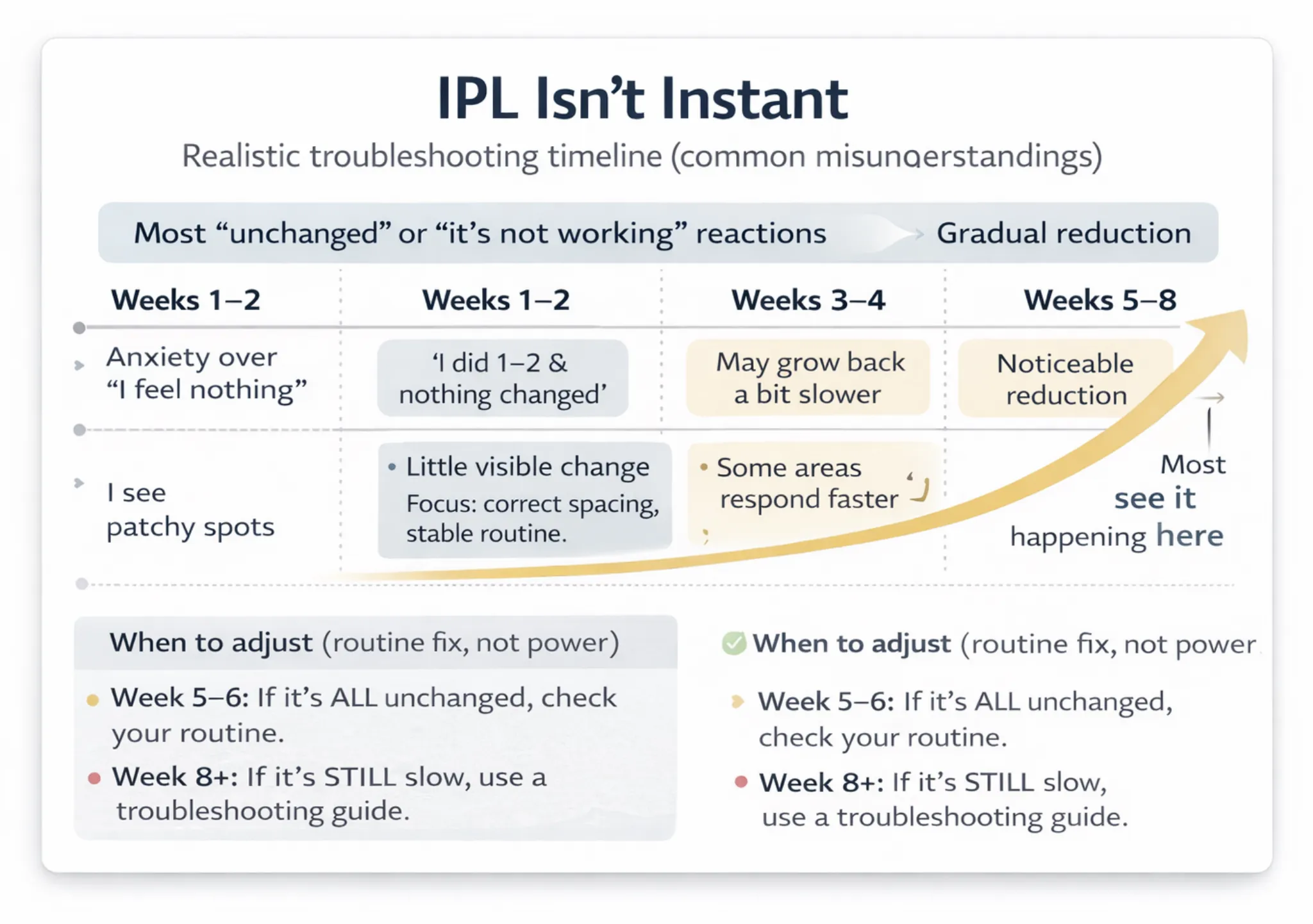
A realistic timeline you can actually use (weeks 1–8)
Weeks 1–2: “Feels like nothing” is common
- Little visible change is normal.
- Focus: correct spacing, consistent weekly sessions, and stable routine.
- If you feel nothing and worry, compare with: No pain / no redness troubleshooting.
Weeks 3–4: the first “signals” often appear
- Hair may grow back a bit slower.
- Some areas respond earlier than others.
- If only some areas improve, read: Why IPL Works on Some Areas but Not Others.
Weeks 5–8: where most people finally say “okay, I see it”
- Reduction becomes more noticeable, especially on legs/arms.
- Underarms/face can be slower or more variable.
- If you’re doing everything right and it’s still slow, this is your map: Why IPL Results Can Be Slow (Weeks 4–8 Explained).
Two “quiet” factors that can slow results (without you realizing)
- Hormones: cycles like postpartum, PCOS, or birth control changes can affect growth patterns. See: Hormones and IPL: Why Results Can Be Slower.
- Stress & sleep: if your routine becomes inconsistent, results stall fast. See: Stress, Sleep, and Hair Growth Cycles.
A simple “progress check” that doesn’t lie to you
- Pick one test area (e.g., one lower leg strip).
- Keep weekly sessions steady for 4 weeks.
- Measure: “How many days until stubble returns?”
- If growth slows, IPL is working—even if you’re not hair-free yet.
Back to the Troubleshooting hub: https://www.mithlux.com/ipl-troubleshooting/
Related content
- Why IPL Results Can Be Slow Even If You’re Doing Everything Right (Weeks 4–8 Explained)
- IPL Doesn’t Hurt (No Redness) — Is It Still Working?
- Why IPL Works on Some Areas but Not Others (Legs vs Underarms vs Face)
- Patchy IPL Results: How to Fix Missed Spots Without Over-Flashing