
MITHLUX · Official IPL Device Store
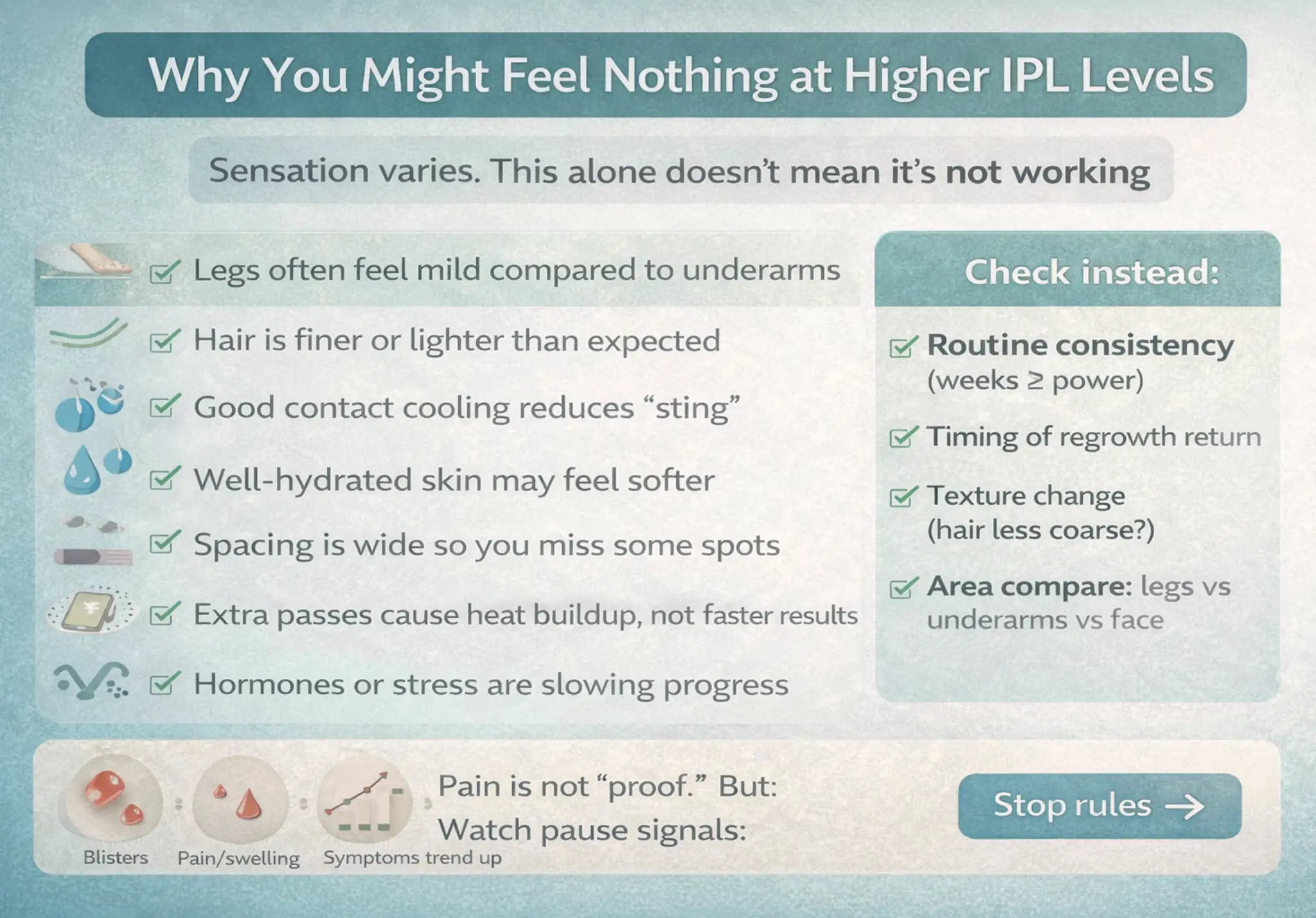
Short answer: Feeling little or nothing at higher IPL levels is often normal. Sensation depends on area, hair density, skin hydration, contact, and timing. What matters more is a consistent routine and safe technique—pain is not a reliable “proof of effectiveness.”
I get why this makes people uneasy. In your head, “higher level = should feel stronger.” But with IPL, sensation is a messy indicator. You can feel a lot and get irritation. Or feel very little and still see gradual reduction over weeks.
First: “No pain” can still be normal (and safer)
Some body areas (especially legs) often feel mild even at higher settings. Underarms and bikini line tend to feel more intense. Face can be tricky and should be conservative. If you want a sanity check, compare your scenario here:
IPL Doesn’t Hurt (No Redness) — Is It Still Working?
9 reasons you might feel nothing—even at high levels
1) The area you’re treating has lower nerve sensitivity
Legs often feel mild compared with underarms. That’s normal. Don’t use sensation from one area to judge another.
2) Hair density is lower than you think
IPL energy is absorbed more by pigment in the hair. Finer or lighter hair can produce less “feedback.” If you suspect suitability issues, verify here:
Is Your Skin Tone & Hair Color Suitable for At-Home IPL?
3) Good contact + good cooling reduces “sting”
If the device has effective contact cooling, it can reduce surface discomfort. That’s not a bad sign—it’s often exactly the point: comfort makes consistency possible.
4) Skin hydration and temperature change sensation
Very dry skin can feel sharper. Well-hydrated skin may feel milder. Either way, don’t chase discomfort.
5) You’re treating too quickly (coverage issues)
Rushing can lead to missed spots and weak coverage—not because of power, but because of method.
If you’re debating technique, choose the method intentionally: Auto-Glide vs Single Flash: Which Causes More Missed Spots?
6) Your spacing is inconsistent
When spacing is too wide, you get “no sensation + no coverage.” When spacing is too tight, you get irritation.
If you’re getting patchy results, fix it here: Patchy IPL Results: How to Fix Missed Spots Without Over-Flashing
7) You’re doing extra passes to “make it feel like something”
This is a hidden risk. Extra passes can increase heat accumulation without improving results. If you’re tempted, read:
One Pass or Two Passes? When a Second Pass Is Risky
8) Hormones or stress are slowing visible progress
If results feel stalled, it may be biology + consistency—not “lack of pain.”
- Hormones and IPL: Why Results Can Be Slower
- Stress, Sleep, and Hair Growth Cycles: Why Consistency Matters More Than Power
9) You’re judging too early
High level today doesn’t guarantee immediate visible change tomorrow. The more honest checkpoint is weeks 4–8.
If you need a timeline anchor: Why IPL Results Can Be Slow (Weeks 4–8 Explained)
What to check instead of pain (the “proof” that matters)
- Routine consistency: weekly sessions for several weeks.
- Regrowth timing: does stubble return later than before?
- Texture change: is hair softer or less coarse over time?
- Area comparison: legs often respond differently than underarms/face.
When you should pause (even if you felt nothing)
Sometimes discomfort shows up later. Trend matters more than appearance. If you see blistering, increasing pain/swelling, or symptoms worsening the next day, follow stop rules:
When should you stop IPL and seek medical advice?
Back to the Troubleshooting hub: https://www.mithlux.com/ipl-troubleshooting/
Related content
- IPL Doesn’t Hurt (No Redness) — Is It Still Working?
- Auto-Glide vs Single Flash: Which Causes More Missed Spots?
- One Pass or Two Passes? When a Second Pass Is Risky
- Why IPL Results Can Be Slow (Weeks 4–8 Explained)