
MITHLUX · Official IPL Device Store
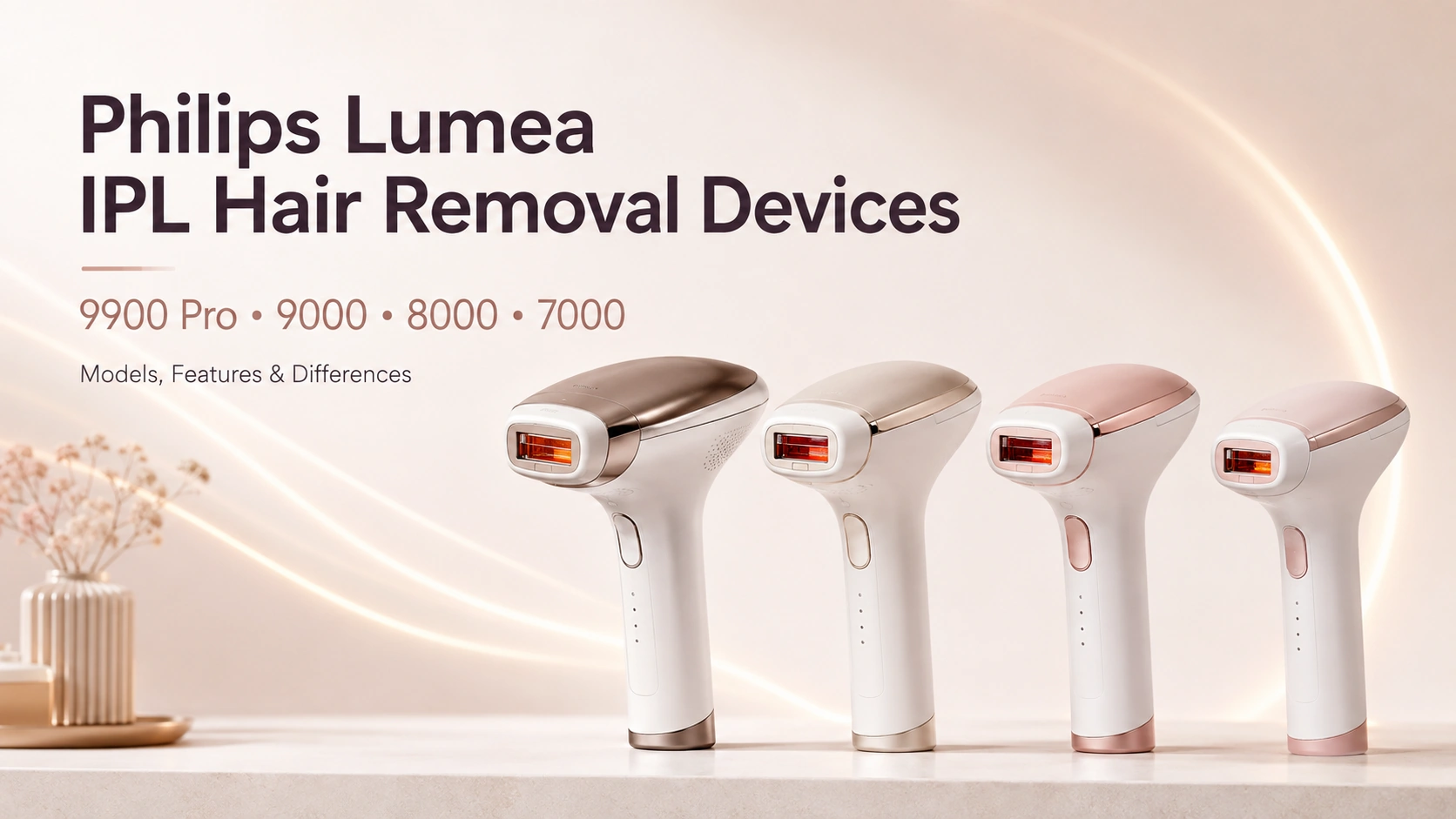
Philips Lumea is a family of at-home IPL (intense pulsed light) hair-removal devices rather than a single product. As of 2026, Philips' current Lumea range includes the 9900 Pro, 9000, 8000 and 7000 Series in selected markets, although model numbers, attachments and availability vary by country.
The biggest differences between Philips Lumea models are not the basic IPL principle. They are the level of treatment guidance, whether the device can be used cordlessly, the number and shape of attachments, and the skin-sensing and app features included with each version.
Quick Answer: What Is the Difference Between Philips Lumea Models?
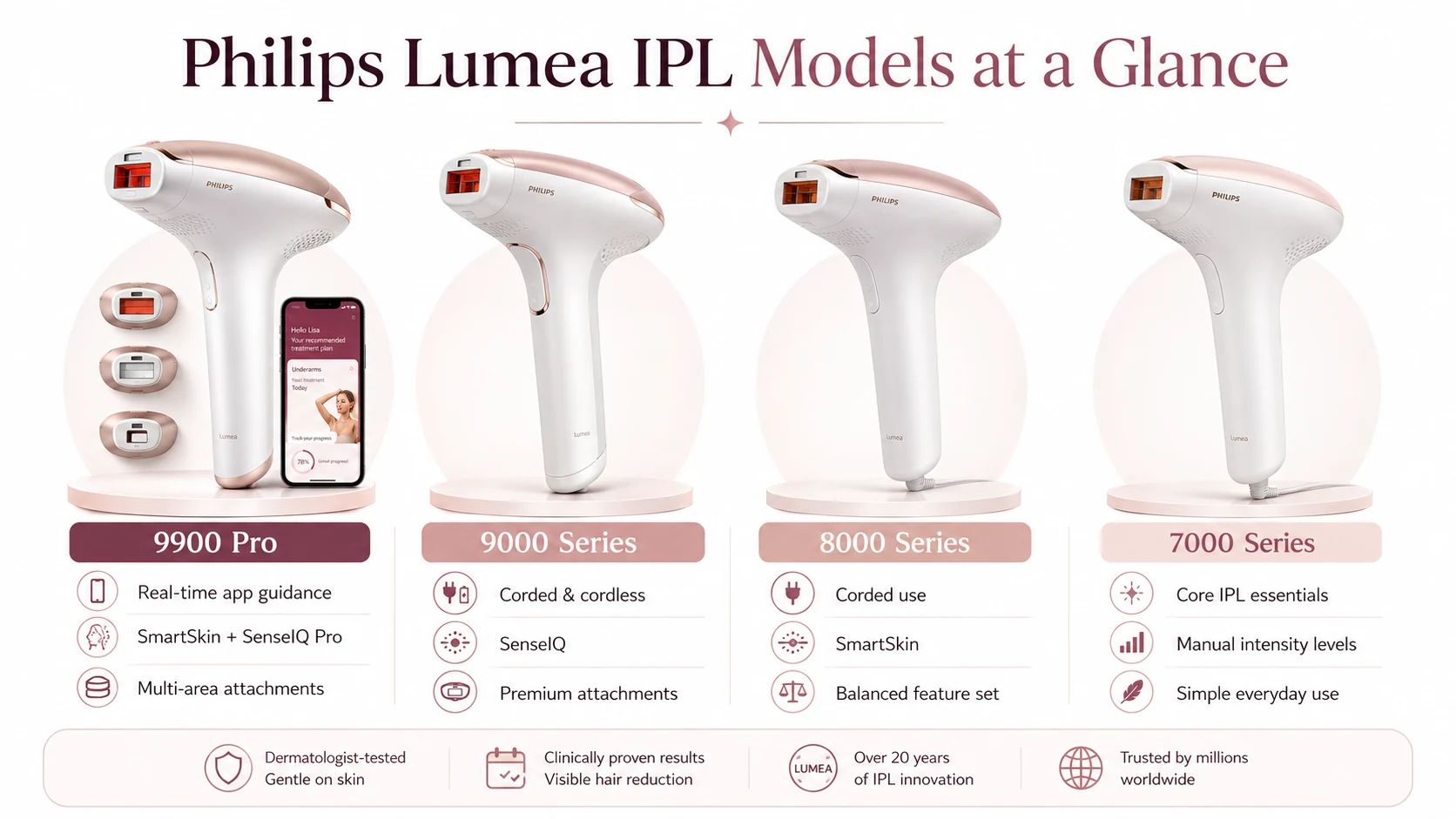
Philips Lumea 9900 Pro is the most advanced current model and adds real-time audio and visual treatment guidance through the Lumea app. The 9000 Series is the premium cordless/corded option with SenseIQ and multiple intelligent attachments. The 8000 Series keeps SmartSkin, SenseIQ and app guidance but is generally corded. The 7000 Series is the simpler value-oriented range with manual intensity settings and fewer advanced guidance features.
For most buyers, the practical question is therefore not simply “Which Philips Lumea is strongest?” but how much guidance, portability and area-specific hardware you actually need.
Philips Lumea Models at a Glance
| Series | Main Positioning | Skin Guidance | Attachments | Corded / Cordless | Standout Feature |
|---|---|---|---|---|---|
| Lumea 9900 Pro | Most advanced | SmartSkin + SenseIQ Pro | Up to 4 area-specific attachments, depending on bundle | Corded | Real-time audio and visual treatment guidance |
| Lumea 9000 | Premium | SmartSkin + SenseIQ | Typically 3–4 intelligent attachments | Corded and cordless | Premium portability with area-specific attachments |
| Lumea 8000 | Full-featured mid/high range | SmartSkin + SenseIQ | Varies by bundle; body, face, bikini and underarm versions exist | Primarily corded | Strong balance of guidance, attachments and price |
| Lumea 7000 | Value / simpler entry | Skin-tone sensing + manual levels | Bundle dependent | Corded | Core IPL functionality with fewer premium features |
Important: Philips sells different model numbers and attachment combinations in different countries. A Series 8000 or Series 9000 package in one market may therefore not contain exactly the same accessories as another package with the same series name.
What Is the Philips Lumea 9900 Pro?
The Philips Lumea 9900 Pro is Philips' newest premium Lumea generation in 2026. Philips positions it as its most advanced IPL system and the first Lumea model with real-time audio guidance.
The device connects with the Philips Lumea app, which can provide audio and visual feedback during treatment. According to Philips, the system monitors movement and helps users cover an area more evenly instead of relying entirely on memory or visual estimation.
The 9900 Pro also includes SmartSkin sensing, five light-intensity settings and curved attachments designed for different body areas. Exact attachment counts depend on the package: some current 9900 Pro configurations contain three attachments, while others contain four.
That makes the 9900 Pro most relevant to people who want more treatment guidance, rather than simply a basic IPL device that flashes when placed against the skin.
What Is the Philips Lumea 9000 Series?
The Lumea 9000 Series remains one of Philips' premium IPL lines and combines SenseIQ technology, a SmartSkin sensor, app guidance and body-area-specific attachments.
One of its most practical differences is that selected Lumea 9000 models support both corded and cordless use. This can make the device easier to position around areas such as the bikini line, underarms or other areas where cable placement may be inconvenient.
Depending on the model, Philips offers body, face, bikini, underarm or precision attachments. For example, Philips lists a face attachment with a smaller treatment window and additional filtering for the upper lip, chin and jawline.
What Is the Philips Lumea 8000 Series?
The Lumea 8000 Series sits below the 9000 Series but retains many of the features that matter most in everyday use.
Current Lumea 8000 models can include a SmartSkin sensor, five adjustable intensity levels, SenseIQ technology, Philips Lumea app support and intelligent attachments for different treatment areas.
The main trade-off is portability: current 8000-series models are generally designed for corded use, whereas selected 9000-series models can operate both corded and cordless.
The number of attachments varies significantly by package. Philips currently lists 8000-series configurations ranging from a single body attachment to packages containing separate body, face, bikini and underarm attachments.
For buyers who primarily treat at home near a power outlet, this can make the 8000 Series a more relevant comparison than automatically paying more for cordless operation.
What Is the Philips Lumea 7000 Series?
The Lumea 7000 Series is the more value-oriented part of the current Lumea family.
Philips lists five manual light-intensity settings, a skin-tone sensor, Lumea app support and corded operation on current 7000-series products. Bundles vary in the number of attachments supplied.
Compared with the higher series, the main difference is not that it uses an entirely different hair-removal principle. Instead, the 7000 Series provides a simpler version of the Lumea experience with fewer premium sensing and guidance features.
How Does Philips Lumea SmartSkin Work?
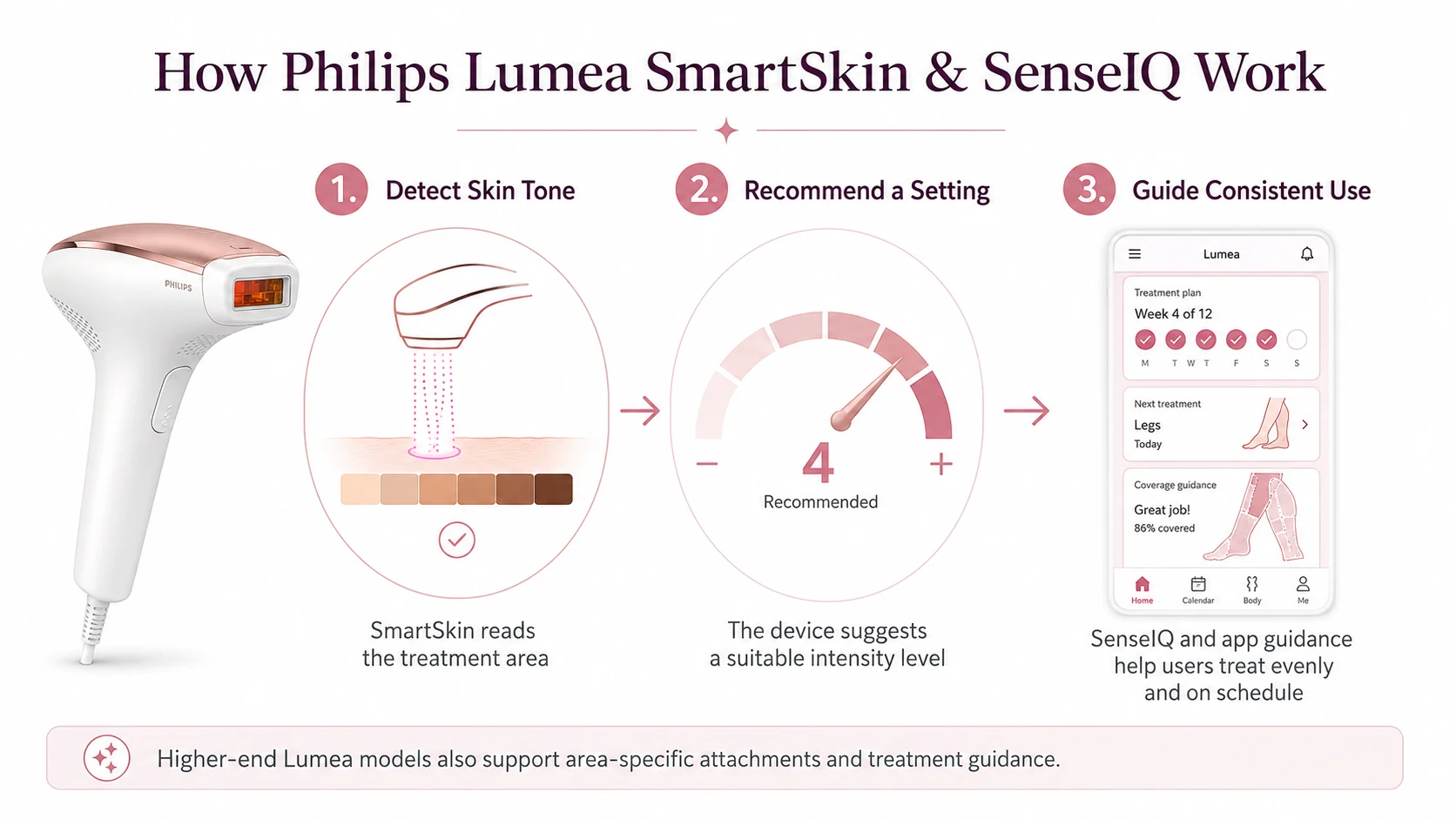
Philips' SmartSkin sensor measures the skin tone in the treatment area and helps the user select an appropriate light-intensity setting.
On compatible Lumea models, the recommended setting is based on the detected skin tone, but users can still choose a lower intensity if the recommended level feels uncomfortable.
Philips also states that Lumea devices include a skin-tone safety function that prevents treatment when the detected skin is too dark for safe IPL use.
That distinction matters: the sensor is not simply a convenience feature. It also contributes to the device's skin-compatibility safeguards.
If you are comparing devices based on skin compatibility rather than brand alone, see our Skin Tone & Hair Color Guide for IPL and Does Skin Tone Affect IPL Safety?.
What Is SenseIQ?
SenseIQ is Philips' broader term for the personalized treatment system used on higher Lumea models.
Depending on the series, SenseIQ can combine skin-tone sensing, area-specific attachments and guidance from the Philips Lumea app.
The newest 9900 Pro expands that concept into SenseIQ Pro, adding real-time treatment feedback through the connected app.
In practical terms, SenseIQ is less about increasing raw IPL output and more about helping users choose settings, follow schedules and apply treatment more consistently.
What Are Philips Lumea Attachments For?
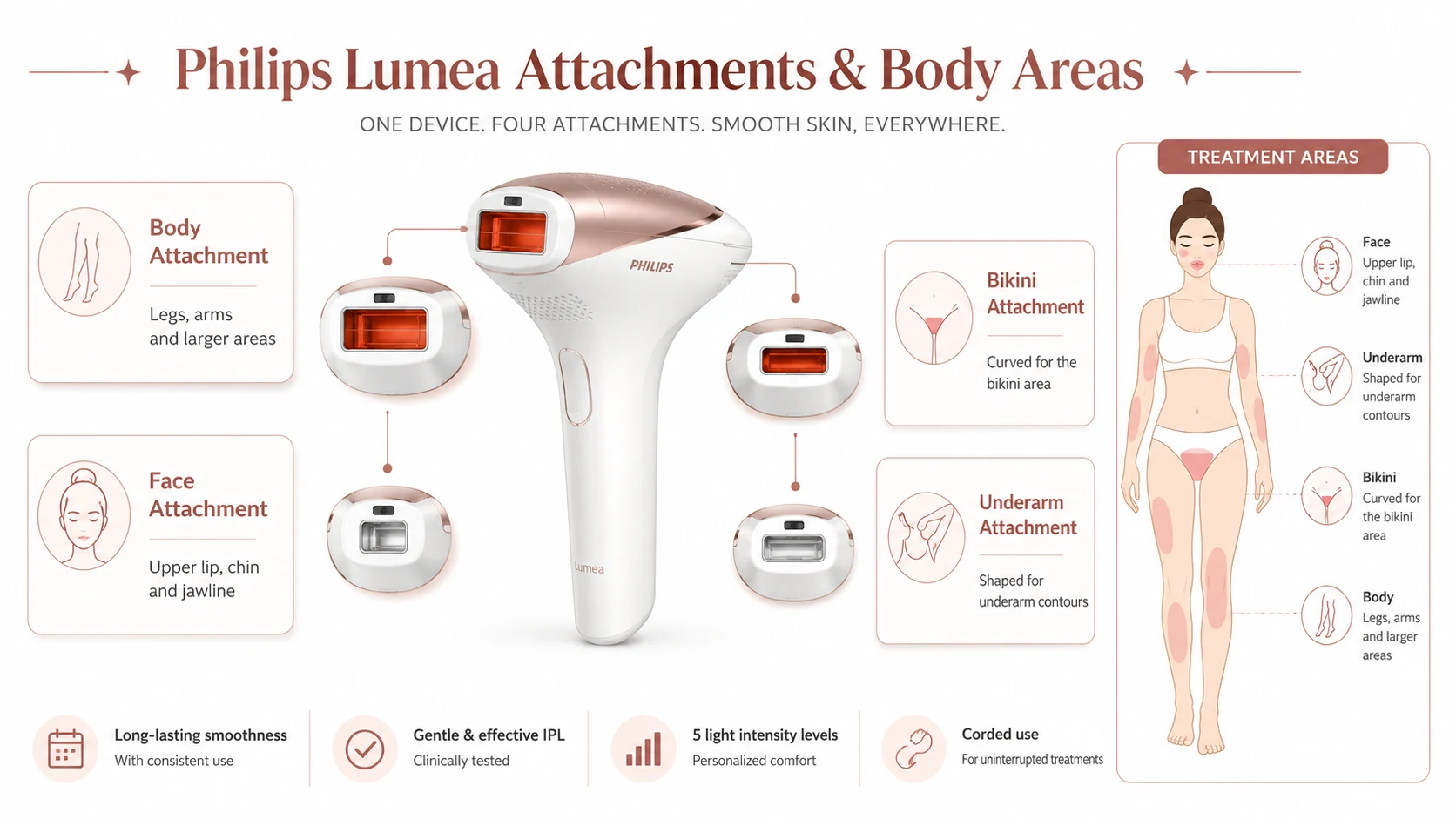
Higher-end Lumea packages use different attachment shapes and window sizes for different treatment areas.
- Body attachment: designed for larger areas such as legs, arms and stomach.
- Face attachment: uses a smaller window and additional filtering for areas such as the upper lip, chin and jawline.
- Bikini attachment: shaped for the bikini area.
- Underarm attachment: shaped for the contours of the underarm.
- Precision attachment: used on selected models for smaller or curved areas.
The exact attachment set depends on the Lumea model number, so buyers should compare the contents of a specific package rather than assuming that every device within the same series is identical.
For more detail on treating individual areas, see: IPL Devices for Face, Chin & Upper Lip, IPL Devices for Underarms, IPL Devices for Bikini Line, and IPL Devices for Legs.
What Hair Colors Work With Philips Lumea?
Philips states that IPL works by relying on contrast between pigment in the hair and pigment in the skin.
Philips Lumea is intended for naturally dark blonde, brown and black hair within the compatible skin-tone range.
Philips says Lumea is generally not effective on light blonde, grey, red or white hair because these hair colors do not absorb enough suitable light energy for effective IPL treatment.
That is a limitation of pigment-targeting IPL technology rather than a limitation unique to Philips.
Related reading: Best IPL Hair Removal Device for Dark Hair and Why Very Light, Red or Grey Hair Often Responds Poorly to IPL.
What Skin Tones Can Use Philips Lumea?
Skin-tone compatibility varies somewhat by Lumea generation and market-specific model.
Philips states that its current Lumea products are not suitable for skin that is too dark for safe IPL treatment. The reason is that darker skin contains more melanin, which can absorb more light energy and increase the risk of unwanted skin reactions.
Some current higher-end Philips Lumea products are listed for skin tones ranging from fair through dark brown, while certain other models use a narrower compatibility range.
For that reason, users should always check the skin-tone and hair-color chart for the exact model number rather than assuming that every Lumea has identical compatibility.
See also: Deeper Skin Tones and IPL and Medium or Olive Skin With Dark Hair.
How Often Do You Use Philips Lumea?
Philips currently recommends an initial schedule of four treatments, one treatment every two weeks.
After the initial phase, Philips recommends approximately one touch-up treatment every four weeks to maintain hair-growth reduction.
Using IPL more frequently than the recommended schedule does not necessarily produce faster results because IPL effectiveness depends partly on treating hairs during responsive stages of the hair-growth cycle.
For a broader explanation of treatment frequency, see How Often Should You Use an IPL Device? and When Should You Switch From Regular IPL to Maintenance?.
Is Philips Lumea a Laser Hair Removal Device?
No. Philips Lumea uses IPL, not a single-wavelength laser.
Consumers frequently use the phrase “laser hair removal” when searching for home hair-removal devices, but technically IPL and laser are different light-based technologies.
Philips describes Lumea as an Intense Pulsed Light (IPL) hair-removal system derived from professional light-based hair-removal technology.
For a detailed explanation, see IPL vs Laser Hair Removal: What’s the Difference?.
Which Philips Lumea Is Best for Face Use?
For facial treatment, the most useful feature is not necessarily the highest-priced Lumea series. A package that includes the dedicated face attachment is usually more relevant.
Philips' face attachments use a smaller treatment window and are designed for areas such as the upper lip, chin and jawline.
Users should follow the treatment boundaries in the manual for their exact model and should not use a facial IPL device around the eyes or on unsuitable skin areas.
Our facial IPL guides include: Can You Use IPL on the Face?, Can You Use IPL on Upper Lip Hair?, and Can You Use IPL on Chin Hair?.
Which Philips Lumea Is Best for Full-Body Use?
For full-body treatment, three factors matter more than the series name alone: treatment-window size, treatment speed and attachment coverage.
Larger body attachments are useful for legs, arms and stomach, while smaller curved attachments can improve contact around underarms and the bikini line.
Cordless use may improve maneuverability, but corded operation avoids the need to manage battery charge during longer sessions.
If full-body treatment is your priority, compare the actual bundle rather than assuming that a higher model number automatically includes every attachment.
See our broader guide: Best IPL Hair Removal Device for Full Body Use: 7 Features That Matter.
Does Philips Lumea Have Cooling?
Philips Lumea focuses primarily on skin-tone sensing, treatment guidance, curved attachments and intensity selection. Cooling is not the central feature that defines the current Lumea range.
That matters for shoppers comparing Philips with IPL devices that use sapphire or active-contact cooling. Cooling mainly addresses treatment comfort, while Philips' SenseIQ approach focuses more heavily on selecting an appropriate setting and guiding application.
Neither design philosophy automatically makes a device better for every user. People who prioritize guided treatment may prefer one approach, while people who are especially sensitive to heat may place greater value on active cooling.
For more context, see Ice Cool IPL vs Regular IPL: Is Cooling Worth It?.
Philips Lumea 9900 Pro vs 9000 vs 8000 vs 7000: Which Should You Choose?
| If You Prioritize... | Series to Look At First | Why |
|---|---|---|
| Maximum treatment guidance | 9900 Pro | Real-time audio and visual feedback through the app |
| Cordless flexibility | 9000 | Selected models support both corded and cordless operation |
| Feature balance | 8000 | SmartSkin, SenseIQ, app support and multiple bundle options |
| Simpler core IPL functionality | 7000 | Five intensity settings and core skin-sensing features without every premium extra |
| Face treatment | Any compatible bundle with a face attachment | The supplied attachment matters more than the series name alone |
| Full-body treatment | 8000 / 9000 / 9900 Pro multi-attachment bundles | More area-specific attachments can improve coverage across different body contours |
What Actually Sets Philips Lumea Apart?
Philips Lumea's strongest differentiator is not simply that it produces IPL flashes. Many at-home devices can do that.
What distinguishes the Lumea ecosystem is the combination of:
- skin-tone sensing;
- multiple adjustable intensity settings;
- body-area-specific attachments;
- treatment scheduling through the Lumea app;
- SenseIQ personalization on higher models; and
- real-time treatment guidance on the newest 9900 Pro generation.
The trade-off is that buyers often pay more for this ecosystem, attachments and guidance features.
That makes Philips Lumea particularly relevant for users who value structured guidance and area-specific treatment design, rather than shoppers whose main priority is simply obtaining the lowest-cost IPL device.
What Should You Check Before Buying a Philips Lumea?
Before choosing a specific Lumea, check these points:
- Exact model number: bundles within the same series can differ.
- Skin-tone compatibility: check the chart for the exact model.
- Hair color: IPL needs sufficient pigment in the hair.
- Attachments: make sure the package includes the areas you want to treat.
- Corded vs cordless use: this differs between Lumea series.
- Guidance features: decide whether SmartSkin, SenseIQ or real-time coaching matters to you.
- Price: compare features you will actually use rather than the series number alone.
For a brand-neutral buying framework, read What Should You Look For in the Best At-Home IPL Device? or Best IPL Hair Removal Device for the Money.
Frequently Asked Questions About Philips Lumea
Is Philips Lumea IPL or laser?
Philips Lumea uses IPL (Intense Pulsed Light), not a conventional single-wavelength hair-removal laser.
What is the newest Philips Lumea model?
As of 2026, Philips identifies the Lumea 9900 Pro as its newest and most advanced Lumea generation in markets where it is available.
What is the main difference between Lumea 9900 Pro and 9000?
The major new feature of the 9900 Pro is real-time audio and visual treatment guidance. The 9000 Series remains a premium SenseIQ option and selected models support cordless as well as corded operation.
What is the difference between Philips Lumea 9000 and 8000?
Both can include SmartSkin sensing, SenseIQ and app guidance. A major practical difference is that selected 9000-series models support cordless use, while current 8000-series models are primarily corded. Attachment combinations also vary.
Can Philips Lumea be used on the face?
Compatible Lumea models can be used on approved facial areas when used with the appropriate attachment and according to the product instructions. Philips lists the upper lip, chin and jawline among the intended areas for its face attachment.
Does Philips Lumea work on blonde hair?
It depends on the shade. Philips states that Lumea can work on naturally dark blonde hair, but it is generally not effective on very light blonde, grey, red or white hair.
Can Philips Lumea be used on dark skin?
Not on every dark skin tone. Philips states that skin that is too dark for IPL treatment should not be treated, and the exact compatible range depends on the model. Always check the skin-tone chart for the specific Lumea model.
How often should Philips Lumea be used?
Philips currently recommends four initial treatments at two-week intervals, followed by maintenance treatments approximately every four weeks.
Is a higher Philips Lumea series always better?
Not necessarily. A higher series generally adds more guidance, attachments or convenience features, but a less expensive model may still cover everything a particular user needs.
Bottom Line
Philips Lumea is best understood as a tiered IPL ecosystem rather than one device.
The 7000 Series covers the fundamentals, the 8000 adds a stronger combination of SenseIQ and attachment options, the 9000 adds premium flexibility including cordless use on selected models, and the newest 9900 Pro adds real-time guided treatment.
For most shoppers, the best choice will depend less on the highest model number and more on four practical questions: Is it compatible with your skin and hair, does it include the attachments you need, do you value guided treatment, and is the additional convenience worth the price difference?
Primary Sources
This article was checked against current Philips product and support information available in September 2026. Philips model numbers, bundles and regional availability can change.