
MITHLUX · Official IPL Device Store
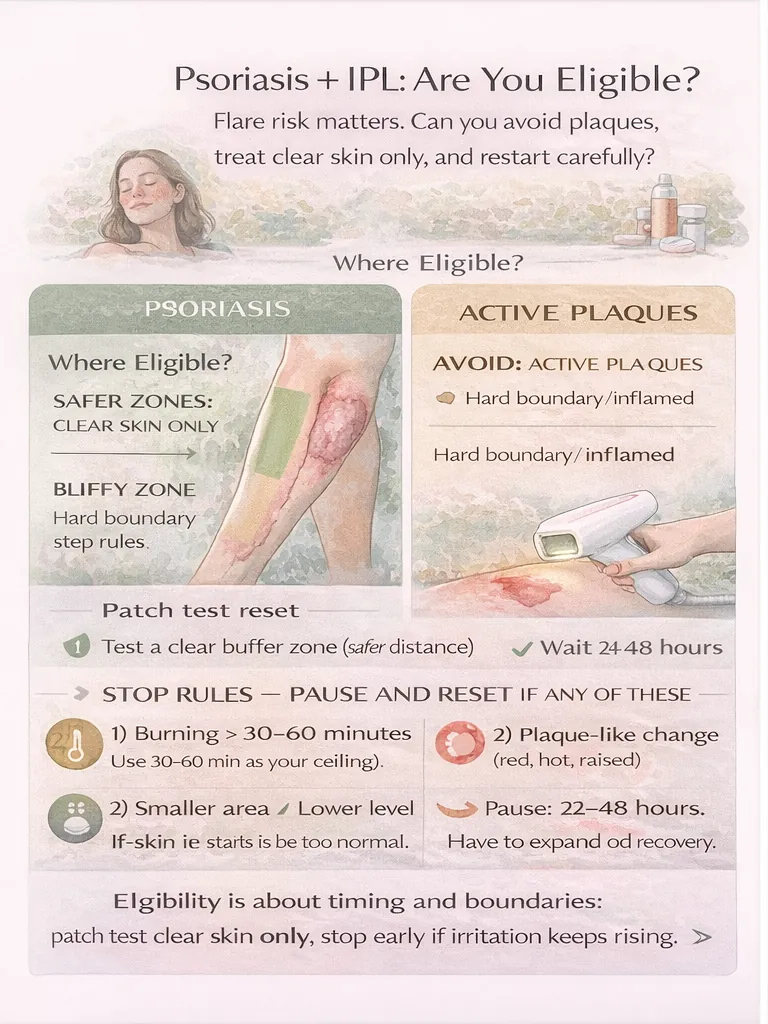
Short answer: If you have psoriasis, you may still be eligible for at-home IPL only on clear, calm skin — but you should avoid active plaques entirely. If plaques are inflamed, cracked, bleeding, recently flared, or being treated with strong actives, it’s safer to pause and restart later with a conservative patch-test reset.
This is one of those “eligibility topics” many sites avoid because it sits on the border between cosmetics and skin disease. The goal here is simple: keep your routine realistic and reduce the chance of triggering irritation or a flare. IPL is a routine-based tool — it’s not worth forcing it through angry skin.
Why psoriasis changes IPL eligibility
Psoriasis skin isn’t just “dry.” Active plaques often mean the barrier is disrupted and the skin is already in a higher-reactivity state. That matters because IPL involves light energy + surface heat. Even if a device is gentle, reactive skin can amplify sensations and recover slower.
Also important: psoriasis can be affected by skin injury/irritation in some people (a phenomenon often discussed as “flare after irritation”). That’s why the safest eligibility approach is not “yes or no,” but where and when.
Eligibility decision: start now, start cautiously, or wait
✅ Eligible to start (with boundaries) if
- You have no active plaques in the area you plan to treat (skin looks baseline, not thickened or scaly).
- No cracking, bleeding, oozing, or soreness.
- Your skin has been stable for at least 2 weeks (no active flare spreading in that zone).
- You can do a conservative patch test and wait 24–48 hours.
⚠️ Start cautiously if
- You’re mostly clear but tend to flare with friction (tight clothing, shaving irritation).
- The area is historically “sensitive” (bikini line, underarms) even when clear.
- You recently adjusted topical routines and aren’t sure how your skin tolerates heat right now.
Start cautiously means: smaller area, lower level, slower pace, strict stop rules.
⛔ Not eligible this week (pause) if
- There are active plaques in the treatment area (red, raised, thickened, scaly).
- Skin is cracked, bleeding, tender, or “hot.”
- You’re treating plaques with something that makes skin more reactive (for example, strong actives) and the area feels stingy.
- You had a recent flare and the area hasn’t returned to baseline.
Where to avoid: the “hard boundary rule”
If you remember only one rule from this page, make it this:
Do not flash directly on active plaques. Treat clear skin only, and leave a comfortable buffer around plaque edges.
If you’re unsure about “avoid zones,” use this practical boundary page (tattoos/moles logic is similar: avoid and leave safe distance):
Patch test reset (psoriasis edition)
If you’re eligible (clear skin), do not jump back into full sessions. Use a reset that protects your skin’s “reactivity budget.”
- Choose a small clear zone away from any plaque edges.
- Use a conservative level.
- Wait 24–48 hours.
- If recovery is normal, expand gradually over the next 1–2 sessions.
How to do it properly: How do you perform a patch test before IPL?
Stop rules (more precise, psoriasis-friendly)
Stop rules are your “don’t bargain with your skin” system. Pause and reset if any of these happen:
Stop immediately (same day) if
- Burning heat lasts longer than 30–60 minutes after a conservative session.
- Any treated area becomes sharply painful, blistered, or looks injured.
- A clear patch suddenly becomes “plaque-like” (raised, hot, rapidly red).
Pause 1–2 weeks and reset if
- Redness or irritation lasts beyond 48 hours when you usually recover faster.
- Skin becomes progressively more reactive over the week (each session feels worse even at the same level).
- You see a flare pattern starting near treated zones.
Longer pause / consider medical advice if
- You suspect a true flare was triggered and it’s expanding.
- You have open plaques, infection signs, or the area won’t calm down.
If you’re not sure what’s “normal reaction vs pause,” use:
- What skin reactions are normal after using IPL?
- What should you do if your skin reacts badly to IPL?
Common mistakes that backfire
- Trying to treat plaques directly to “solve the problem faster.” (High risk, low reward.)
- Over-flashing to compensate for missed spots — this raises irritation risk. Use this instead: Patchy IPL Results: How to Fix Missed Spots Without Over-Flashing
- Mixing aggressive skincare with IPL when your barrier already runs sensitive: When skincare makes IPL feel worse (or look ineffective)
Sources & references (third-party, verifiable)
Part of this hub: Back to IPL Eligibility