
MITHLUX · Official IPL Device Store
Short answer: If you’re prone to keloids or hypertrophic scars, you may still be eligible for at-home IPL on intact skin — but you should be extra cautious because irritation and injury risk matter more. If you have a strong history of keloids, recent active scarring, or you’re treating areas that easily get inflamed bumps/ingrowns, it may be smarter to pause and consider professional guidance before starting.
This topic is tricky because IPL does not “cut” the skin like a blade. But eligibility isn’t only about cuts — it’s about whether your skin tends to overreact to irritation. Your safest plan is to treat IPL as a low-injury routine and run a more conservative “risk screen.”
First: keloid vs hypertrophic scar (why the difference matters)
- Hypertrophic scars usually stay within the original injury boundary.
- Keloids can grow beyond the original injury area and are more unpredictable.
You don’t need to self-diagnose perfectly. You just need to know whether your skin has a pattern of “overbuilding” scar tissue after irritation.
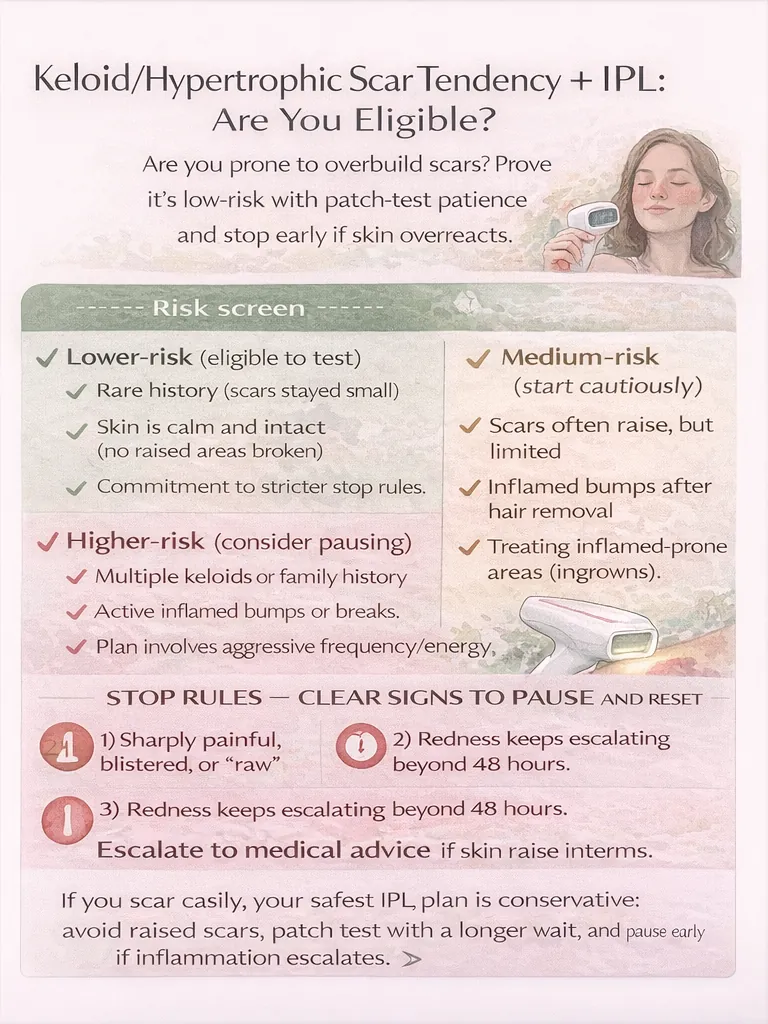
Eligibility risk screen (60 seconds)
✅ Lower-risk (often eligible to test) if
- You rarely scar abnormally, and past scars stayed small and stable.
- You’re treating intact skin (no open bumps, no broken barrier).
- You can commit to conservative levels and strict stop rules.
⚠️ Medium-risk (start cautiously) if
- You have a few raised scars in the past but they’re stable and limited.
- You tend to get inflamed bumps/ingrowns after hair removal (inflammation raises risk).
- You’re treating high-friction areas (bikini line, underarms) where irritation is more likely.
⛔ Higher-risk (consider pausing) if
- You have a strong keloid history (multiple keloids, family tendency, or keloids from small triggers like acne/piercings).
- You currently have active inflamed lesions, open bumps, or skin that easily breaks.
- Your plan involves aggressive frequency or pushing levels (high chance of irritation).
Where to avoid: scars, raised tissue, and “reactive zones”
Even if you’re eligible, treat these as avoid zones:
- Raised scars and known keloid areas (do not flash directly on them).
- Areas with active bumps, folliculitis, or broken skin.
- Tattoos/PMU and other pigment-dense zones (distance rules apply).
Use this “avoid + safe distance” page as a practical template:
Patch test reset (keloid-prone strategy)
The goal is to prove you can tolerate IPL without escalating inflammation.
- Patch test a small area at a conservative level.
- Wait 48 hours (use the longer wait, because delayed irritation matters here).
- If normal recovery, treat a slightly larger area next session — still conservative.
Patch test guide: How do you perform a patch test before IPL?
Stop rules (scar-tendency edition, more granular)
Stop immediately if
- You feel sharp pain or burning that doesn’t calm down quickly.
- You see blistering, skin injury, or “raw” patches.
- A bump/follicle becomes intensely inflamed after treatment.
Pause and reset if
- Redness lasts beyond 48 hours or gets worse day 2–3.
- You develop clusters of bumps that persist (inflammation is the risk amplifier).
- Your skin becomes progressively more reactive week-to-week.
Escalate to medical advice if
- You notice a new raised scar forming after repeated irritation.
- You suspect infection (spreading redness, warmth, pus, fever).
If bumps/ingrowns are your usual trigger, start here:
- What if you get bumps after underarm IPL?
- Bumps after IPL: clogged follicles, irritation, or ingrowns?
How to lower risk without “over-restricting” yourself
- Lower level beats higher level if your skin tends to inflame.
- Smaller area beats full-body sessions early on (reduce cumulative irritation).
- Spacing matters: don’t “stack flashes” over the same skin trying to force results.
Two helpful decision pages:
Sources & references (third-party, verifiable)
Part of this hub: Back to IPL Eligibility