
MITHLUX · Official IPL Device Store
Short answer: It’s common for one side to look better than the other after IPL. This usually comes from differences in coverage, angle, pressure, or hair growth cycles — not because the device isn’t working. The solution is controlled adjustment, not more aggressive treatment.
If you’ve ever noticed that one side of your body seems smoother, slower-growing, or clearer than the other after IPL, you’re not alone. This is one of the most common early concerns people have — and in most cases, it’s not a failure. It’s a signal.
IPL does not treat “areas” evenly by default. It treats exactly what it reaches, at the angle and consistency you apply. Small differences in how you move, position, or overlap can create visible differences over time.
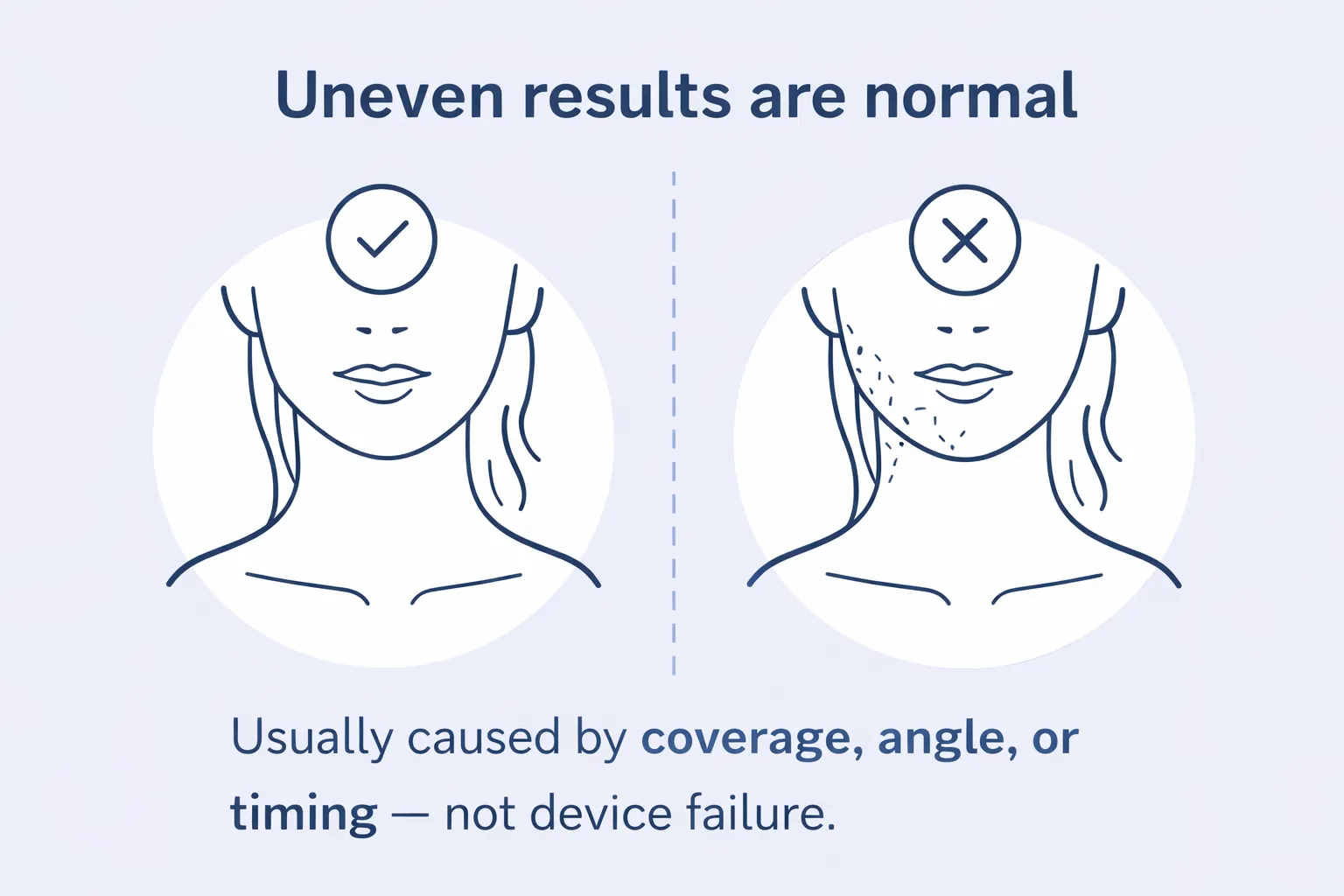
Why one side can respond faster than the other
Uneven results are usually caused by a combination of small factors rather than one big mistake.
- Coverage differences: one side may have more complete overlap, while the other has missed patches.
- Angle and contact: slight tilting can reduce effective energy delivery.
- Dominant hand bias: most people naturally treat one side more carefully than the other.
- Hair growth variation: hair does not grow evenly across the body or even within the same area.
- Skin tone differences: subtle variations can affect how energy is absorbed.
If you’re unsure whether your overall progress is normal, this guide helps set expectations: What Does “Working Normally” Look Like After 2, 4, and 8 Weeks of IPL?.
Why this is more noticeable in early weeks
In the early stages, results are subtle. That makes differences more visible.
For example, one side may show slightly slower regrowth or thinner hair earlier, while the other looks unchanged. This doesn’t mean one side “failed.” It often means one side simply entered a responsive phase sooner.
This is also why early signs can feel inconsistent. If you want to understand what counts as real progress, see How Do You Know If IPL Is Helping Even Before Hair Falls Out?.
The most common mistake: trying to “fix it fast”
When people see uneven results, they often react by doing more on the weaker side:
- adding extra passes,
- increasing intensity,
- or treating the same area too frequently.
This usually makes things worse, not better.
IPL works through cycles. You cannot “force” one side to catch up in a single session. Trying to do so increases the risk of irritation and disrupts your overall routine.
What you should do instead
A better approach is controlled consistency:
- Improve coverage: move more slowly and deliberately on the weaker side.
- Check overlap: ensure you’re not leaving gaps between flashes.
- Maintain the same level: do not increase intensity just for one side.
- Stay consistent: let both sides progress across multiple sessions.
If your routine already feels difficult to maintain evenly, it may help to simplify it. For example: Which Areas Should You Prioritize First?.
When uneven results are completely normal
In many cases, uneven results are simply part of the process.
Hair grows in cycles, and different follicles respond at different times. That means:
- one side may appear smoother first,
- one patch may shed earlier,
- and another area may take longer to respond.
Over time, these differences usually even out — especially if your routine stays consistent.
When you should adjust more carefully
If one side consistently lags behind over multiple weeks, it’s worth checking for structural differences:
- Are you reaching the same areas evenly?
- Is your angle consistent across both sides?
- Are you rushing one side more than the other?
In some cases, uneven tone can also play a role. If part of the area looks darker or reacts differently, it’s important to test it separately. See How to Patch Test Uneven Areas.
Does schedule inconsistency make this worse?
It can — but not always.
If your timing is irregular, one side may accidentally get better coverage or more consistent treatment than the other. But this is still a consistency issue, not a device issue.
If your schedule isn’t perfect, don’t try to compensate aggressively. Instead, focus on returning to a steady rhythm. This helps: Can You Do IPL on an Irregular Schedule?.
A simple way to think about it
If one side looks better than the other, don’t panic.
- It usually means your routine is working — just unevenly applied.
- It rarely means the device failed.
- It never means you should rush to correct it aggressively.
IPL is not about making both sides perfect at the same time. It’s about guiding both sides forward steadily.
With consistent, controlled sessions, uneven results tend to balance out naturally.