
MITHLUX · Official IPL Device Store

If you want to use one IPL hair removal device on your legs, underarms, bikini line, and selected facial areas, choosing the right device involves more than comparing maximum power.
Full-body IPL creates a different set of demands: large areas need speed, smaller areas need control, sensitive zones may benefit from better comfort features, and different parts of the body may tolerate different energy levels.
The best full-body IPL device is therefore not necessarily the strongest one. It is the device that gives you enough control, comfort, coverage, and consistency to maintain a routine across several treatment areas.
Quick Answer: What Matters Most for Full-Body IPL?
For full-body use, look for a balanced combination of:
- an efficient treatment window
- manual and automatic treatment modes
- multiple adjustable energy levels
- good comfort or contact cooling
- easy handling during longer sessions
- clear skin-tone and hair-color compatibility
- controls that work for both large and small treatment areas
Before comparing devices, it is also worth checking whether your skin tone and hair color are suitable for IPL. You can start with the Mithlux IPL Suitability Checker or review the Skin Tone & Hair Color Guide for IPL .
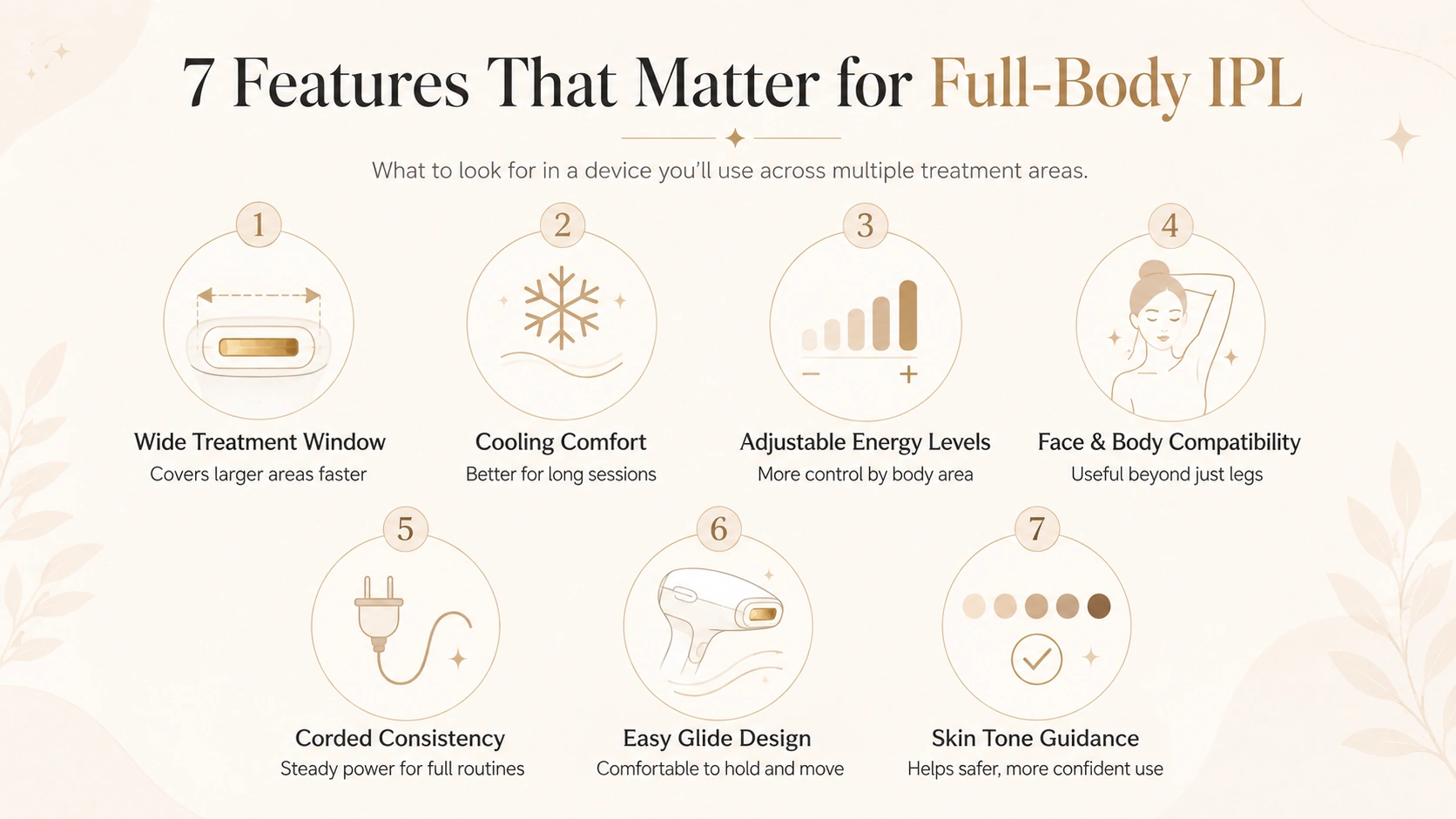
7 Features That Matter Most
| Feature | Why It Matters for Full-Body Use |
|---|---|
| Treatment window size | Larger areas such as legs need efficient coverage, while smaller areas still require reasonable placement control. |
| Manual + automatic modes | Automatic flashing can improve efficiency on larger areas, while manual control is useful around smaller treatment zones. |
| Adjustable energy levels | Legs, underarms, bikini line, and facial areas may not all feel comfortable at the same setting. |
| Contact cooling | Cooling can make repeated flashes more comfortable, especially on areas that feel more heat-sensitive. |
| Comfort and ergonomics | Full-body routines can take longer, so grip, control, and overall handling become more important. |
| Skin and hair compatibility | A device is only useful if IPL is appropriate for your skin tone and hair color in the areas you plan to treat. |
| Area-to-area consistency | A practical full-body device should make it realistic to maintain a routine across several different body areas. |
1. Treatment Window Size Should Balance Speed and Control
Treatment window size becomes much more important when you move from a single small area to a full-body routine.
Legs contain a large treatment surface, so a window that covers a reasonable amount of skin per flash can make sessions more efficient. On the other hand, very small areas such as the upper lip or chin require more precise positioning.
This means the goal is not simply to find the largest possible window. A better full-body design balances coverage on larger areas with enough control for smaller permitted areas.
If legs are one of your main treatment areas, see our IPL for Legs guide for more detail on coverage, spacing, and treatment technique.
You can also read How Far Apart Should Leg IPL Flashes Be? if you are concerned about missed areas or unnecessary overlap.
2. Manual and Automatic Modes Serve Different Areas
A full-body IPL routine often benefits from having more than one way to trigger flashes.
An automatic or glide-style mode can be convenient for larger, relatively flat areas such as the legs. Manual flashing provides more deliberate control when treating smaller areas where positioning matters more.
Neither mode is automatically better. The useful feature is having enough control to choose the mode that fits the area you are treating.
If you are deciding when to glide and when to use individual flashes, see Auto-Glide vs Single Flash: Which Causes More Missed Spots? .
Whatever mode you use, keeping the treatment window flat against the skin matters. Our guide to placing the IPL window flat explains why consistent contact matters.
3. Adjustable Energy Levels Matter More Across Multiple Body Areas
Full-body treatment does not mean every body area should automatically be treated at the same intensity.
Your legs may tolerate a setting comfortably while your underarms, bikini line, or facial areas feel noticeably more intense. Individual sensitivity can also change over time.
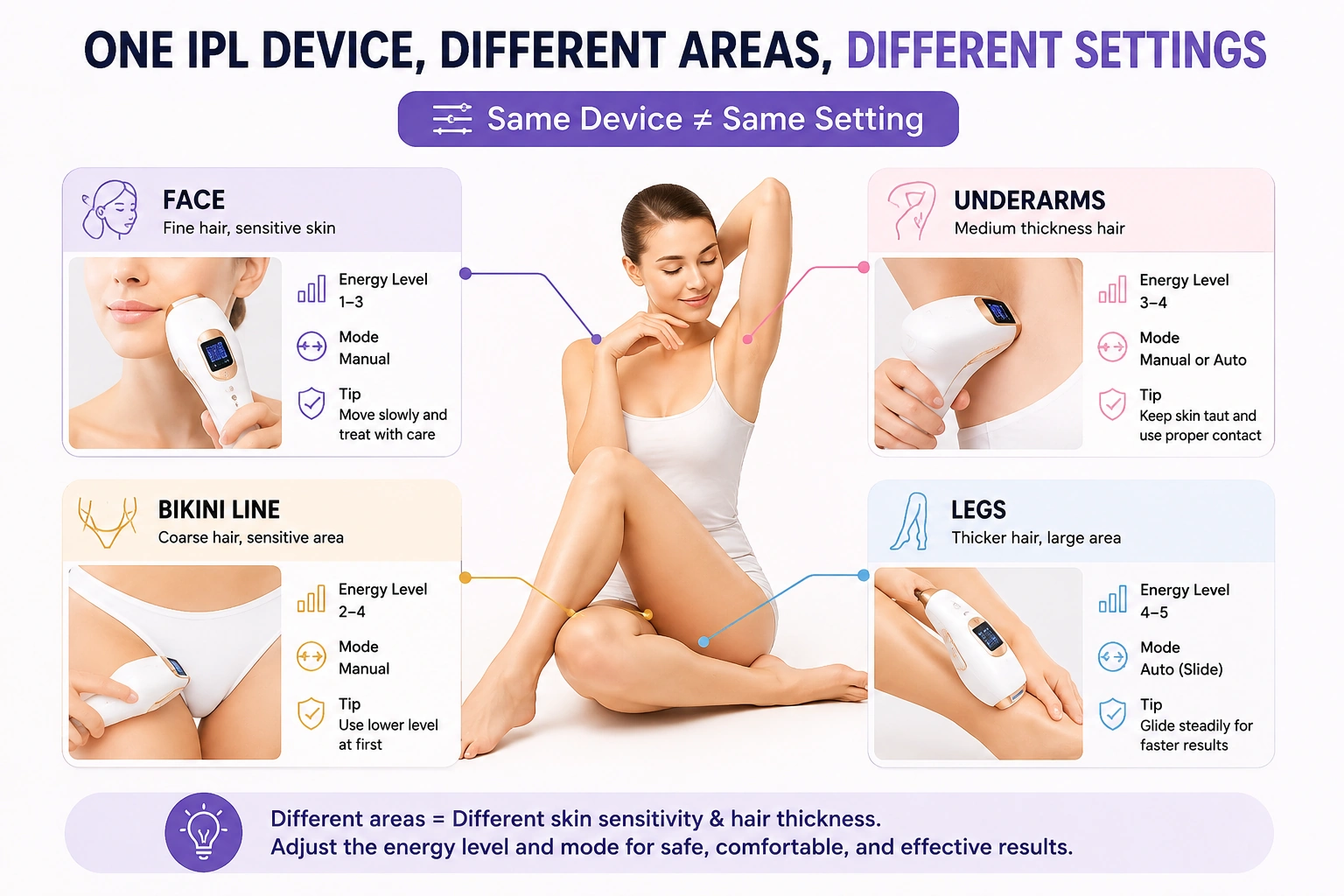
Multiple adjustable energy levels give you room to start conservatively and adapt the treatment to different areas instead of forcing one setting across the entire body.
If you are new to IPL, review How to Choose a Starting IPL Level .
It is also worth remembering that a higher setting is not automatically a better setting. See Can I Increase the Level for Better Results? for a safer way to think about intensity.
4. Cooling Can Matter More When You Treat Several Areas
IPL produces a warm sensation during treatment, and that sensation may feel different depending on the body area.
Underarms, bikini line, and smaller facial zones may feel more sensitive than larger areas such as the legs. If heat sensation makes you reluctant to finish sessions, a contact-cooling feature may improve treatment comfort.
Cooling does not make an unsuitable skin tone suitable for IPL, and it should never be used as a reason to ignore pain or irritation. Its main purpose is comfort and consistency.
If you are unsure whether cooling is worth prioritizing, read Ice Cool IPL vs Regular IPL: Is Cooling Worth It? .
You can also see How to Choose an Ice Cool IPL Hair Removal Device for a deeper look at cooling-system buying criteria.
One Full-Body IPL Option to Consider
The Mithlux S2 Pulse is one example of a device designed around both comfort and control. It combines a sapphire cooling contact window with six adjustable energy levels and treatment modes intended for different areas.
That combination may be useful for people who want one device for multiple permitted face-and-body areas rather than buying separate devices for each zone.
As with any IPL device, suitability still depends on your skin tone, hair color, treatment area, and correct use.
5. Comfort and Ergonomics Matter More Than They Seem
A device that feels easy to use for a two-minute test may feel very different during a longer legs-and-body session.
For full-body IPL, practical details start to matter:
- Can you hold and position the device comfortably?
- Can you move across larger areas without constantly adjusting your grip?
- Are the controls easy to reach?
- Can you clearly tell when the treatment window is sitting correctly?
- Does the device make it realistic to complete the session rather than rush it?
Full-body results depend heavily on consistent coverage. A more powerful device provides little benefit if awkward handling leads to missed areas.
If uneven coverage is already a concern, read Patchy IPL Results: How to Fix Missed Spots Without Over-Flashing .
6. Skin Tone and Hair Color Still Determine Whether IPL Makes Sense
“Full body” describes where a device may be designed to be used. It does not mean IPL is appropriate for every person, every hair color, or every part of the body.
IPL relies on pigment in the hair to absorb light energy. Very light blonde, red, white, or gray hair may respond poorly because there is less melanin available to target.
Skin tone also matters because pigment in the skin can absorb light energy. Always follow the skin-tone compatibility limits provided for the specific device.
For more detail, see:
- Does Skin Tone Affect IPL Safety?
- Hair Color and IPL: Why Very Light, Red, or Grey Hair Often Responds Poorly
- Deeper Skin Tones and IPL: What You Should Know
If you are uncertain whether IPL is worth starting at all, our reality-based IPL eligibility checklist can help you think through the decision before buying.
7. The Best Full-Body Device Is the One You Can Use Consistently
Full-body IPL is a routine, not a one-session treatment.
Hair grows in cycles, which means different areas may respond at different speeds. Legs, underarms, bikini line, and facial hair do not necessarily progress on an identical timeline.
That is why consistency often matters more than chasing the highest possible energy level or the shortest advertised session time.
For a general routine overview, see the IPL Hair Removal Schedule .
If you already treat several body areas and are wondering whether they should all follow the same timing, read Should Face and Body IPL Follow the Same Schedule? .
What Should a Full-Body IPL Routine Actually Cover?
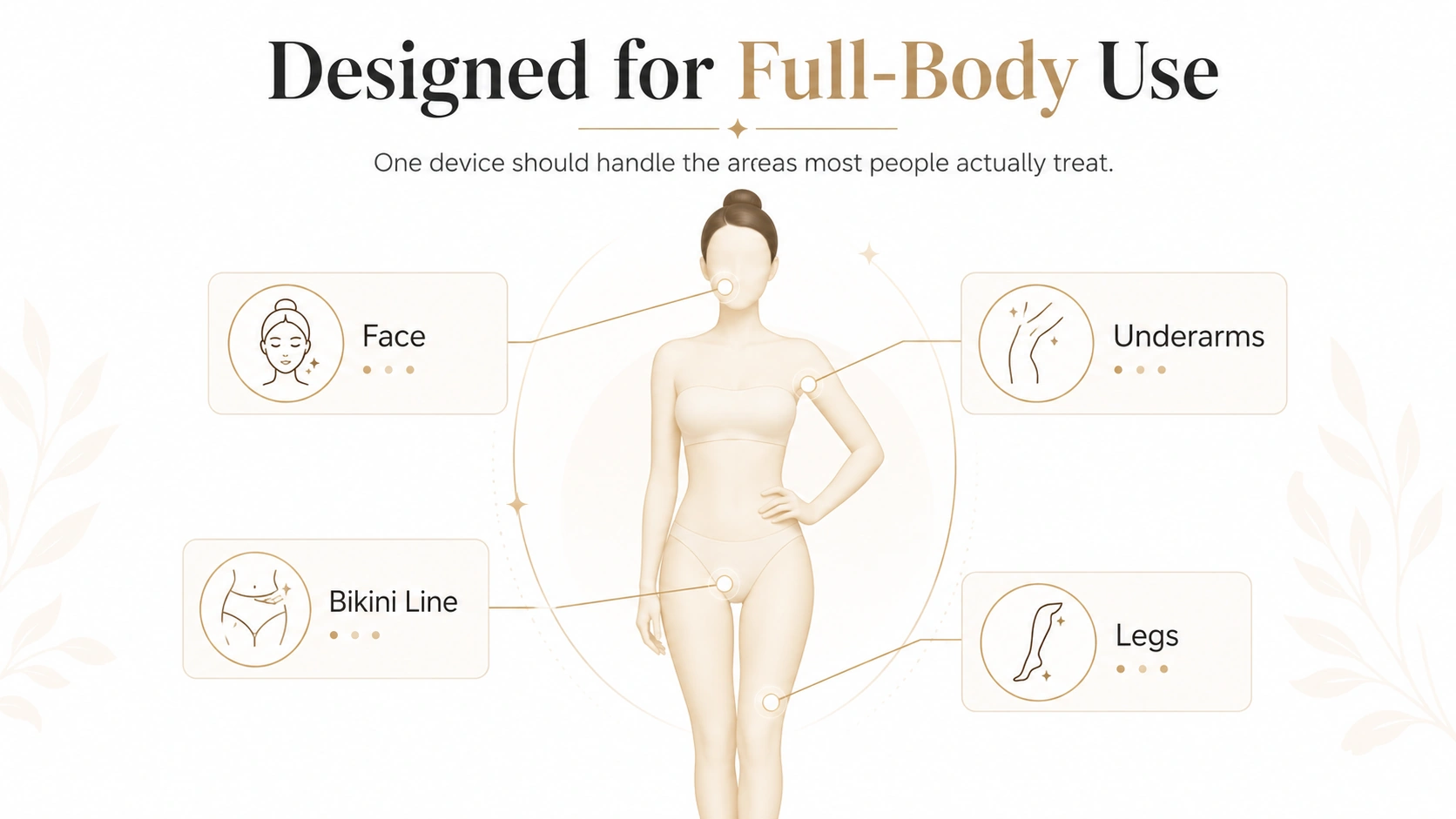
“Full body” should not be interpreted as permission to flash every part of the body. Treatment areas still need to follow the device manufacturer's instructions and normal IPL safety boundaries.
Legs
Legs are one of the largest and usually most time-consuming IPL areas. Efficient coverage, comfortable handling, and a repeatable pattern matter more here than extreme precision.
See: IPL for Legs .
Underarms
Underarms are smaller but may feel more sensitive, and natural skin-tone differences in the area should be considered before treatment.
See: Is IPL Safe for Underarms? .
Bikini Line
Bikini-line IPL requires more attention to treatment boundaries and naturally darker skin areas. Only treat external areas permitted by the device instructions.
See: IPL for Bikini Line: Safety, Spacing & Results .
Face
Facial IPL usually requires the greatest positioning control. Follow the device instructions carefully regarding permitted facial areas and avoid areas around the eyes.
See: IPL for Face and our Upper Lip & Chin IPL Guide .
Should You Buy Separate IPL Devices for Face and Body?
Usually, not necessarily.
A well-designed at-home IPL device can often cover multiple permitted treatment areas if it provides enough control for small zones and enough efficiency for large zones.
Buying separate devices may make sense when you need highly specialized features, but for many users the more practical question is whether one device can comfortably handle:
- large-area treatment
- small-area positioning
- multiple intensity levels
- different treatment modes
- reasonable session comfort
The Mithlux S2 Pulse is one option for users who prefer a single IPL device for multiple permitted face-and-body areas, with sapphire contact cooling and six adjustable intensity levels.
It should still be compared with other devices based on your individual skin tone, hair color, budget, comfort preferences, and treatment areas.
Is a More Powerful IPL Device Better for Full-Body Use?
Not automatically.
Maximum energy is only one specification. Full-body usability also depends on coverage, contact, treatment speed, energy control, comfort, and whether you can complete the routine consistently.
A device with more energy but poor ergonomics or limited control may be less practical than a well-balanced device with adjustable settings.
For a deeper discussion, see Do More Energy Levels Make an IPL Device Better? .
Do You Need Cooling for Full-Body IPL?
No. Cooling is not required for IPL to work.
Its main value is comfort. If heat sensation makes you shorten sessions, skip sensitive areas, or avoid staying consistent, contact cooling may be worth prioritizing.
This becomes more relevant when one device is being used across areas that feel very different, such as legs, underarms, bikini line, and facial zones.
Cooling should always be considered alongside correct energy settings, suitability guidance, and patch testing rather than used as a substitute for them.
Patch Test Before Building a Full-Body Routine
Do not begin by treating every planned body area in one session simply because the device is marketed for full-body use.
Different areas may respond differently. Follow the manufacturer's patch-test instructions and start conservatively before expanding treatment.
Our guide How Do You Perform a Patch Test Before IPL? explains the basic process.
You can also read After a Patch Test, How Do You Decide Whether to Increase the Level? .
Bottom Line
The best IPL hair removal device for full-body use is not simply the device with the largest window or highest maximum power.
Look for a device that balances efficient coverage, precise control, adjustable intensity, comfort, skin-and-hair suitability, and practical handling.
Large areas such as the legs benefit from efficient coverage, while underarms, bikini line, and facial zones may require more deliberate control and greater attention to comfort.
A good full-body IPL device should make it easier to maintain a consistent routine across several appropriate treatment areas — not encourage you to treat every area at the same intensity or in exactly the same way.
Frequently Asked Questions
Can one IPL device be used for the whole body?
Many at-home IPL devices are designed for multiple permitted face-and-body areas, but “full body” does not mean every part of the body is appropriate for treatment. Follow the permitted treatment areas and safety instructions for the specific device.
What is the most important feature for full-body IPL?
There is no single most important specification. A practical full-body device should balance efficient coverage, adjustable intensity, easy handling, skin-and-hair compatibility, and enough control for both large and small areas.
Should you use the same IPL level on your legs, underarms, and bikini line?
Not necessarily. Different body areas can have different sensitivity and skin characteristics. Follow your device instructions, patch-test appropriately, and adjust only within the permitted energy range.
Is cooling important for full-body IPL?
Cooling is not required for IPL effectiveness, but it can improve comfort. This may be useful when treating several areas or zones that feel more sensitive to repeated flashes.
Is an automatic flash mode better for full-body treatment?
Automatic or glide modes can make larger areas more efficient, while manual flashing can provide better control on smaller areas. Having access to both can be useful for a multi-area routine.
Should you treat your entire body in one IPL session?
You do not need to. Many users divide treatment areas across different sessions. Follow the schedule and treatment instructions provided with your device, especially when starting out.