
MITHLUX · Official IPL Device Store
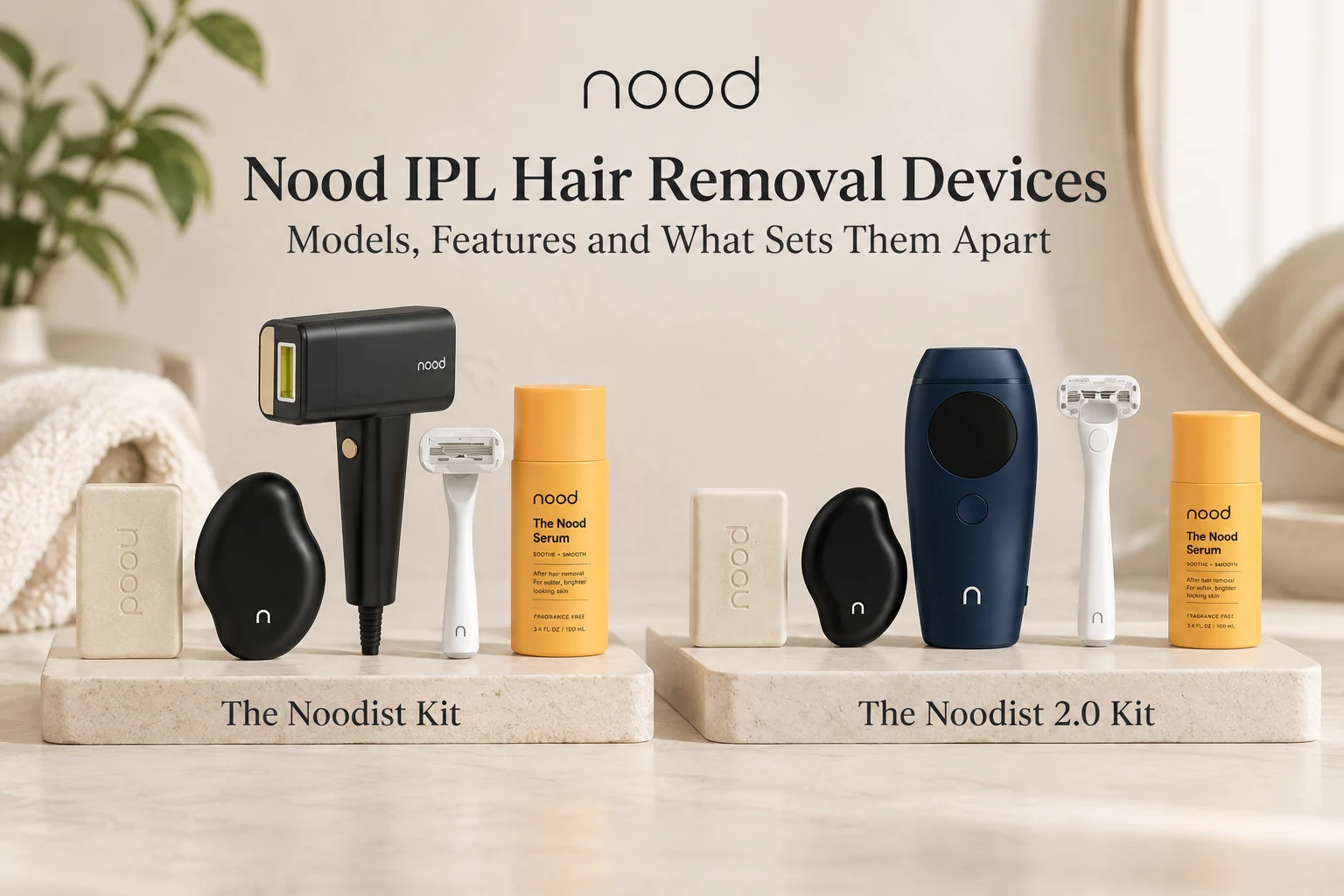
Nood is an at-home hair removal brand best known for its IPL devices, particularly The Flasher 2.0 and the newer Flasher Pro. Unlike brands with a long list of closely related models, Nood currently keeps its main IPL lineup relatively simple: one device focused primarily on hair reduction, and one higher-powered model that adds cooling and a separate skin-rejuvenation lens.
That makes the lineup easier to understand, but the two devices are aimed at noticeably different buyers. The Flasher 2.0 is the simpler hair-removal-focused option, while the Flasher Pro adds higher energy output, faster treatment, cooling and interchangeable lenses.
This guide explains how the current Nood IPL lineup is structured, what the major differences are, and how Nood compares conceptually with other popular at-home IPL brands such as Braun, Philips Lumea, Ulike, JOVS and SmoothSkin.
Quick Answer: What Nood IPL Devices Are Available?
Nood's current IPL range is centered around two main devices:
- The Flasher 2.0 — the simpler and more affordable hair-removal-focused model.
- The Flasher Pro — the more advanced model with higher energy output, faster flashing, cooling and interchangeable hair-removal and skin-rejuvenation lenses.
Both use intense pulsed light rather than a true single-wavelength medical laser. If you are still comparing the two technologies, see our guide to IPL vs laser hair removal.
Nood Flasher Pro vs Flasher 2.0
| Feature | Nood Flasher 2.0 | Nood Flasher Pro |
|---|---|---|
| Main purpose | At-home IPL hair reduction | IPL hair reduction + skin-rejuvenation functions |
| Energy density | About 4.5 J/cm²* | Up to 7 J/cm² |
| Hair-removal wavelength | 510–1200 nm | 510–1200 nm Hairless Lens |
| Additional lens | No | Ageless Lens for skin appearance |
| Cooling | No dedicated cooling system | CryoSoothe™ cooling |
| Flash speed | Slower | Faster |
| Glide mode | Yes | Yes |
| Best suited to | Users mainly interested in hair reduction | Users wanting higher output, faster treatment and additional skin features |
*Nood's current product materials list approximately 4.5 J/cm² for The Flasher 2.0, while some comparison materials round the figure slightly differently. Specifications can change, so check the manufacturer's current listing before purchase.
The Flasher 2.0: Nood's Simpler IPL Option
The Flasher 2.0 is the model most people associate with Nood. It uses the company's PrecisionPulse™ IPL system and is designed primarily for long-term hair reduction rather than additional cosmetic skin treatments.
Nood currently lists a wavelength range of 510–1200 nm, an energy density around 4.5 J/cm², and a pulse width of approximately 10 ms. It also includes continuous glide operation for treating larger areas more efficiently.
The concept is straightforward: shave the treatment area, place the light window against suitable skin, select an appropriate intensity and deliver repeated IPL flashes over the area according to the recommended schedule.
If you are new to IPL, the important question is not simply how many power levels a device offers. Correct skin and hair suitability, treatment consistency and comfortable energy selection matter more. Our IPL device guide for beginners explains these factors in more detail.
Who Is The Flasher 2.0 Best For?
The Flasher 2.0 makes the most sense for someone who:
- wants IPL mainly for hair reduction;
- does not need built-in cooling;
- does not need a separate skin-rejuvenation lens;
- prefers a simpler device rather than paying for additional features;
- is comfortable following a consistent multi-week IPL schedule.
For users mainly treating large areas such as the legs, treatment-window size and flash speed become especially important. See our guide to the best IPL features for legs for more detail.
The Flasher Pro: Nood's Higher-End Model
The Flasher Pro represents a significant step up from The Flasher 2.0 rather than a minor cosmetic update.
Nood lists output up to 7 J/cm², a faster flash cycle, CryoSoothe™ cooling and two interchangeable optical lenses.
- Hairless Lens: intended for IPL hair reduction.
- Ageless Lens: intended for cosmetic skin-rejuvenation applications such as improving the visible appearance of tone and texture.
The Hairless Lens uses a listed wavelength range of approximately 510–1200 nm, while the Ageless Lens uses a different optical range intended for its separate cosmetic function.
The presence of cooling is one of the biggest practical differences between the Pro and 2.0. Cooling does not make IPL inherently more effective, but it can improve comfort at higher settings and may make consistent treatments easier for some users.
If cooling is one of your priorities, our guides to ice-cool IPL and cooling IPL vs regular IPL explain what cooling does — and what it does not do.
What Actually Separates Nood From Other IPL Brands?
Nood is not unusual simply because it uses IPL; Braun, Philips, Ulike, JOVS, SmoothSkin and many other manufacturers use the same broad light-based principle. The differences are mainly in how each company packages the technology.
1. A Small, Easy-to-Understand Device Range
Philips and Braun have multiple generations and regional model numbers that can make comparison complicated. Nood's current range is much easier to understand.
The choice is essentially:
- Flasher 2.0: hair-removal-focused IPL.
- Flasher Pro: higher-output IPL with cooling and additional optical functions.
If you prefer a larger ecosystem with several model tiers, compare Nood with our Philips Lumea model guide or Braun IPL model guide.
2. The Pro Combines Hair Removal and Skin-Focused Functions
The Flasher Pro's interchangeable lenses make it more similar conceptually to multifunction beauty devices than a basic IPL handset.
That distinguishes it from devices whose entire optical system is dedicated only to hair reduction.
However, buyers should separate the two goals. A feature intended to improve the visible appearance of skin is not the same thing as increasing hair-removal performance.
3. Cooling Is Reserved for the Higher-End Model
The Flasher 2.0 does not use the dedicated cooling system found on the Pro.
This is different from brands such as Ulike and JOVS, where cooling technology has become a major part of the product identity.
For people who are especially concerned about comfort on the bikini line, underarms or face, cooling may be more valuable than it is for someone treating only the legs.
4. Nood Emphasizes a Broader Hair-Care Routine
Nood also markets shaving, exfoliation and hair-regrowth-care products alongside its IPL devices. This makes the brand feel more like a complete hair-removal routine than a manufacturer focused only on hardware.
Those supporting products are optional. IPL effectiveness still depends primarily on appropriate hair/skin contrast, adequate light exposure and consistent use.
Nood vs Braun IPL
Braun IPL devices generally emphasize automatic skin-tone sensing and a highly established IPL platform.
Nood takes a somewhat different approach. The Flasher 2.0 is relatively straightforward, while the Pro emphasizes higher output, cooling and interchangeable lenses.
In practical terms:
- Consider Braun if automatic skin sensing and a mature, hair-removal-focused system are priorities.
- Consider Nood Flasher Pro if cooling and added skin-focused functionality matter more.
Nood vs Philips Lumea
Philips Lumea has one of the broadest IPL model families, with different attachments and model tiers depending on region.
Nood is much simpler to navigate. Rather than choosing among numerous Lumea numbers, buyers mainly decide between the Flasher 2.0 and Flasher Pro.
Philips may appeal more to shoppers who value specialized body attachments and established treatment guidance, while Nood may appeal to people who prefer a simpler model hierarchy.
Nood vs Ulike
Ulike has built much of its current identity around contact cooling and comfortable high-frequency treatment.
That makes the Flasher Pro the more direct Nood comparison because it also integrates cooling. The standard Flasher 2.0 does not.
If comfort is your biggest concern, compare the cooling implementation, treatment speed, energy delivery and treatment-window design rather than simply looking at the maximum energy number.
Nood vs JOVS
JOVS also emphasizes cooling and more premium device design in several of its IPL models.
Nood's lineup is simpler, while JOVS offers more variation between devices. The right choice therefore depends partly on whether you prefer a straightforward two-model range or a broader selection of specialized designs.
Nood vs SmoothSkin
SmoothSkin is strongly focused on IPL hair removal itself, with automatic skin-contact and power-management features being central to many of its devices.
Nood's Flasher Pro expands further into combined hair-removal and cosmetic skin applications. Someone who wants a dedicated hair-removal tool may therefore evaluate the two brands differently from someone looking for a multifunction device.
Can Nood Be Used on the Face?
Like other at-home IPL devices, facial use requires more caution than treating larger body areas.
IPL should generally be used only on areas specifically permitted by the manufacturer's instructions, and treatment should remain below the eye area. Hair color, skin tone, pigmentation and recent skincare use can all affect suitability.
For more detail, see:
- Best IPL Hair Removal Device for Face, Chin & Upper Lip
- Can You Use IPL on the Face?
- Can You Use IPL on Upper Lip Hair?
- Can You Use IPL on Chin Hair?
- Face IPL Aftercare
Can Nood Be Used on the Bikini Line and Underarms?
These are common IPL treatment areas, but they can also be more sensitive and more pigmented than surrounding skin.
Users should pay particular attention to skin tone, intensity selection and exact treatment boundaries.
Related Mithlux guides:
- Best IPL Hair Removal Device for Bikini Line
- Best IPL Hair Removal Device for Underarms
- Can You Use IPL for Brazilian Hair Removal?
- Is IPL Safe for Underarms?
How Long Should Nood IPL Take to Show Results?
Nood publishes relatively fast result claims for its devices, particularly the Flasher Pro. Those figures should be treated as manufacturer-reported expectations rather than a guarantee for every user.
IPL works gradually because only hairs in responsive growth phases can be effectively targeted during each treatment session. Visible changes commonly appear progressively rather than all at once.
Hair color, skin tone, body area, treatment consistency and individual growth cycles can all change the timeline.
For a broader explanation, see:
- When Should You Start Seeing IPL Results?
- What Does “Working Normally” Look Like After 2, 4, and 8 Weeks of IPL?
- Early Signs IPL Is Working
- How Long Does IPL Hair Removal Last?
Does Higher IPL Energy Automatically Mean Better Results?
No. The Flasher Pro's higher maximum energy output is a meaningful specification, but maximum energy alone does not determine whether one IPL device will work better for a particular person.
Useful energy must still be delivered safely and consistently. Skin tone, hair pigmentation, pulse characteristics, contact quality and treatment adherence all matter.
A device used comfortably and consistently at an appropriate level can be more useful than a theoretically more powerful device that a user repeatedly avoids because treatment feels too intense.
See Do More Energy Levels Make an IPL Device Better? for a deeper explanation.
Who Is Nood IPL Most Suitable For?
Nood may be worth considering if you want a relatively simple IPL lineup and prefer choosing between a straightforward hair-removal model and a more feature-rich premium option.
The Flasher 2.0 may make more sense if:
- hair reduction is your main objective;
- you do not need cooling;
- you do not need a skin-rejuvenation lens;
- you want to avoid paying for features you may not use.
The Flasher Pro may make more sense if:
- you value built-in cooling;
- you want faster treatment;
- you prefer higher available energy output;
- you are interested in the additional cosmetic skin lens.
Who Should Be More Cautious With IPL?
IPL is strongly dependent on the contrast between pigment in the hair and surrounding skin. It is not equally suitable for every combination of skin tone and hair color.
Very light blonde, white, grey and some red hair usually contain too little melanin for conventional IPL to target effectively. Darker skin may absorb more light in the epidermis and requires greater caution or may fall outside a particular device's approved range.
Before buying any device — Nood or otherwise — it is worth reading:
- Does Hair Color Affect IPL Results?
- Deeper Skin Tones and IPL
- Best IPL Hair Removal Device for Dark Hair
- When IPL Is Not Worth Starting
What Should You Compare Before Choosing Nood?
Rather than asking whether Nood is simply “better” than another brand, compare the characteristics that affect your actual treatment routine:
- Skin and hair compatibility
- Maximum usable energy
- Cooling or comfort features
- Flash speed
- Treatment-window size
- Manual vs glide operation
- Facial-use guidance
- Warranty and return terms
- Price relative to features you will actually use
If you are comparing across price points, see Best IPL Hair Removal Device for the Money: What Matters at $50, $100 and $300+.
Final Takeaway
Nood's current IPL lineup is easier to understand than many competitors. The Flasher 2.0 is primarily a straightforward at-home hair-reduction device, while the Flasher Pro adds higher output, faster operation, cooling and a second optical lens for cosmetic skin applications.
The Pro is clearly the more technically ambitious device, but that does not automatically make it the better purchase for everyone. Buyers interested only in reducing unwanted hair may not need its additional functions.
As with all at-home IPL devices, the most important questions remain the same: Is your skin and hair combination suitable? Can you use the device consistently? Is the treatment comfortable enough to maintain the schedule? And are you paying for features that genuinely improve your routine?
Explore Other IPL Brands
- Braun IPL Hair Removal Devices: Models, Features and What Sets Them Apart
- Philips Lumea IPL Hair Removal Devices: Models, Features and What Sets Them Apart
- Ulike Laser Hair Removal Devices: IPL Models, Features and What Sets Them Apart
- JOVS Hair Removal Devices: Models, Features and What Sets Them Apart
- SmoothSkin IPL Hair Removal Devices: Models, Features and What Sets Them Apart
Related Reading
- What Should You Look For in the Best At-Home IPL Device?
- Is an At-Home IPL Device Worth It?
- What to Look for in an At-Home Laser Hair Removal Device
- Best IPL Hair Removal Device for Full Body Use
- Best IPL Hair Removal Device for Sensitive Skin
Editorial note: Product specifications, prices and manufacturer claims can change over time. Mithlux reviews device features for educational comparison and recommends checking the manufacturer's current instructions, suitability chart and safety guidance before use.