
MITHLUX · Official IPL Device Store
IPL Troubleshooting: Why It’s Not Working (and How to Fix It Safely)
If your results feel slow, patchy, or your skin starts reacting, it usually isn’t “you doing everything wrong.” It’s almost always one of a few fixable factors: suitability, schedule, technique, or skin barrier timing.
Reference only. Always follow your device instructions and perform a patch test first. For a routine overview, see IPL Hair Removal Schedule.
Short answer: Most “IPL not working” issues come from suitability, inconsistent schedule, or small technique details (shaving, spacing, overlap). Fixes are usually simple: reset your routine, protect your skin barrier, and track progress weekly—not session by session.
If you want a quick baseline check first, use IPL Suitability Checker. If you’re unsure whether your skin tone / hair color combo is in the “slow/limited” range, see Skin Tone & Hair Color Guide for IPL.
Start here: which problem sounds like you?
No results (or very slow)
You’ve done several sessions, but your hair looks basically the same. This usually means a mismatch in suitability, schedule, or expectations (not “you need to blast the highest level”).
Jump to: Why results feel slow → Reset plan
Patchy results / missed spots
Some areas reduce, others don’t. Most of the time this is a spacing + coverage pattern issue (especially on curves like underarms or ankles).
Jump to: Fix patchiness
Irritation / darkening / bumps
Your skin feels stingy, red, bumpy, or looks like it’s getting darker. This is usually a skin barrier + timing issue (sun, actives, overlap), and it has clear “pause rules.”
Jump to: Normal vs not normal → Stop rules
A simple troubleshooting flow (save this)
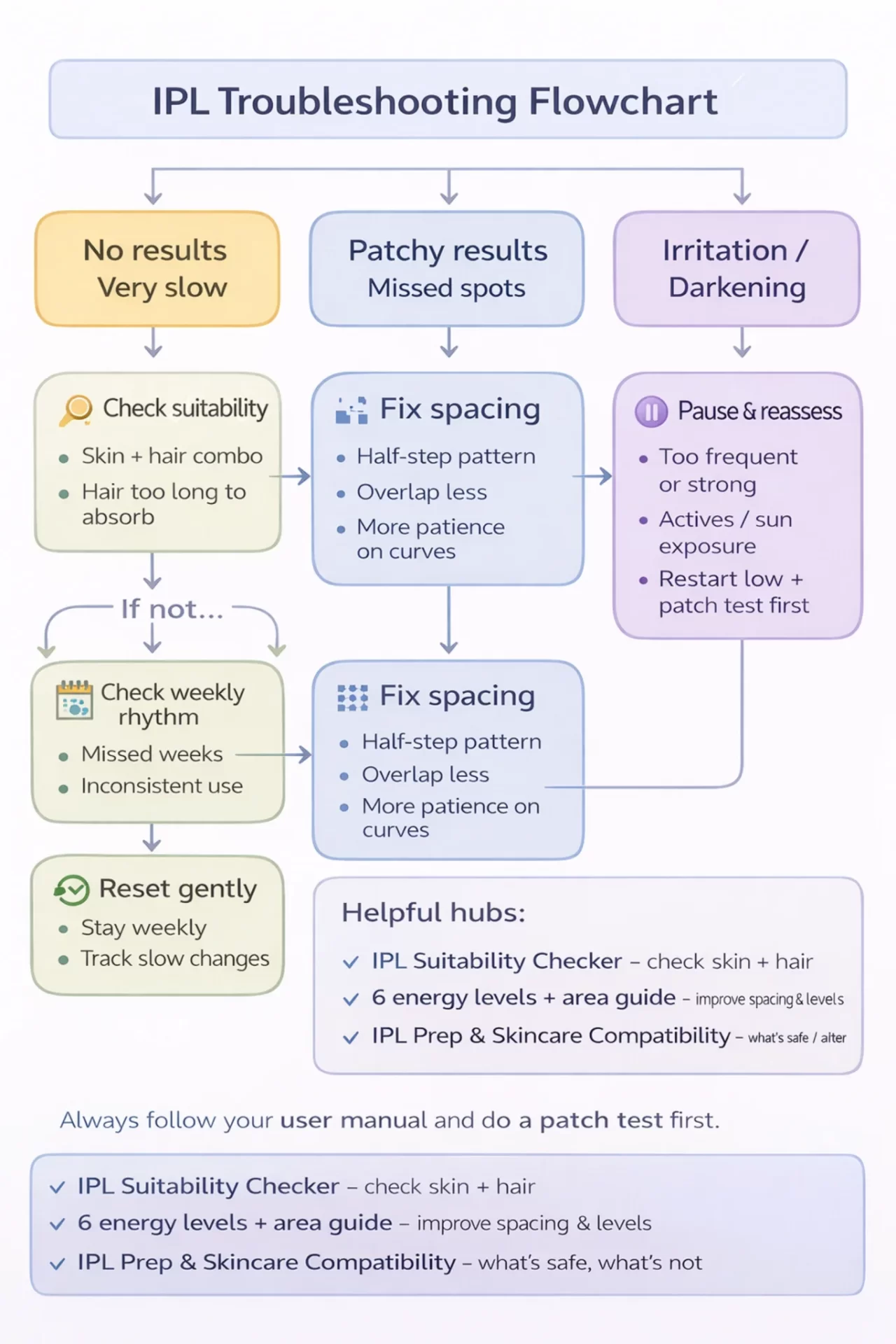
Start here:Slow results, patchy spots, or irritation? Check the most common causes first—then adjust your routine calmly.
Why results feel slow (the 4 most common causes)
1) Suitability and contrast
IPL relies on contrast: the light is meant to be absorbed more by hair pigment than skin pigment. If hair is very light/fine, or skin and hair have low contrast, progress can be slower—or limited.
2) Inconsistent schedule (the quiet killer)
Most people don’t “fail IPL”—they just can’t stay consistent for long enough. If you skip weeks often, you keep missing hair in the most responsive growth phase.
3) Technique details
If hair isn’t shaved close enough, spacing is too random, or you keep overlapping the same spot, you can get the worst combo: less effective coverage + more irritation.
4) Expectations (session thinking vs weekly thinking)
IPL is routine-based. It’s better to track weekly changes (regrowth speed, thickness, patch size), not “did hair disappear right after session.”
Helpful hubs you can read next: IPL Hair Removal Safety, Aftercare & Results, Safety & Usage.
A practical check (30 seconds)
- Skin + hair: Are you in a “slow/limited” zone on the chart?
- Schedule: Have you truly been weekly without big gaps?
- Shave: Was hair shaved close before sessions?
- Coverage: Are you moving in a pattern (not random tapping)?
- Comfort: Any irritation forcing you to pause often?
If you’re unsure about levels and safe area differences, use 6 energy levels + area guide.
Patchy results: the fix is usually spacing (not “more power”)
Patchiness is one of the most common complaints because most people treat by “feel.” A simple pattern beats guessing every time.
- Divide the area first: treat in zones so you don’t lose track mid-session.
- Use a consistent step: move about half a window-width each flash.
- Don’t chase missed hairs: repeated flashes on the same spot can raise irritation risk.
- Slow down on curves: underarms, ankles, knees need more patience and often a lower level.
- Keep your angle flat: full contact helps consistency.
If you want area-specific spacing tips (without guessing): IPL for Legs, IPL for Underarms, IPL for Bikini Line, IPL for Face & Upper Lip.
Skin reactions: what’s normal vs what needs a pause
| Often normal | Pause & adjust | Stop & get advice |
|---|---|---|
| Mild warmth, light redness, or a “stingy” feeling that settles quickly. Skin looks calm again within a short time. | Redness lasts longer than expected, discomfort is building, or you notice irritation trends (especially if you recently used strong skincare or had sun exposure). | Blistering, broken skin, intense swelling, or strong pain that doesn’t improve. When in doubt, choose the conservative option. |
If your irritation seems skincare-related, start with IPL Prep & Skincare Compatibility.
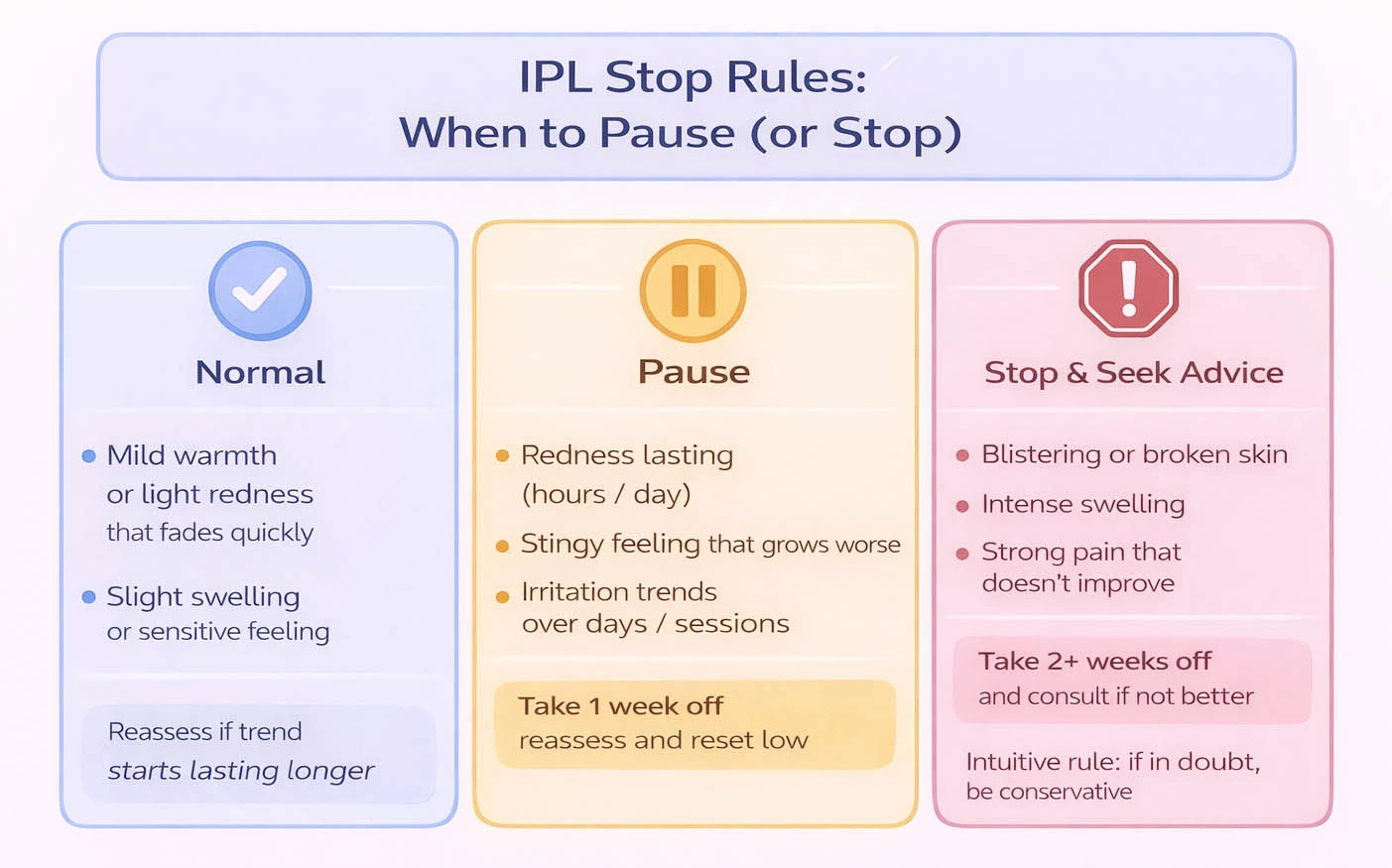
Start here:If your skin isn’t calm, don’t force it. Restart only when fully settled—and patch-test first.
A calm “pause rule” you can trust
If your skin is not calm, don’t try to “push through.” A clean reset is usually faster than forcing sessions and creating longer recovery. When you restart, patch test first and step back one level.
Reset plan: 7 days to calm down + 4 weeks to get back on track
7-day reset (comfort first)
- Day 0–2: keep skincare simple and gentle. No harsh actives. Focus on barrier comfort.
- Day 3: patch test a small area at a lower, comfortable level.
- Day 4–7: if skin stays calm, resume one zone with conservative spacing and no overlap chasing.
Next 4 weeks (consistency beats intensity)
- Stay on a steady weekly rhythm (don’t compress sessions to “catch up”).
- Track weekly changes: regrowth speed, thickness, and patch size (same lighting helps).
- Adjust level gradually only if your skin stays comfortable.
If you want a clean “do this / avoid that” checklist before sessions, see Skin Prep Guide.
Sources & references (third-party, verifiable)
These references help validate the general principles behind light-based hair removal: gradual results, the importance of suitability, and the need to protect the skin barrier and follow safe use guidance.
- American Academy of Dermatology (AAD) — Laser hair removal overview
- Mayo Clinic — Laser hair removal: what it is, results, risks
- Cleveland Clinic — Laser hair removal: expectations and safety notes
- GOV.UK consultation: Licensing of non-surgical cosmetic procedures in England
Tip: For at-home routines, “safe and steady” is usually the fastest path long-term.
Ready to follow a consistent routine?
Realistic note: IPL is routine-based. Results are gradual over several weeks with consistent weekly use. If you prefer a one-time solution, IPL may not be your best fit.
Shop MITHLUX IPL Devices
Want the “official” setup checklist first? MITHLUX S2 Pulse User Manual
IPL Troubleshooting – FAQs
A: Most “no results” situations come from suitability, an inconsistent weekly schedule, or small technique details (shaving, spacing, overlap). IPL changes are usually gradual—track weekly, not session-by-session.
Related:
A: Not automatically. If schedule or coverage is the real issue, raising the level can increase irritation without fixing results. Confirm suitability, tighten your spacing pattern, then adjust levels gradually only if your skin stays comfortable.
Related:
A: Patchiness is usually spacing and coverage, not “insufficient power.” Slow down, use a consistent pattern (about half a window-width per move), and avoid repeatedly flashing the same spot to “chase” missed hairs.
Related:
A: Pain often spikes when the skin barrier is irritated (sun exposure, strong actives, fragrance/deodorant residue) or when coverage overlaps too much. Lower the level, simplify skincare, and prioritize comfort for the next session.
Related:
A: Mild redness or warmth that settles quickly can be normal. If you notice persistent burning, worsening pain, blistering, or strong darkening trends, pause and let skin fully calm before restarting with a more conservative setup.
Related:
A: Yes. Strong actives can increase sensitivity and make IPL feel harsher. If you’re reacting, simplify for a few days, let skin calm, then restart with a patch test and a gentler level.
Related:
Foundation hubs (start here if you're unsure)
These guides explain suitability, safety boundaries, and how IPL works — the basics behind most troubleshooting decisions.
Troubleshooting topics (organized by problem type)
Results & progress issues
Pain, sensation & comfort
Skin reactions & visible changes
Routine conflicts & slow-response contexts
This troubleshooting system is designed to help you identify the type of problem first, then adjust safely — not guess.